
 E-Paper



Samsung may have solved the foldable crease before Apple's first foldable even launches
Samsung's new Flex Titanium display promises a tougher, less creased foldable screen. Meanwhile, Apple is rumoured to be taking a very different route.

 Prefer HTon Google


In the coming days, the race for foldables is poised to enter one of its most ruthless stages yet. This is because Samsung has announced what it claims is one of the most innovative display technologies for its upcoming folding phones, aka the Galaxy Z Fold8 series. Spoiler alert: this new tech may finally eliminate the crease on the internal screen of a folding smartphone while further enhancing its durability. The timing is particularly interesting, as Apple has long been rumoured to equip its upcoming iPhone Ultra with a near-crease-free internal display, thanks to its advanced hinge design.

In this article, we take a closer look at how Samsung has managed to beat Apple in the quest to launch a foldable with a near-crease-free display. We also explore what this breakthrough means for the future of folding smartphones.
The Galaxy Z Fold8 series could finally make the crease disappear
In a blog post, Samsung reveals that it has developed a new Flex Titanium technology for its upcoming Galaxy foldable devices. With this technology, the brand aims to enhance the durability of the internal folding screen and reduce crease visibility, resulting in a much more immersive viewing experience. Samsung claims it achieves this by introducing titanium into the internal screen’s composition. In its blog, the brand believes the new material can withstand external shock, is flexible enough to endure repeated folding, and occupies less space within the device's structure without increasing its thickness.
To make this possible, Samsung says it first placed the titanium-alloy film beneath the OLED panel, resulting in 20 times greater mechanical stiffness than with a polymer film. According to the brand, this also enabled it to produce a much slimmer display panel, almost one-third the thickness of an average human hair, using a precision rolling process.
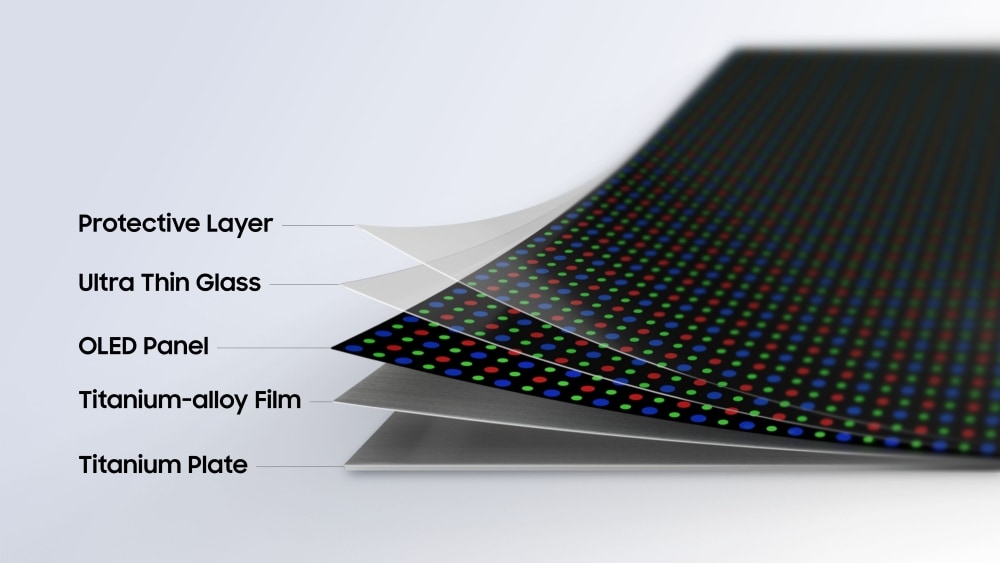
Moreover, the South Korean tech giant adds that it introduced a new titanium plate beneath the OLED-titanium stack. Using advanced hole-processing technology, Samsung says it helped eliminate air gaps between the module and the adhesive on the plate, allowing the two to bond more tightly. With this change, the internal folding display has been strengthened while remaining flexible enough to accommodate repeated folding.
Regarding display quality, Samsung reveals that it incorporated a high-resolution architecture and next-generation organic materials into the layered display. This could result in ultra-vivid display resolution while reducing power consumption.
If Samsung's claims hold true, the Galaxy Z Fold8 series could become one of the first foldables to combine a near-crease-free design with a reinforced internal display. The company says these upgrades improve both durability and the viewing experience. However, Apple is also believed to be closing in on the same goal, albeit through a very different approach. So, let’s check it out.
Apple could erase the foldable crease in a completely different way
Apple is reportedly working on a new hinge display that could lead to a near-crease-free display on its upcoming iPhone Ultra foldable. Essentially, the brand is rumoured to be considering a liquid-metal hinge for its foldable, as its amorphous structure offers greater flexibility while maintaining scratch resistance and durability.
Moreover, the Cupertino tech giant could reduce the number of moving parts in the iPhone Ultra’s hinge by using 3D-printed metal components. This is expected to improve structural rigidity, lower overall weight, and distribute stress more evenly across the foldable display.
According to a TrendForce report, Apple is also exploring display-level improvements to minimise the crease. These include a variable-thickness ultra-thin glass (UTG) that is thinner along the fold for better flexibility and thicker elsewhere for improved durability. The report also says Apple could use an advanced optically clear adhesive (OCA) to fill microscopic gaps, reducing crease visibility.


