E-Paper


From horse-drawn carriages to online trades: The 69-year history of Diwali Muhurat trading
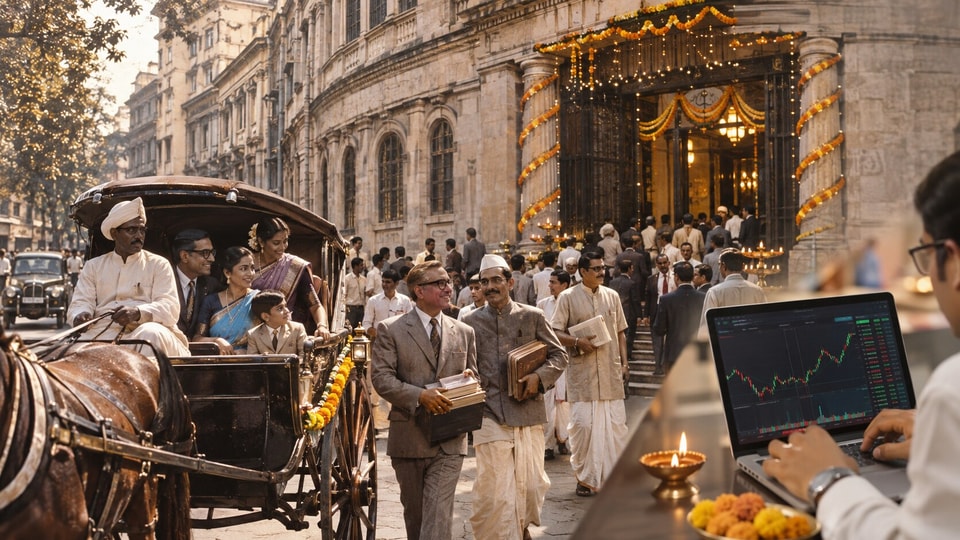
Diwali Muhurat trading began in 1957, when brokers gathered with families at BSE, with some even arriving in horse-drawn carriages.

 Prefer HTon Google


Today, buying shares during Diwali Muhurat trading takes just a few taps on a smartphone. But decades ago, the occasion looked very different on Mumbai's Dalal Street. Brokers gathered at the stock exchange with their families, performed prayers, distributed sweets and celebrated the festival together. Some even arrived in horse-drawn carriages.
(Also read: What is muhurat trading? Check timing, meaning and other details)
As Indian stock exchanges hold their special Diwali trading session on Sunday, November 8, the tradition, which began in 1957, enters its 69th year.
How did Diwali Muhurat trading begin?
According to the National Stock Exchange's (NSE) November 2024 research report, Muhurat trading has been part of India's financial markets since 1957.
The practice is rooted in the belief that making investments during an auspicious period on Diwali brings prosperity. It also marks the beginning of the new financial year under the Hindu calendar, known as Samvat.
In its official historical publication, The Temple of Wealth Creation, the Bombay Stock Exchange (BSE) describes how brokers traditionally brought their families to the exchange for Lakshmi Puja and Chopda Puja, a ceremony involving the worship of account books.
When brokers came in horse-drawn carriages
One of the more unusual details comes from an Economic Times report published in October 2009, which recalled how some wealthy brokers hired horse-drawn carriages from Chowpatty to bring their families to Dalal Street for the celebrations.
The report also recalled the remarkable habits of stockbroker Manubhai Maneklal, who reportedly completed 250 to 300 transactions on the trading floor without writing them down, recording the deals from memory afterwards.
His father, Maneklal Keshavlal, was also known for relying on his memory to record transactions, according to the retrospective.
How technology changed the tradition
The celebrations gradually changed as stock exchanges moved towards electronic trading.
According to BSE's historical records, the exchange introduced its computerised BSE On-Line Trading (BOLT) system in March 1995, replacing the traditional open-outcry trading system by July that year.
The duration of Muhurat trading has also varied. An archived Rediff report from November 7, 1999 recorded a 90-minute session, during which the Sensex gained 52.09 points.
Another memorable session came in 2008, amid the global financial crisis. According to NSE's research, five Nifty indices rose by at least 5.8 per cent during that year's Muhurat trading.
The scale has grown significantly since then. NSE recorded 96.9 lakh trades in its cash market segment during the 2024 session.
For 2026, Zerodha's official trading schedule confirms that the main equity session begins at 2.20 pm on November 8.
(Also read: Muhurat Trading 2025: Why this one-hour Diwali session is significant for traders?)
Although the way people trade has changed considerably, Muhurat trading continues to bring together India's stock market traditions and the festive spirit of Diwali.