
 E-Paper



Can Venezuela counter if the US strikes? Amid Trump's threats, a look at military capacities | Explained
Trump has hinted that US missions against alleged drug-smuggling boats in the Caribbean and Pacific could evolve into strikes inside Venezuela

 Prefer HTon Google


US President Donald Trump on Saturday cautioned that the airspace above and around Venezuela should be considered “closed in its entirety”, offering no further explanation as the US intensifies pressure on President Nicolas Maduro’s government.
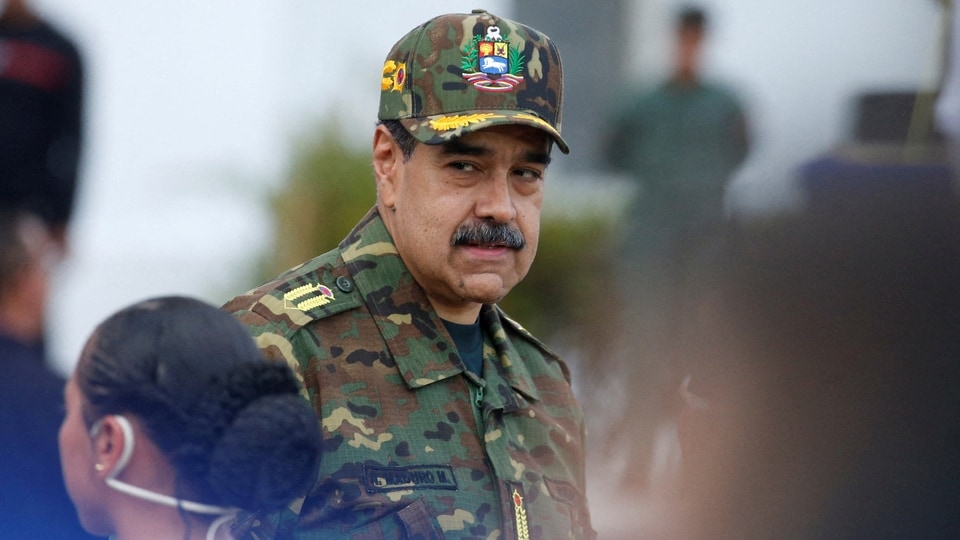
Trump has hinted that US missions against alleged drug-smuggling boats in the Caribbean and Pacific — operations that have killed more than 80 people — could evolve into strikes inside Venezuela, according to a Reuters report.
He has also reportedly held a phone call with Maduro in which the two discussed a possible US visit by the Venezuelan leader.
Venezuela’s armed forces are heavily outmatched by the US military and weakened by poor training, stagnant wages and aging equipment, according to six sources familiar with the country’s defence readiness, Reuters reported.
Also Read | Trump says airspace above and around Venezuela should be considered closed
Can Venezuela respond to a US attack?
Maduro has shored up loyalty by appointing officers to government posts, but rank-and-file soldiers earn about $100 a month in local currency, roughly a fifth of what studies say a family needs for basic expenses.
Sources say desertions, already a problem in many units, could rise if the US launched a military strike. In recent years, the bulk of Venezuelan forces’ experience has come from responding to protests, where they largely confront unarmed civilians, according to the Reuters report.
Maduro has claimed that 8 million civilians are training as militia members.
One source, however, estimated that only a few thousand intelligence operatives, armed ruling-party loyalists and militia personnel would actually join defensive operations, according to the report.
Much of the military’s hardware, mostly Russian-made, is decades old.
Venezuela purchased around 20 Sukhoi fighter jets in the 2000s, but they are seen as inadequate against US aircraft such as B2s.
The country’s Russian-made helicopters, tanks and portable missile systems are also considered outdated.
How can it respond to a US attack?
Planning documents and sources indicate Caracas would rely on guerrilla-style resistance or create widespread disorder if the US launched air or ground strikes, according to the Reuters report.
Officials have publicly spoken of a “prolonged resistance”, without offering details.
In practice, this would involve small military units operating from more than 280 locations, using sabotage and other guerrilla tactics.
Venezuela has already deployed 5,000 Russian-made Igla missiles, which Maduro recently highlighted on state television.
Military orders call for units to scatter and conceal themselves at designated positions if attacked, one source said, , the Reuters report stated.
A separate strategy, described in documents as “anarchization” and not acknowledged by officials, would employ intelligence services and armed ruling-party groups to create turmoil in Caracas and render the country ungovernable, according to the Reuters report.
Colombian guerrilla groups, including the National Liberation Army, operate in western Venezuela, an area that also serves as a key coca-growing region.
Government-aligned colectivos, or collectives, often ride in motorcycle groups to confront demonstrators and are sometimes armed.
Opposition groups, NGOs, the US and several Latin American governments accuse Maduro and Venezuela’s military of links to drug-trafficking networks, which are also blamed for violence.
The government denies the allegations, arguing that Washington is pursuing regime change to seize control of Venezuela’s vast oil reserves.


