
 E-Paper



China’s crewed spacecraft Shenzhou-12 docks with under-construction space stn
Launched Thursday morning, Shenzhou-12 docked with Tianhe, the space station’s core module at 3.54pm, completing the journey in six and half hours

 Prefer HTon Google


China’s Shenzhou-12 manned spacecraft has successfully docked with an under-construction space station in the earth’s lower orbit with three Chinese astronauts, the China Manned Space Agency (CMSA) said Thursday.
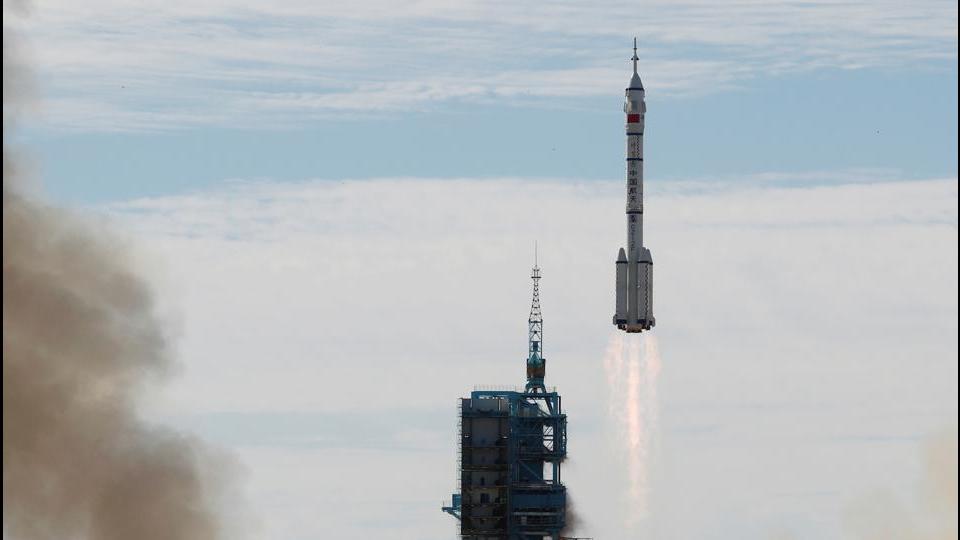
It marked the latest milestone in China’s ambitious space programme, which expects to build a habitable space station by 2022.
Launched Thursday morning, Shenzhou-12 docked with Tianhe, the space station’s core module at 3.54pm, completing the journey in six and half hours.
The three men – Nie Haisheng, Liu Boming and Tang Hongbo – on board will spend three months on the Tianhe module, which is said to be orbiting at some 340km to 380km above the earth.
It was China’s seventh crewed mission to space but marked a number of firsts for the country – the first manned one during the construction of China’s space station, the first in nearly five years after the country’s last manned mission in 2016 and China’s longest crewed space mission to date.
The Shenzhou-12 – or “Divine Vessel” – capsule took off atop a Long March 2F rocket on Thursday at 9.22am from the Jiuquan satellite launch centre in the Gobi desert.
Shenzhou-12 is the third of 11 missions – four of which will be crewed – needed to complete China’s first full-fledged space station.
Construction of the space station began in April with the launch of Tianhe, the first and largest of three modules. The station is expected to be completed by 2022.
Thursday’s launch is Beijing’s latest demonstration of its growing confidence and capability in space. In recent months, China has returned rock and soil samples to earth from the surface of the moon and landed a six-wheeled robot on Mars; it also landed a craft on the far side of the moon in 2019.
Once built, China’s space station will be the only alternative to the two-decade-old, US-led International Space Station (ISS), which may be retired in 2024, Reuters news agency reported.
The ISS – from which China is excluded – comprises Canada, Japan, the Russian Federation, the US, and 11 member states of the European Space Agency.
Also Read | A year on, Galwan braveheart’s kin wait for govt to keep its word
“The mission’s launch was broadcast live on CCTV, China’s state broadcaster and also live streamed on China’s social media platforms on Thursday morning, drawing hundreds of millions of views and soon topping the trending list on China’s Twitter-like Sina Weibo,” a state media report said.
Since 2003, China has launched six crewed missions and sent 11 astronauts into space, including Zhai Zhigang, who carried out China’s first spacewalk ever on the 2008 Shenzhou mission.
On May 30, a cargo spacecraft carrying supplies including food and equipment docked with China’s first space station’s key module Tianhe as part of the preparation for the station to host three astronauts this month.
The unmanned Tianzhou-2, or “Heavenly Vessel” in Chinese, docked with Tianhe (the key module).The launch and docking of Tianzhou-2 was carried out a month after Tianhe, the first part of the space station Tiangong, “Heavenly Palace” in Chinese, was launched.
In late April, China sent to space Tianhe, the management and control hub of Tiangong, the permanent space station, which it plans to complete by 2022 as part of its ambitious space programme.
The Tianhe, which was sent to orbit by a rocket, can provide electricity and accommodate three astronauts for up to six months.


