
 E-Paper



EU sets aside China’s rights record, seals pact with Prez Xi that may upset US
EU’s big win, as its leaders have projected the agreement with President Xi Jinping, deals a huge blow to the US President-elect Joe Biden’s hopes of rebuilding the transatlantic alliance in an effort to take on an assertive China.

 Prefer HTon Google


Chinese and European Union leaders sealed a landmark investment pact on Wednesday that would make it easier for their companies to invest in each other’s economies despite concerns around Beijing’s patchy labour rights record.
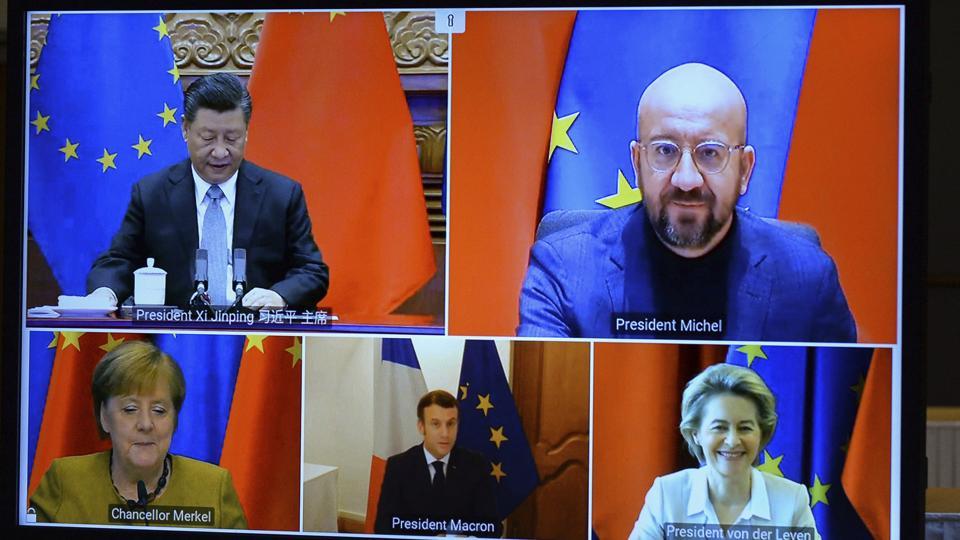
President Xi Jinping had intervened earlier this month to extend key market access concessions to businesses under the EU-China Comprehensive Agreement on Investment (CAI) that had been under discussion for years. President Xi’s concession persuaded the European Union to accede to the pact that Brussels expects to open up lucrative opportunities for its businesses.
“Today, the EU and China concluded in principle negotiations on an investment agreement,” European Commission President Ursula von der Leyen tweeted after a video call with President Xi that also involved EU Council president Charles Michel, French President Emmanuel Macron; and German Chancellor Angela Merkel who holds the rotating presidency of the EU till tomorrow and was seen to have pushed hard for the deal.
Also Read: Whats and whys of the EU-China investment agreement
President Xi, according to a Reuters report, told the meeting that the investment deal will offer bigger markets and a better business environment for both Chinese and European investments. It shows China’s determination and confidence in opening up, President Xi said, adding that the pact would stimulate the global economy, promote economic globalisation and free trade.
But the EU’s big win, as its leaders have projected the agreement, deals a huge blow to the US President-elect Joe Biden’s hopes of rebuilding the transatlantic alliance in an effort to take on an assertive China.
There has been no reaction from the United States to the agreement so far; there will be more than one. President-elect Biden’s choice for national security adviser Jake Sullivan had earlier this month tweeted the incoming Biden administration’s request to hold “early consultations with our European partners on our common concerns about China’s economic practices”.
Also Read: EU, China leaders seal long-awaited investment deal
Polish foreign minister Zbigniew Rau too had called for more consultations and transparency to bring EU’s transatlantic allies on board. “A good, balanced deal is better than a premature one,” the minister tweeted last week. Members of European Parliament too have expressed concern at the EU rushing through the agreement.
Indian officials who have been tracking the negotiations say President Xi’s concession was timed to get the agreement done and dusted before the end of Germany’s presidency and the Biden administration takes charge in a few weeks.
One official said the promptness with which the EU had set aside concerns around China’s rights record also erodes its credibility as a defender of human rights, and that of its lawmakers.
The pact with China comes less than a fortnight after European lawmakers adopted a resolution to condemn forced labour in China’s Xinjiang region, where workers from the Muslim Uighur community are coerced to manufacture goods ranging from cars to medical protective equipment that are often sold on the EU market.
Beijing’s standard response to such criticism of its rights record has been a loud denial. An Indian official said it was unlikely that Beijing would have agreed for verification of its claim that its companies do not use forced labour.
According to the EU, China had committed to pursue ratification of the International Labor Organization’s rules on forced labour.
The 27-nation bloc said the agreement is the most ambitious that China has ever agreed with a third country and will give additional access to many areas including the electric cars and hybrid vehicles sector, as well as private hospitals, telecoms, cloud and financial services, international maritime transport and air transport-related services. According to EU figures, China is now the bloc’s second-biggest trading partner behind the United States, and the EU is China’s biggest trading partner. China and Europe trade on average over €1 billion a day, according to news agency AP.


