E-Paper



Iran’s Fordow nuclear site bombed by US: What before-after satellite pics reveal
The images from Fordow nuclear site reveal what looks like plumes or residual smoke near the impact zones, suggesting recent activity in the area.

 Prefer HTon Google


The day after US President Donald Trump claimed Iranian nuclear sites were “completely and fully obliterated,” satellite images show what the extend of surface damage following an airstrike by American stealth bombers and Massive Ordnance Penetrator (MOP) or bunker buster bombs.
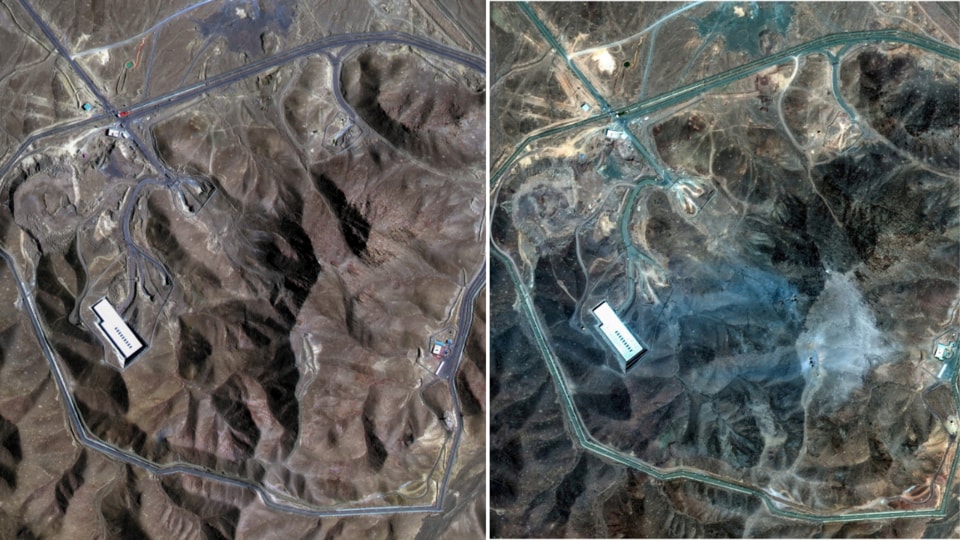
Commercial satellite imagery, including visuals from Maxar Technologies, shows at least six visible impact craters on the mountain in Fordow under which Iran’s centrifuge halls are believed to be buried.
“They just punched through with these MOPs, I would expect that the (Iranian nuclear) facility is probably toast,” news agency Reuters quoted David Albright, former UN nuclear inspector and head of the Institute for Science and International Security as saying.
However, UN nuclear chief Rafael Grossi refrained from making early assumptions. “At this time, no one, including the (International Atomic Energy Agency), is in a position to assess the underground damage at Fordo,” reported the Associated Press. Follow Iran Israel war live updates.
Before and After images of Fordow
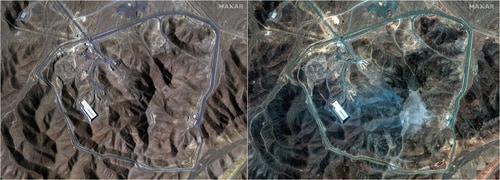
While the full impact of the strikes on Iran’s nuclear infrastructure remains unclear, Satellite imagery shows a stark contrast at Iran’s Fordow nuclear site before and after the reported US airstrike.
In the “before” image, the facility appears intact, with the surrounding terrain undisturbed and the main rectangular white-roofed structure showing no visible signs of damage. Roads, entry points, and nearby infrastructure remain orderly, and there is no indication of surface disruption.
Also read | 'Bullseye:' Trump claims 'monumental damage' caused to Iranian nuclear sites
In the “after” image, however, the same area displays significant changes: a wide section in front of the facility is covered in grey dust or debris, with visible ground disturbance and multiple markings that appear to be craters.
The layout of the site remains largely the same, but the surface terrain in specific areas shows darkened patches and disrupted soil patterns. The images also reveal what looks like plumes or residual smoke near the impact zones, suggesting recent activity in the area.
Nuclear reserves built deep to resist attacks
A satellite imagery specialist at the CNA Corporation, Decker Eveleth, noted, “The hall containing hundreds of centrifuges is too deeply buried for us to evaluate the level of damage based on satellite imagery,” reported Reuters.
Fordow is one of several underground nuclear sites in Iran, built deep within mountainous terrain specifically to defend against attacks of this kind.
Also read | What is Fordow nuclear facility? Iran touts that all nuclear material is ‘in a safe place’
General Dan Caine, chairman of the US Joint Chiefs of Staff told Reuters that seven B-2 bombers dropped 14 GBU-57/B bombs — each weighing 30,000 pounds — on the site. “Initial assessments indicate that the sites suffered extremely severe damage,” he said, but declined to confirm whether the underground nuclear facilities were completely destroyed.
Were Uranium reserves relocated before US airstrike?
In the days leading up to the strike, satellite images captured what was described as “unusual activity” at Fordow — with a long line of vehicles at the facility’s entrance.
A senior Iranian official told Reuters that a significant portion of Iran’s 60% enriched uranium stockpile was relocated before the strike.
Also read | Did Iran move 400kg uranium from key nuclear site before US strikes? Israel officials reveal
“I don’t think you can with great confidence do anything but set back their nuclear program by maybe a few years,” said Jeffrey Lewis of the Middlebury Institute of International Studies. “There’s almost certainly facilities that we don’t know about.”
The strike on Fordow was part of a broader US operation — codenamed “Midnight Hammer” — which also hit nuclear sites in Natanz and Isfahan. While the Fordow strike involved bunker-busting MOPs, the attacks on Isfahan and Natanz reportedly included Tomahawk cruise missiles.
Iran has consistently maintained that its nuclear activities are for peaceful purposes. The IAEA has yet to confirm whether Iran’s enrichment capabilities have been permanently degraded.