E-Paper



Lisa Cook, the Fed Governor at the Center of a Firestorm
The first Black woman to serve as a Federal Reserve Board governor is at the center of an unprecedented power struggle


 Prefer HTon Google


When Mary Parham-Copelan was running for student-council president of her middle school in Milledgeville, Ga., as a young Black girl back in the early 1980s, she asked one of the older girls she looked up to, Lisa Cook, for help with her speech.
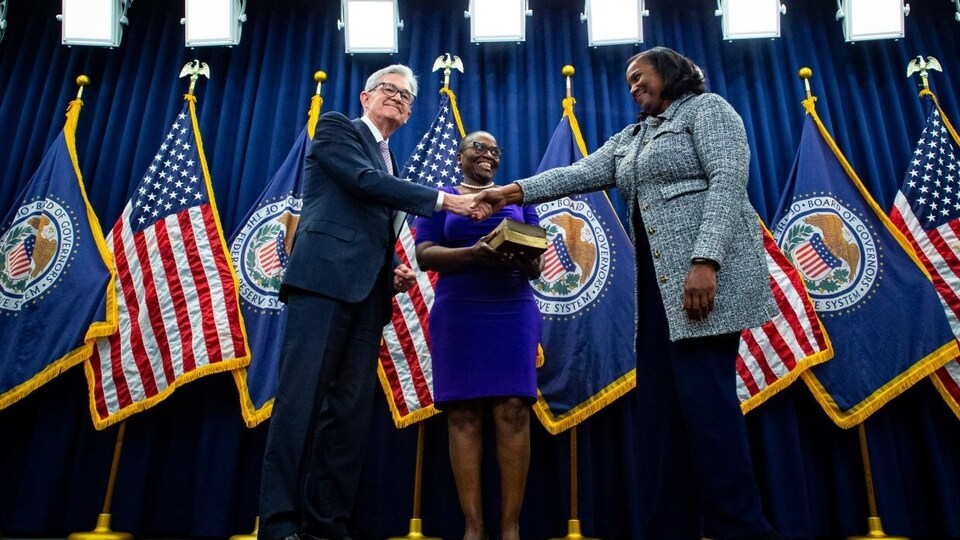
Cook, who hailed from a prominent family in the rural town of about 17,000, told Parham-Copelan that above all else, she needed to command the audience of classmates in the school gym, that she needed to make sure her voice was heard.
Some 40 years later, Cook became the first Black woman to serve as a Federal Reserve Board governor in Washington, a powerful perch that gives her a voice in setting the trajectory of the American economy. Now, she is at the center of an unprecedented power struggle pitting the independence of the central bank against the authority of the president.
On Monday, President Trump moved to fire Cook, 61, accusing her of committing mortgage fraud before she joined the Fed.
The specific reason cited for her dismissal, according to Bill Pulte, a Trump appointee who leads the Federal Housing Finance Agency: Two mortgage documents that were signed 14 days apart—one on a home in Michigan, where Cook taught, the other on an apartment near her childhood home in Atlanta—both listing those properties as a “primary residence.”
Cook, an academic economist appointed by President Joe Biden in 2022, has refused to go quietly, saying she considers her firing illegal and that she will fight it in a lawsuit. She hasn’t given an explanation for the two mortgage filings, which the Trump administration has alleged amount to a federal crime. No charges have been filed.
Though never an outspoken member of the Fed’s board during her two years in the role, Cook as an economist has been guided by deep convictions from her upbringing in the South and her winding career, friends and colleagues say—including by her belief that racial adversity has profoundly shaped the economic fortunes of Black Americans.
If she is successful in challenging her dismissal, she will remain poised to shape Fed policy for years to come. Her term is scheduled to end in 2038.
Cook grew up a child of the civil-rights movement. Her mother, she said in a speech last year to a women’s business group in Charleston, S.C., was the first tenured Black faculty member at Georgia College & State University. Her father was a well-known chaplain in Milledgeville, about 100 miles southeast of Atlanta. Cook and her sisters were among the first Black students to desegregate the local schools, she said in the speech.
“My family lived through the events that brought Milledgeville out of a deeply segregated South,” she said. “I drew strength from the example set by my family, others in the civil-rights movement, and the village that raised me.”
Parham-Copelan, now Milledgeville’s first female mayor, recalled the Cook family as decidedly middle class. Their mother led a Girl Scout troop. Other girls in the neighborhood aspired to be like the Cook girls. Their parents were prominent in town, and the Cook sisters were natural leaders, she said.
“They were raised understanding the importance of having a seat at the table. I heard their mother say that many times,” Parham-Copelan said.
Economics wasn’t Cook’s first academic passion. She studied philosophy at Spelman College, a historically Black women’s school in Atlanta, and earned further humanities degrees at Oxford and in Senegal. Traveling in West Africa, Cook discovered a renewed curiosity about how the economy works during a routine errand.
“One of the first things I do is to buy a Bic pen,” she told an interviewer in 2018, recalling her time in Africa. “Each one was 10 dollars! Ten dollars! This completely stunned me. I knew how poor most people were. I knew students had to have these pens to write in their blue books. It just started this whole train of thought.”
As an economics graduate student at the University of California, Berkeley in the early 1990s, shortly after the fall of the Soviet Union, Cook gravitated toward studying the Russian economy and sought to work with Greg Grossman, a Cal professor who was an authority in the field.
Grossman told Cook that if she could learn the language, he would take her on as a student. A year and a half later, she stopped by his office and struck up a conversation in Russian, the fifth language she had learned, Cook recalled in a speech this year.
As her academic career unfolded, Cook’s interest returned back home to the racial divisions of the Deep South. She began trawling historical records to explain divergent economic outcomes between white and Black Americans. Several of her papers focus on lynching, an example of the violence that she and other researchers have argued hindered economic opportunities for generations of Black people in the 19th and 20th centuries. In a 2017 paper, she used a comprehensive historical data set to make the case that lynching was more common in areas with more racial segregation.
In 2018, she told an interviewer that as public consciousness of racial issues grew, she felt her work had become more resonant. “With police shootings and mass shootings associated with hate crimes, I think people get it now,” Cook said.
In 2005, Cook was hired by Michigan State University, where she taught as a professor of economics and international relations. She maintained a residence in Ann Arbor, about 65 miles away.
In Ann Arbor, she dove into another passion, music and the arts, serving as a board member and eventually co-chair of a performing-arts organization, the University Musical Society, from 2014-2022.
While living in Ann Arbor, Cook also joined an informal group of University of Michigan professors and local business people who would meet periodically to socialize and discuss different topics. Cook was a regular and enthusiastic attendee of the gatherings, said Marianne Udow-Phillips, a lecturer at the University of Michigan’s School of Public Health and former director of the state human services department under former Democratic Gov. Jennifer Granholm.
“She’s deeply knowledgeable, but she’s also a very good listener, and I have always been impressed with her as an ongoing learner, not just somebody who feels like they’ve got all the answers,” said Udow-Phillips.
Cook was one of four officials Biden elevated to the Fed’s board of governors. During her Senate confirmation, Democrats praised Cook’s academic background while Republicans criticized her dearth of monetary-policy experience. In 2022 she was confirmed in a 51–50 vote that fell straight along party lines, lifted by a tiebreaking vote from Vice President Kamala Harris.
To investors and economists who track the Fed closely, Cook has knitted herself into the board’s consensus decisions on interest rates, voting in lockstep with Fed Chair Jerome Powell and the Fed’s majority on interest rates throughout her tenure. Before Pulte accused Cook of committing mortgage fraud last week, she did little to draw attention to herself.
By Tuesday, those who know Cook—from Milledgeville to Michigan—were speaking out in her defense.
Parham-Copelan vowed that her childhood friend would stand her ground at a time when “Black women are being attacked for no reason.”
Betsey Stevenson, former chief economist for the Labor Department during President Barack Obama’s administration and who served with Cook on the executive committee of the American Economic Association, said that unless there was substantive proof of a criminal act, firing her risked the independence of the central bank.
“Firing Lisa Cook is a problem, regardless of what you think of Lisa Cook,” she said.
Write to Dan Frosch at dan.frosch@wsj.com and Matt Grossman at matt.grossman@wsj.com