
 E-Paper



Myanmar earthquake: Thailand investigates Bangkok skyscraper collapse over China firm link
This 33-storey high-rise building, despite having been dotted with cranes, collapsed in the intense quake shake.

 Prefer HTon Google


A powerful 7.7 magnitude earthquake struck Myanmar on Friday, causing the collapse of a 33-storey high-rise under construction in Bangkok, Thailand, located over 1,000 kilometers from the epicenter.
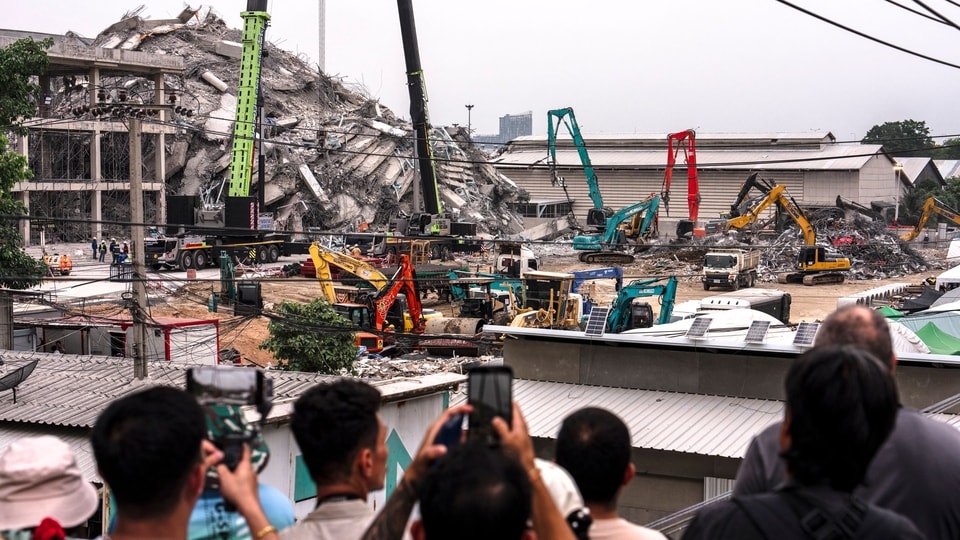
Thailand's Deputy Prime Minister Anutin Charnvirakul visited the site on Saturday and called for a swift investigation. The incident has raised questions, particularly due to the involvement of a Chinese firm in the building's joint venture.
‘Something definitely wrong’
This 33-storey high-rise building, despite having been dotted with cranes, collapsed in the intense quake shake. So far, eight bodies have been recovered from the debris of the skyscraper.
Questions over how and why the skyscraper collapsed so quickly have begun to do the rounds. Prof Suchatchavee Suwansawas, a civil engineer and politician from the Democrat Party, told The Telegraph UK that something was "definitely" wrong.
ALSO READ | Bangkok skyscraper reduced to rubble after strong tremors from Myanmar earthquake. Video
"You see all other buildings, even high-rise buildings under construction, they are safe. So either the design was wrong or construction was wrong, but it's too soon to reach conclusions," he noted.
Constructed over 3 years
The collapsed building reportedly was the unfinished headquarters of the Thailand's State Audit Office (SAO) and had been under construction for three years, at a cost of more than two billion Thai baht (around $58 million).
It was a joint venture between Italian-Thai Development Plc and China Railway Number 10 (Thailand) Ltd. The latter company is a subsidiary of a Chinese firm named China Railway Number 10 Engineer Group Company, holding 49 per cent of shares, the largest amount of stake foreign entities can hold in a Thai company, The Telegraph UK reported.
As per local Thai media, China Railway Number 10 Thailand was established in 2018, serving as a construction contractor for office buildings, residential buildings, public roads, railways, and underground railways.
ALSO READ | Bangkok earthquake videos: How swimming pool water shook violently, threatened swimmers
In 2023, the company reported a net loss of 199.66 million baht, from a revenue of 206.25 million baht and expenses of 354.95 billion baht.
Its shareholders comprise of Sophon Meechai with 40.80 per cent shares, Prachuab Sirikhet with 10.20 per cent shares and Manas Sri-anant with 3 per cent shares.
Thailand deputy PM orders probe
The Ministry of Industry, meanwhile, had sent an inspection team to the collapsed skyscraper's site to determine whether low quality steel or poor engineering design contributed to the incident.
Thailand's deputy prime minister Anutin Charnvirakul also ordered a high-level probe into the collapse after having visited the site. "I am appointing the investigation committee. I have given them seven days to report back as to what's going on and what caused the falling down," he told reporters.
At least 18 people were killed in Bangkok, while 33 others injured and 78 remained missing, city authorities said on Sunday. And of these, the majority of deaths were of the workers who got crushed under the rubble of the collapse skyscraper.
ALSO READ | Why was Bangkok earthquake so strong and devastating? Expert explains
Rescuers are racing against time to get to the survivors, digging through the massive debris containing shattered concrete piles and twisted metal, a Reuters report said. A Thai police commander Teerasak Thongmo, said that his team of policemen and rescue dogs were working to locate the survivors. "Our team is trying to find anyone that might still be alive. Within the first 72 hours, we have to try and save those still alive," he added.
In Myanmar, the earthquake so far has claimed around 1,700 lives, injured 3,400 others and left over 300 persons missing as of Sunday.
Why did Thailand take the hit of Myanmar earthquake
Experts have said that earthquakes that are very shallow, like this one which just 10 km from the surface, increase the amount of shaking that takes place at the surface. Geologists even described the force of the quake as equivalent to that of "334 atomic bombs".
Dr Rebecca Bell, a reader in tectonics at Imperial College London, explained to BBC that the size of the earthquake was massive because of the type of fault, which was of 'straight nature'.
"This straight fault also means a lot of the energy can be carried down its length - which extends for 1,200 km south towards Thailand," she said.
ALSO READ | From Myanmar to Bangkok: How the earthquake’s shockwaves travelled over 1,000 kilometres
And in Bangkok, which is built on soft soil, seismic waves i.e., the earth's vibrations, slow down and build up and get bigger in size. Hence, making the ground shaking even more intense.
'Flat slab'
As per a BBC report, Prof Amorn Pimarnmas, president of the Structural Engineers Association of Thailand, said despite regulations being in place in 43 provinces on earthquake-proofing buildings, less than 10 per cent of the structures were actually estimated to be resistant to quakes.
However, the collapsed skyscraper was relative and thus, updating building standards would have been applied to it. Dr Pimarnmas also noted that Bangkok's soft soil could have played a part in its collapse, as it can amplify the ground shaking three to four times over.
Some experts also pointed towards a "flat slab", a construction process wherein floors are made to rest directly on columns without the use of beams.
Dr Christian Málaga-Chuquitaype, a senior lecturer in earthquake engineering at Imperial College London, explained, "Imagine a table supported only by legs, with no extra horizontal supports underneath. While this design has cost and architectural advantages, it performs poorly during earthquakes, often failing in a brittle and sudden (almost explosive) manner."
Some hope left
Meanwhile, friends and family of those trapped under the collapsed skyscraper showed some hope as thermal imaging drones reportedly identified at least 15 persons to still probably be alive.
But the optimism is beginning to tire down. One of the kins, Pat Kongporn, whose parents are stuck under the rubble, told The Telegraph that she spoke to her mother and father at about 12:30 pm (local time) on Friday, just before the earthquake struck.
Having travelled to Bangkok from a city 50 miles north, she said that she would stay until there is some information about her parents or until their bodies are found.


