E-Paper



Oman’s Salalah port goes up in flames after drone strike, video shows thick plumes of smoke | Watch
Oman has moved all vessels out of its main oil export terminal at Mina Al Fahal, located outside the Strait of Hormuz, in a precautionary measure.

 Prefer HTon Google


Oman’s Salalah port was seen engulfed in flames on March 12 after reported drone strikes on the oil storage facilities. British maritime security firm Ambrey said confirmed that the strikes targeted port infrastructure but noted that no merchant vessels were damaged.
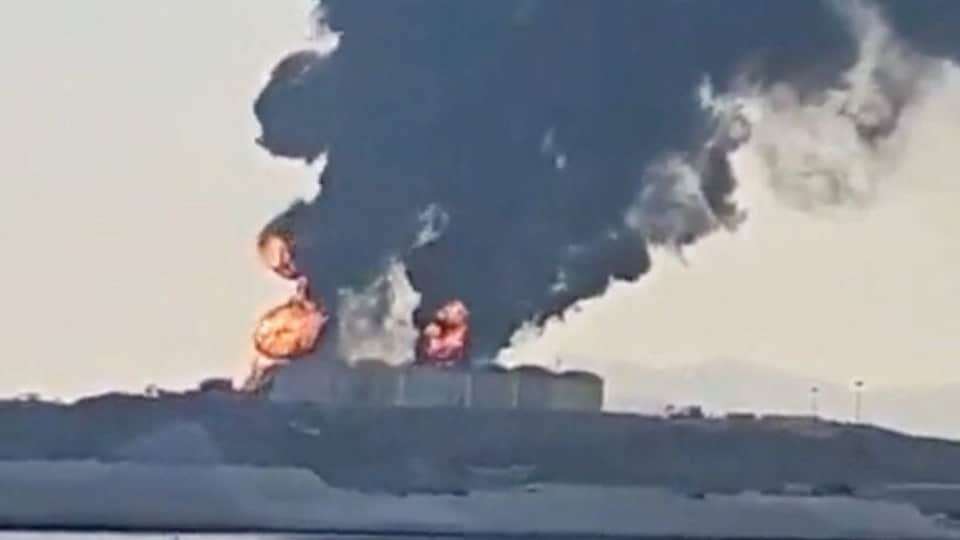
Salalah has since suspended operations at its container and general cargo terminals, while other Omani ports are working normally, according to Bloomberg, which cited a report from Inchcape Shipping services.
Following the attack, Oman moved all vessels out of its main oil export terminal at Mina Al Fahal, located outside the Strait of Hormuz, as a precautionary measure, Bloomberg reported on Thursday.
About a million barrels of Omani oil are exported daily from Mina Al Fahal, according to data intelligence firm Kpler.
The incident appears to be part of a broader pattern of Iranian strikes on Gulf energy facilities, carried out in retaliation for ongoing military action by the United States and Israel.
Oman on the US-Israel war
Following the incident, Oman’s Sultan Haitham bin Tariq al-Said spoke with Iranian President Masoud Pezeshkian and expressed his disapproval and condemnation of the attacks on Omani territory.
The Sultan reiterated Oman’s neutral stance in the conflict while affirming that the country would take all necessary steps to safeguard its security and stability.
The strikes came days after Sultan Haitham bin Tariq congratulated Ayatollah Mojtaba Khamenei on his appointment as Iran’s new supreme leader, The Times of Israel reported, citing the official Oman News Agency on March 9.
What is happening in US-Israel war?
The United States stated it plans to release 172 million barrels of oil as part of a coordinated effort by countries worldwide to cool rising prices.
Global crude consumption is slightly above 100 million barrels per day, and Gulf producers have already had to cut about 6% of that supply so far, with reductions in the Middle East potentially increasing further.
The near-closure of the Strait of Hormuz, through which roughly a fifth of the world’s oil normally passes, has pushed up prices of crude, natural gas and refined fuels such as diesel, heightening fears of a fresh inflation crisis.
Mediation efforts by Oman failed
Oman’s earlier efforts to mediate between Tehran and Washington have largely collapsed under the pressure of the 11-day war.
Separately, the UK Maritime Trade Operations Centre (UKMTO) reported that three commercial vessels were struck by “unidentified projectiles” near the Strait of Hormuz, according to Al Jazeera.