
Sign in

Philippines: Devotee nailed to cross for 32nd time in Good Friday crucifixion re-enactment

The Catholic Church in the Philippines tolerates the ritual but says it does not support such gory displays of devotion, describing them as a “misinterpretation of faith”.

Updated on: Mar 30, 2018, 19:22:38 IST
Reuters, Cutud, Philippines | By
Share
Share via
  • facebook
  • twitter
  • linkedin
Copy link
  • copy link

A Philippine man who has been nailed to a cross every Easter for the past 32 years in a Good Friday re-enactment of Jesus Christ’s crucifixion says he no longer feels any pain from his wounds.
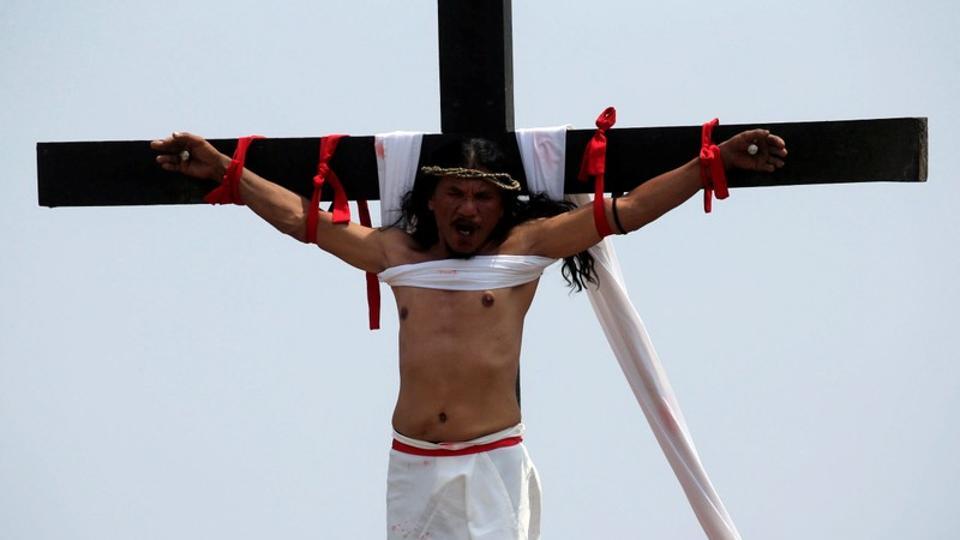
Ruben Enaje, 58, who is portraying Jesus Christ for the 32nd time, grimaces in pain after being nailed on a wooden cross during a Good Friday crucifixion re-enactment in Cutud village, Pampanga province, north of Manila, Philippines on March 30. (REUTERS)

Ruben Enaje, 58, again portrayed Christ on Friday in the traditional religious rite in Cutud village, about 76 km (47 miles) from the capital Manila.
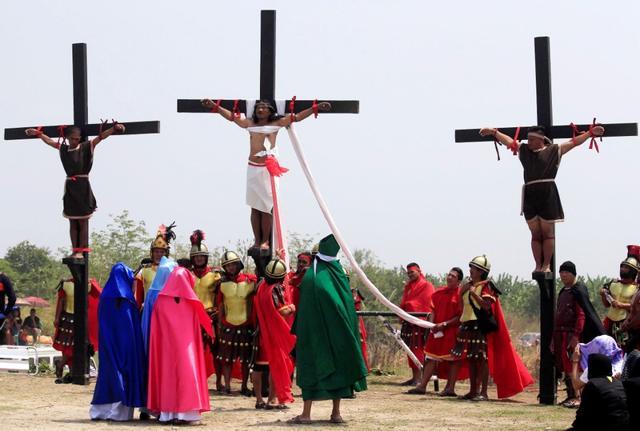
Ruben Enaje (C), 58, who is portraying Jesus Christ for the 32nd time, is seen nailed on a wooden cross during a Good Friday crucifixion re-enactment in Cutud village, Pampanga province, north of Manila, Philippines on March 30. (REUTERS)

“In the past, I went home injured and limping, but this year I feel so great,” Enaje said after the ritual held under a sweltering sun.

He said he believed his strong Catholic faith helped him avoid pain.

“I feel like he is telling me ‘go ahead, keep it up’,” he said, referring to God.

Easter is a festival marking the crucifixion and resurrection of Christ.

About 80 percent of the 105 million people in the Philippines, a former Spanish colony, are Catholic.

Enaje said he felt strong enough to perform in two or three more crucifixions, until he turns 60.

Enaje was among three devotees nailed to wooden crosses in the village on Friday, including a woman taking part for the seventh time.
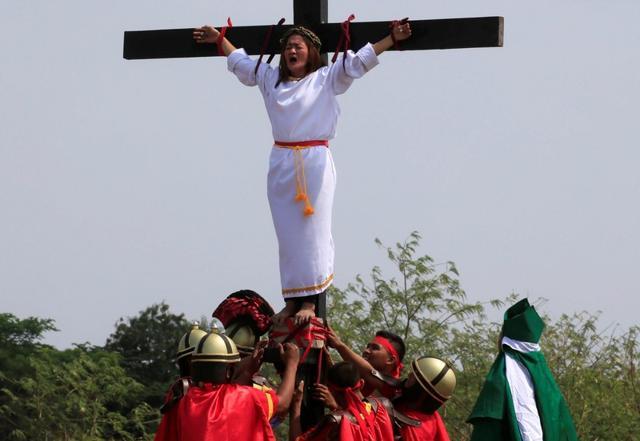
Mary Jane Sazon, 39, grimaces in pain after she was nailed on a wooden cross for the 7th time, during a Good Friday crucifixion re-enactment in Cutud village, Pampanga province, north of Manila, Philippines on March 30. (REUTERS)

Actors wearing Roman soldier costumes attached the devotees to crosses by hammering two-inch nails soaked in alcohol through their hands and feet and hoisted them up in a field packed with domestic and foreign tourists.

The Catholic Church in the Philippines tolerates the ritual but says it does not support such gory displays of devotion, describing them as a “misinterpretation of faith”.
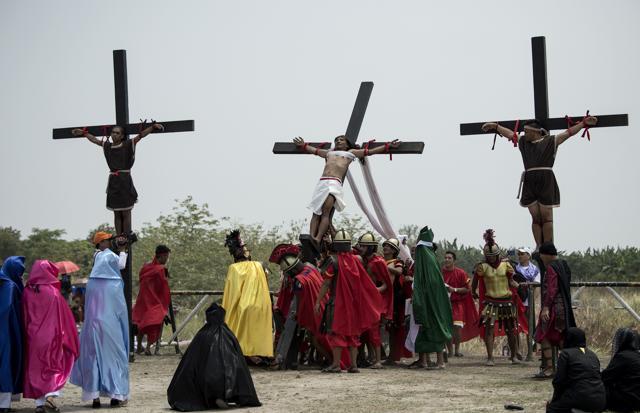
A reenactment of the crucifixion of Jesus Christ during Good Friday celebrations ahead of Easter in the village of Cutud near San Fernando, north of Manila on March 30. (AFP Photo)

Many Catholics in the Philippines perform religious acts of penance during the Holy Week at Easter as a form of worship and supplication.

Some believe penance cleanses sins, cures illnesses and even leads to wishes coming true.

  • HT News Desk
    ABOUT THE AUTHOR
    HT News Desk

    Follow the latest breaking news, major developments and agenda-setting stories from India and around the world with the newsdesk at Hindustan Times. Operating round the clock, the desk brings together experienced editors, reporters and correspondents to deliver fast, accurate and contextual reporting across subjects that influence public policy, governance, business, society and international affairs. The HT News Desk covers politics, elections, government policies, the economy, business and markets, science and technology, the environment, law and order, infrastructure, education, climate issues and geopolitics, while closely tracking developments across states, institutions and global capitals. The team also leads coverage of major breaking news events, policy announcements, court proceedings, natural disasters, public emergencies and significant international developments. Reports published by the newsdesk are based on information gathered from reporters on the ground, official statements, government agencies, court records, regulatory filings, recognised institutions and other authoritative sources. Stories undergo editorial scrutiny and verification processes to ensure accuracy, fairness and relevance, and are updated as events evolve and additional information becomes available. Whether covering a key political decision in New Delhi, an economic policy shift affecting millions, a landmark court ruling or a major global event, the HT News Desk aims to provide readers with reliable, fact-based journalism that delivers not only the latest developments but also the context and analysis needed to understand their wider implications.Read More