
 E-Paper



'Story of humanity': A diverse crew to moon mission after over 50 years, why is NASA's Artemis II important | Explained
Before the 32-story SLS rocket's liftoff, launch director Charlie Blackwell-Thompson told the crew, "Good luck, Godspeed Artemis II. Let's go."

 Prefer HTon Google


After more than 50 years, the United States sent four astronauts on a historic flight, Artemis II, to the Moon -- a move that marks the revival of the National Aeronautics and Space Administration's (NASA) human lunar exploration programme.
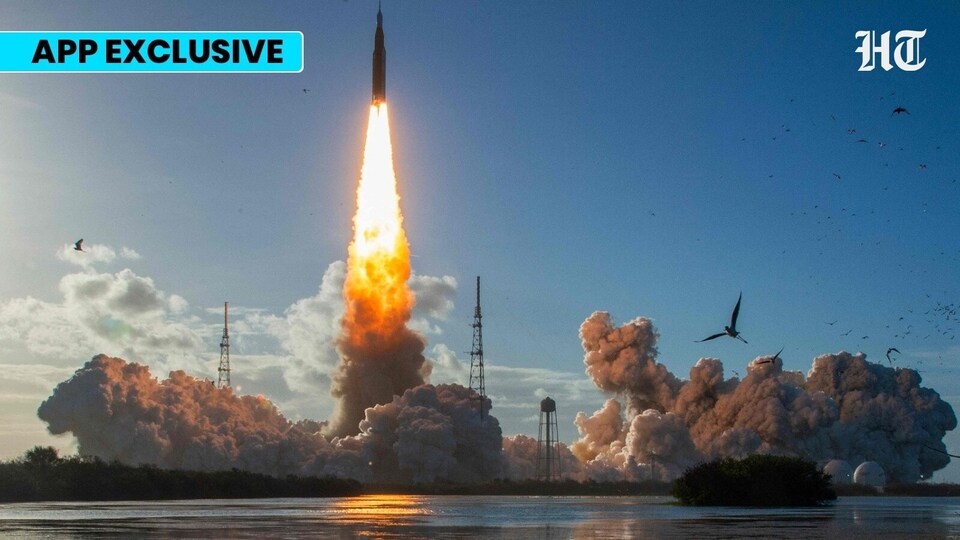
In NASA's words, the crewed Artemis II mission "marks a key step toward long-term return to the Moon and future missions to Mars".
Mission commander Reid Wiseman, pilot Victor Glover, and specialists Christina Koch and Jeremy Hansen lifted off from the Kennedy Space Centre in Florida on board the Orion spacecraft aboard the Space Launch System rocket from Launch Pad 39B.
Before the 32-story rocket's liftoff, launch director Charlie Blackwell-Thompson told the crew, "Good luck, Godspeed Artemis II. Let's go."
Artemis II Liftoff:
Scores of people gathered in Florida to watch Artemis II take off from the Space Centre.
Artemis II calls for an Apollo recall
NASA's Artemis II mission brings back memories of the Apollo era, the days of humans on and around the Moon.
The US space agency's Apollo programme operated between 1968 and 1972, achieving a historic feat of the first human landing on the Moon.
App Exclusive | Artemis II launch ahead: Why it's taken over five decades for Nasa to look to the moon again for a crewed mission
Apollo 11 etched its name in space history on July 20, 1969, when astronauts Neil Armstrong and Buzz Aldrin walked on the lunar surface.

The last lunar landing and human walk on the Moon surface was in 1972, when Apollo 17 was launched on December 7. Astronauts Eugene Cernan and Harrison Schmitt walked on the lunar surface. Since then, no human has returned to the Moon.
That very year, NASA's Apollo programme ended, primarily due to budget limits and changing political scenarios.
About Artemis II
Mission: The Artemis II is a 10-day mission with no moonwalk. The Orion spacecraft will orbit the Moon, aiming to test critical systems and pave the way for a future lunar landing. The mission follows the success of the uncrewed Artemis I in 2022.
Spacecraft: Orion is NASA's newest spacecraft for human missions, developed to send astronauts to the Moon. According to the space agency, the spacecraft will also eventually be crucial for sending humans to Mars. Built by Lockheed Martin, four astronauts can live up to 21 days in the Orion without docking to another spacecraft. The bottom of the capsule is covered by the world's largest ablative heat shield, measuring 16.5 feet in diameter, as it will withstand the hottest temperatures while returning to Earth.

Rocket: The Orion spacecraft lifted off on board the Space Launch System rocket, NASA's backbone for deep space exploration and Artemis. SLS is the only rocket that can, in a single launch, send Orion, astronauts and cargo directly to the Moon. The SLS rocket comes in at 98 metres, packing more thrust at liftoff with its four main engines and two strap-on boosters.
Tests: The science operations of the Artemis II mission will lay the foundation for safe and efficient exploration of the Moon and Mars. The mission's crew will work with scientists on Earth to conduct science investigations that will pave the way for future crewed missions.
Artemis II crew
The crew of the Artemis II is diverse, including the first Black astronaut ever sent on a mission to the Moon, and the first woman to fly on a lunar mission.
Mission commander Reid Wiseman, aged 50, recorded 165 days aboard the International Space Station during a 2014 mission. He is a former US Navy test pilot who later served as NASA's chief astronaut before being selected as the commander of Artemis II.
A 49-year-old Victor Glover became the first Black astronaut ever to be sent on a lunar mission. He previously spent 168 days in orbit, beginning in 2020, as pilot of NASA's Crew-1 mission. Before joining the US space agency, he flew more than 40 aircraft during a career in the American Navy.

With Artemis II, mission specialist Christina Koch is the first woman to fly on a mission to the Moon. She set the record for the longest continuous spaceflight by a woman in 2019, having spent 328 days aboard the ISS. Koch also participated in NASA's first three all-female spacewalks.
A 50-year-old Jeremy Hansen is the first Canadian and the first non-US citizen sent on a lunar mission. He is a Royal Canadian Air Force colonel who was selected for Ottawa's astronaut corps in 2009. His participation in Artemis II is a reflection of the long-standing US-Canada partnership.
Why is Artemis II so important
The biggest landmark that the Artemis II mission marks is NASA's return to a lunar exploration programme, an intent left behind more than five decades ago.
Not only does it mark America's return to the Moon, but it also marks the beginning of a journey that will lay the path for a long-term human presence on the lunar surface.
Another big achievement that it marks is that NASA sent the first woman, Christina Koch, a Black astronaut, Victor Glover, and the first non-American, Jeremy Hansen, to fly around the Moon.
ALSO READ | Artemis II update: When will 4 NASA astronauts return to Earth? Timeline revealed
Glover said, "It's the story of humanity. Not Black history, not women's history, but that it becomes human history."
It mirrors the 1968 Apollo 8 mission, the first crewed spacecraft to the Moon. It lifted off from the Earth, orbited the Moon and returned home. It serves as a shakedown of the system before the American space agency attempts to launch a lunar landing mission.
Artemis II also left Earth on a new rocket, the SLS, which is shorter but more powerful than the Apollo programme's Saturn V rocket.

If all goes as planned, the mission will also make the Artemis astronauts the most remote travellers.
After spending the first 25 hours of the mission circling the Earth, the crew will steer their Orion capsule around the separated upper stage as a docking practice for future moonshots.
If all's well, Orion's main engine will take the crew to the Moon some 2,44,000 miles. On day six of the flight, the spacecraft will reach its farthest point from Earth as it sails beyond the Moon.
This will also mean that the Apollo 13 distance record will be overtaken by that of the Artemis II crew, making these astronauts the most remote travellers.
The roughly six-hour flyby of the Artemis mission will allow astronauts to witness the Moon at arm's length, in the size of a basketball. The mission's flyby will be monitored by their lunar mentor, NASA geologist Kelsey Young, who will monitor the process from Mission Control in Houston.
The astronauts are also likely to witness snippets of a total solar eclipse with eclipse glasses, as the Moon would briefly block the Sun from their perspective, The Associated Press reported.

NASA's science mission chief Nicky Fox said that Artemis offers a fresh beginning since half the world's population was not even born when the space agency's moonwalkers left their mark on the lunar surface.
“There are a lot of people who don’t remember Apollo. There are generations who weren’t alive when Apollo launched. This is their Apollo,” Fox was quoted as saying.
ALSO READ | Where is Artemis II now? How to track NASA's Moon mission in real time
NASA is in the zone for the long haul with Artemis this time. Unlike Apollo, which focused on a competitive race against the Soviet Union. Meanwhile, Artemis aims for a sustainable moon base.
It is notable that the Trump administration and NASA administrator Jared Isaacman want Americans to make the next boot prints on the Moon's surface, not the Chinese.
Timeline of Artemis II
Launch: On April 1, 2026 (local time), Artemis II lifted off aboard the Space Launch System from NASA's Kennedy Space Centre in Florida. After the launch, the Orion crew capsule separated from the SLS rocket's upper stage and enter the orbit around Earth.
Day 1 and 2: The first 25 hours of the Artemis II will be spent orbiting the Earth, conducting vast system checks. Orion spacecraft's life-support, propulsion, navigation and communications systems will be tested to ensure the spacecraft is ready to enter deep space. Then, Orion's propulsion system will perform a critical engine burn, known as translunar injection, to send the spacecraft out of Earth's orbit and onto a trajectory to the Moon.
Day 3 and 4: During the transit to the Moon, astronauts will keep monitoring the spacecraft systems as the mission continues to move farther away from Earth. Communications and navigation would be monitored by mission controllers.
Moon flyby: Orion will move from behind the Moon on a "free-return" trajectory, a path that naturally swings the spacecraft back towards the Earth without any extra propulsion. This will lead Orion to reach its maximum distance from Earth.
Day 8: Following the Moon flyby, Orion will spend several days returning home while carrying out additional deep-space tests.
Day 9 and 10: Orion will begin approaching the Earth, with key components separating before entering the atmosphere at a speed of about 25,000 miles per hour. One of the primary objectives of Artemis II is also to test the capsule's heat shield during re-entry. The spacecraft is likely to splash down in the Pacific Ocean, where recovery teams will be waiting to retrieve the crew.
(With inputs from agencies)


