Leave it to the United Nations to make a bad problem worse. Using donor funds from governments and companies, the U.N. bought a Very Large Crude Carrier, an oil tanker called the Yemen, for $55 million in 2023. The goal was noble. Off Yemen’s Houthi-controlled Red Sea coast was a Floating Storage and Offloading vessel called the Safer, which was rusted and at risk of sinking. Inaction spelled potential environmental disaster, involving the release into the ocean of four times as much oil as the Exxon Valdez spill and up to $20 billion in cleanup costs. And so the U.N. sent the VLCC Yemen to empty the FSO Safer.
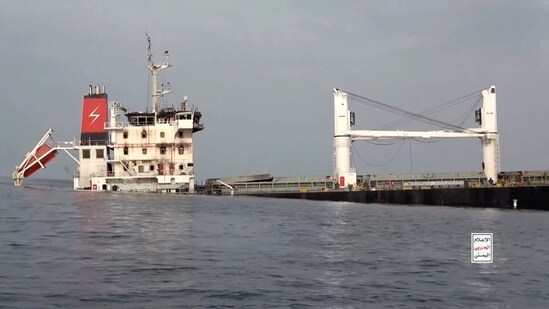
A vessel said to be Greek-operated, Liberia-flagged Eternity C sinks in a footage released by Yemen's Houthis, in the Red Sea (REUTERS FILE)
Not everything went according to plan. Following the transfer of oil, the Yemen was supposed to be operated by Yemen’s state oil company under the advisory oversight of the U.N. Development Program. In practice, the vessel serves as a floating fuel station for the Houthis. On paper, the U.N. transferred ownership to Yemen’s internationally recognized government—but control is what matters, and the Houthis have it.
As if seizing the transferred oil wasn’t enough, the Houthis are now using the Yemen to help Russia evade sanctions. According to a recent Lloyd’s List investigation, the Yemen was involved in transferring more than a million barrels of Russian oil from early 2024 to June 2025. The Valente tanker conducted ship-to-ship transfers with the Yemen in March and April last year. Another vessel, the Savitri, made a delivery in October 2024.
The first offloading from the Yemen occurred on this June 10, to a Panama-flagged tanker that then sailed to Ras Isa, the Houthi-controlled port where shore storage has since been damaged by U.S. and Israeli airstrikes. The Yemen has become the Houthis’ primary offshore storage hub and a key element of their war economy.
All this is being underwritten by the international community. While the Houthis attack commercial vessels and threaten global shipping, the U.N. is bankrolling their offshore oil logistics by paying $450,000 a month for the Yemen’s operations. A vessel designed to prevent one catastrophe is facilitating another—moving Russian oil in defiance of sanctions, sustaining the Houthis’ illicit fuel economy, and prolonging a regional war.
This isn’t the U.N.’s first blunder to benefit the Houthis. Since the group seized Yemen’s capital in 2014, the U.N. has kept its headquarters in Houthi-held Sana’a rather than relocating to Aden, the internationally recognized government’s interim capital. That choice has allowed the Houthis to detain U.N. personnel, storm U.N. offices and exploit aid shipments. Nearly half of all detained U.N. employees worldwide are held by the Houthis.
The 2018 Stockholm Agreement made matters worse. Brokered to avert humanitarian disaster from a military offensive to retake Hodeidah port, the agreement cemented Houthi control of this strategically significant economic hub on Yemen’s west coast. The U.N. kept its agreement and funded the port’s reconstruction, while the Houthis have refused to abide by their commitments. Houthi control over this region has enabled the group to attack more than 100 commercial vessels since November 2023.
If the U.S. is serious about restoring deterrence in the Red Sea and enforcing sanctions on Russia, it must cut off Houthi oil flows. While U.S. options are limited by concerns over potential environmental disaster, the Trump administration is already moving in the right direction by terminating a Biden-era authorization earlier this year that allowed oil transactions through Houthi-controlled areas. The White House should go a step further by designating the Yemen as property in which the Houthis have an interest, exposing any vessels or intermediaries that interact with the ship to secondary sanctions.
The tragedy of purchasing the Yemen isn’t that the U.N. tried to avert an oil spill. It’s that the operation was naively conceived, poorly executed and left open to predictable exploitation. Whether it involves Hamas, Hezbollah or the Houthis, good intentions are no substitute for good strategy when confronting Iran’s terrorist proxies.
Mr. Meizlish is a senior research analyst and Ms. Toomey a research analyst at the Foundation for Defense of Democracies.
Get the latest World News, breaking headlines and global updates from the US, UK, Pakistan, Bangladesh, Russia and other countries. Follow major international events on Hindustan Times.
Home/World News/The Houthis And The U.N.’s Ship Of Fools

 E-Paper