
 E-Paper


NASA’s Webb confirms 1st discovery of frozen water around young star just like Solar system
NASA's James Webb Space Telescope has confirmed that crystalline water ice exists in the debris disk surrounding HD 181327, a young star that resembles the sun.

 Prefer HTon Google


In a historic finding, NASA's James Webb Space Telescope has confirmed that crystalline water ice exists in the debris disk surrounding HD 181327, a young star that resembles the sun.
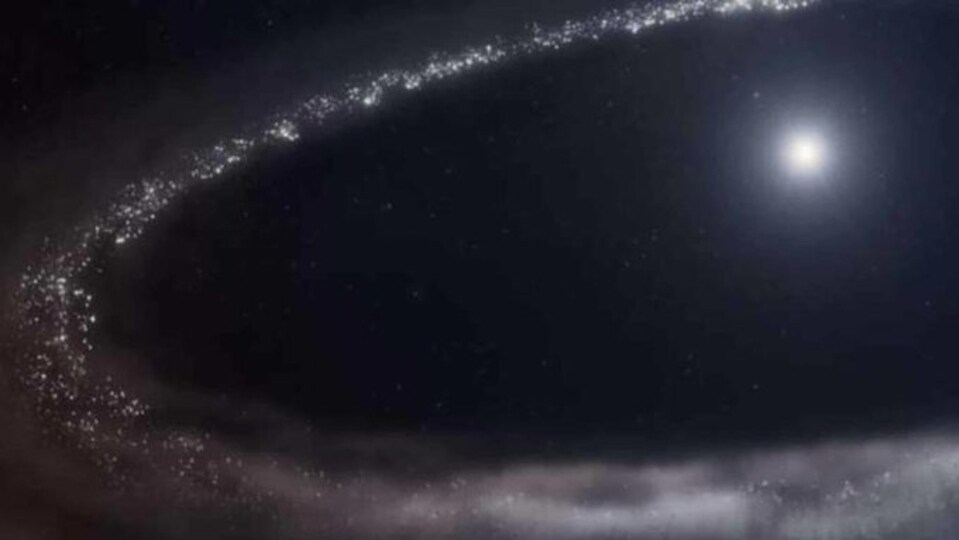
The study, published in Nature, is the first clear-cut evidence of frozen water in an atmosphere outside of the solar system. The water ice, which is present with small dust particles, aids in the understanding of the early phases of the evolution of planetary systems. Webb's delicate instruments opened a fresh chapter in the study of planet formation by observing the detailed spectra that revealed the structure and arrangement of ice particles across the disk.
Webb's finding of Crystalline Water Ice shows Solar System similarities
The ice that Webb discovered has a crystalline structure, which is also present in other well-researched regions of the solar system, like the Kuiper Belt and Saturn's rings.
“Webb unambiguously detected not just water ice, but crystalline water ice, which is also found in locations like Saturn’s rings and icy bodies in our solar system’s Kuiper Belt,” said Chen Xie, the study’s principal author and assistant research scientist at Johns Hopkins University.
The small, dusty water ice particles that Webb's instruments picked up were the result of collisions inside the debris disk.
These frozen granules support the theory that planet formation processes may be common throughout the galaxy by directly connecting to circumstances that may have prevailed in the early solar system.
Also Read: Indian astronaut to travel soon to ISS as part of ISRO-NASA Mission
Does star have water ice?
Water ice is not evenly distributed across the debris disk of HD 181327. According to Webb's observations, the outer portions, where the temperature is low enough to maintain frozen water, have a high concentration of ice. “The outer area of the debris disk consists of over 20% water ice,” Chen Xie stated.
As one moves inward, the amount of ice drops decreases significantly. The areas nearest to the star have almost no water ice, whereas the center of the disk has about 8%.
This gradient is probably caused by the UV rays from the star vaporizing the water ice in the warmer, inner regions. Furthermore, some water might be trapped inside planetesimals, which are expansive bodies that are challenging for Webb to detect. The physical and chemical conditions of newborn planetary systems can be inferred from this unequal distribution.


