E-Paper


Why some sand dunes 'sing' while most stay silent: The science behind the mysterious hum
The phenomenon that Marco Polo believed was associated with spirits can now be described through granular mechanics and acoustics.

 Prefer HTon Google


There are accounts of odd noises coming out of some of the sand dunes dating back to ancient times. During his journey through the Gobi Desert in Asia in the 13th century, Venetian merchant and explorer Marco Polo wrote about music made by ghosts, which he believed were desert spirits. It is an extraordinary natural occurrence that goes by the names of singing or booming sands.
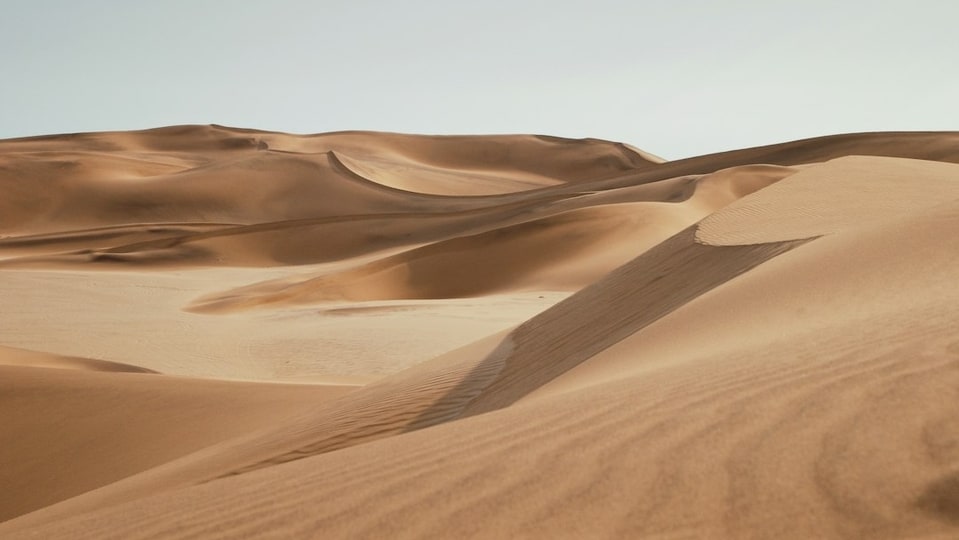
It appears in various places across the world, including the Nevada Sand Mountain, Morocco’s Erg Chebbi, and Omani deserts. If sand slides down the steep slope of a dune under the influence of either the wind or a step, it can produce a sound like a deep hum that continues for several minutes and is even comparable in volume to the sound of a passing motorcycle.
The physics of falling grains
French physicist Bruno Andreotti offered one of the clearest explanations for what happens inside that avalanche. In a 2002 paper titled The Song of Dunes as a Wave-Particle Mode Locking, published in Physical Review Letters, he showed that as sand grains tumble downhill, their collisions send elastic waves rippling through the dune's surface layer. Those vibrations can then couple to the air as sound. Andreotti's measurements found that the loudness caps out at around 105 decibels, at the point where the shaking becomes strong enough to briefly lift grains off the flowing layer.
The frequency, he discovered, is determined by the shear rate within the avalanche; in other words, how often the grains are bumping into each other, which came to about 100 hertz in his studies. Surprisingly, his findings showed that the elastic waves can influence the particles' motion, causing them to vibrate in tune and resulting in the entire avalanche vibrating at one particular frequency. In simple words, the sand dune synchronizes the motion of its grains into a coherent sound rather than producing only random noise.
Why some dunes stay silent
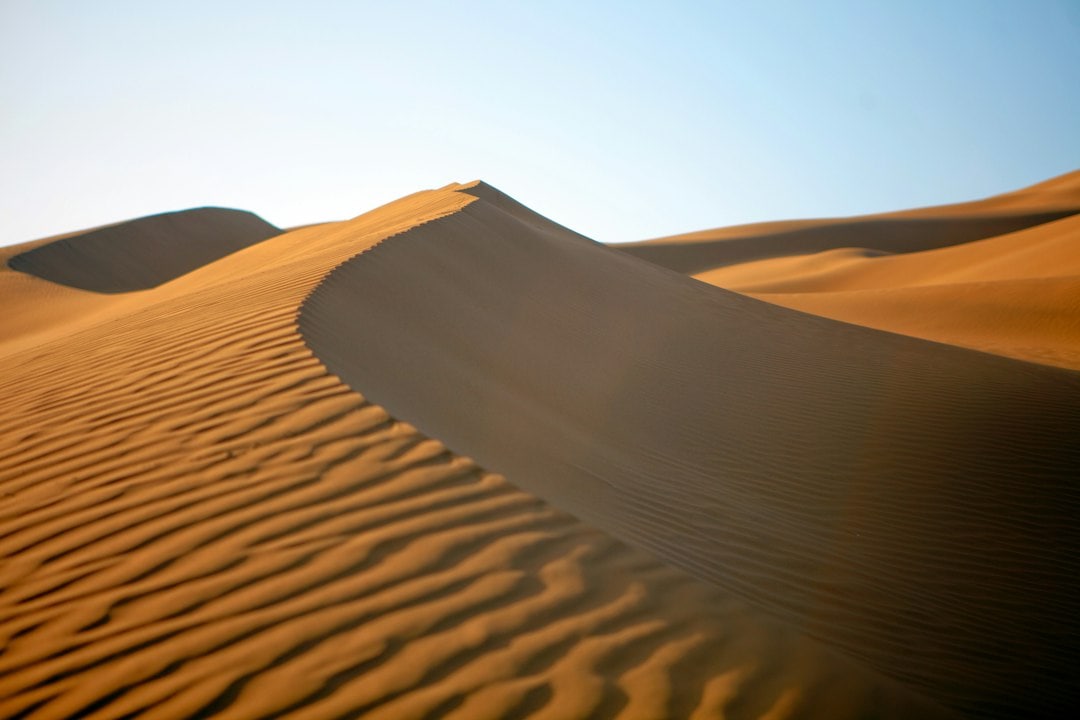
Andreotti's paper explained the mechanism, but it left a bigger question open: Why do only a few dozen dunes out of thousands worldwide actually sing? Caltech researchers Melany Hunt and Nathalie Vriend took on that puzzle in Booming Sand Dunes, a review published in the Annual Review of Earth and Planetary Sciences in 2006 that pulled together decades of fieldwork on the phenomenon.
Their survey counted close to 40 known singing sites around the globe, with a dominant frequency band of roughly 70 to 110 hertz and fainter higher harmonics layered on top. They also documented that the sound often keeps resonating for a while even after the sand itself has stopped moving, a detail the review discusses in terms of the dune's near-surface structure helping support and amplify the vibrations, allowing the sound to persist rather than disappearing immediately when the avalanche ends.
According to the review, the booming sand is typically well-sorted, rounded, and devoid of fine materials and moisture, though the mentioned features are not enough to provide an explanation for all cases. A nearby dune could appear very similar but remain silent if differences in grain shape, sorting or moisture prevent the grains from entering the same synchronized motion. At the same time, some dunes with apparently suitable grain characteristics do not produce booming sounds, and Hunt and Vriend noted that the precise conditions required for the phenomenon were not fully understood.
Together, the two studies provide complementary explanations for different parts of the mystery rather than resolving every question about singing sands. The research done by Andreotti in 2002 clarifies how a falling particle can become involved in synchronized motion and generate a coherent vibration. Hunt & Vriend’s review from 2006 examines the broader conditions associated with booming dunes and highlights why the phenomenon occurs only at certain sites. The phenomenon that Marco Polo believed was associated with spirits can now be described through granular mechanics and acoustics, although the exact combination of conditions that makes some otherwise similar dunes sing while others remain silent is still not completely understood.