Sign in

Carbon pricing: A game changer for industry from Paris

Nearly 200 countries on Saturday agreed to a global carbon pricing mechanism that will provide market-led framework to collectively reduce emissions and give boost to energy-intensive industry to adopt greener technologies.

Published on: Dec 14, 2015, 07:30:24 IST
Hindustan Times | By , Paris
Share
Share via
  • facebook
  • twitter
  • linkedin
  • whatsapp
Copy link
  • copy link

Nearly 200 countries on Saturday agreed to a global carbon pricing mechanism that will provide market-led framework to collectively reduce emissions and give boost to energy-intensive industry to adopt greener technologies.

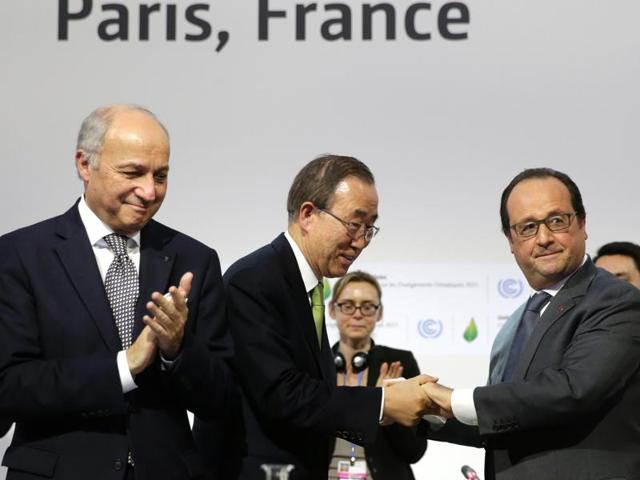
French President Francois Hollande (R) shakes hands with UN secretary general Ban Ki-moon next to French foreign minister and COP21 president Laurent Fabius (L) during the final session of the COP21 United Nations climate change conference in Le Bourget near Paris on Saturday. (AFP)

Under the new mechanism, all carbon exchanges will be inter-connected, enabling holders of carbon credits to trade it internationally. For instance, a company in Delhi will be able to trade credit, earned for saving emissions, in Europe or United States.

India already has a domestic carbon exchange through the cap and trade mechanism called Perform, Achieve and Trade (PAT) for some of the most polluting sectors, such as iron and steel and cement. China set up its domestic carbon exchange in 2014.

Read|One word made the difference: How Paris climate pact was won

In this, the government sets an emission reduction target for each sector on an annual basis, with industry bodies having to provide a goal for each company. The companies that achieve their targets to reduce emissions can trade the credit (equivalent to a tonne of carbon saved) with ones that fail to meet their emission reduction goal, thereby ensuring all become a part of low carbon growth pathway.

Ajay Mathur, director general of the Bureau of Energy Efficiency, recently told HT that not adopting cleaner technologies under PAT was a disincentive for industries as it would make their production unviable for competition in the open market.

Companies from Maharashtra to Gujarat have found that the cost of adopting energy efficiency technologies can be recovered in less than three years through savings in energy bills. Mathur said savings of more than 10,000 MW were achieved in 2014 through PAT – this will improve as the global mechanism will provide better prices for carbon credits.

Read|Paris deal: Climate scientists, green groups sound note of caution

  • Chetan Chauhan
    ABOUT THE AUTHOR
    Chetan Chauhan

    Chetan Chauhan is the National Affairs Editor looking into all aspects of news and features from across India. A Chevening scholar with over three decades of experience in reporting and news management, Chetan has extensively covered all important aspects of the social sector, political economy, environment and climate change nationally and internationally. He did a journalism course at the Reuters Institute of Journalism in Oxford and Digital Media training at Nanyang Technological University in Singapore. He started as a reporter with The Statesman in 1996 and joined the Hindustan Times in 2000 in the metro bureau covering environment, crime and Delhi politics. He covered hot local news, from the Jessica Lal murder case to the rebellion of Delhi Congress MLAs against then Chief Minister Sheila Dikshit, to the replacement of toxic vehicle fuel with cleaner compressed natural gas (CNG) in the national capital. Some of his stories on air pollution became part of the Supreme Court’s landmark MC Mehta versus Government of India case in the National Capital Region (NCR), forcing the government to take corrective measures. As part of the national political bureau since 2004, he covered important central sectors such as environment, education, social justice, labour, rural development, water resources, renewable energy, agriculture, broadcasting and the Planning Commission for more than a decade producing several exclusive and investigative breaking stories. His specialisation is the environment, having covered at least a dozen United Nations global conferences on climate change, biodiversity and wildlife including climate summits in Paris, Copenhagen and Bali. He also covered India’s two five-year plans ---11th and 12th and reported on drafting and execution of right based laws such as Right to Education, Right to Information and rural job guarantee law, MG-NREGA, now being introduced in new format as VG-RAM-G Act. He has in-depth knowledge of social sector issues. He was one of the first to report on tigers vanishing from Sariska and Panna wildlife reserves in 2004 and 2008, respectively, leading to the setting up of the National Tiger Conservation Authority (NTCA) and the introduction of stringent penal provisions for poaching. He has written extensively on the rising human-animal conflict in India and the degradation of India’s biodiversity hotspots because of mining and other activities. Since 2004, Chetan has covered Parliament comprehensively and participated in training on the nuanced coverage of Parliament proceedings. He has travelled extensively across India to cover national and provincial elections since 1998, especially in the Hindi heartland states, considered India’s road to power. He writes a regular column for Hindustan Times, Ecostani, on important national politics, economy, Himalayan ecology and environmental issues. His other responsibilities include providing inputs for edits and edit page articles for the publication, apart from managing news flow from across India.Read More

Get the latest headlines from US news and global updates from Pakistan, Nepal, UK, Bangladesh, Russia and US Iran war Live, get all the latest headlines in one place on Hindustan Times.