
 E-Paper



Suspected debris of MH370 may have sunk: Australia
The international team hunting for Malaysia Airlines Flight MH370 in the southern Indian Ocean has not turned up anything so far, and Australia's deputy prime minister said the suspected debris may have sunk. Flight MH370 hunt leads to debris off Australia coast | MH370 debris analysis slowed by enormous data

 Prefer HTon Google


Search planes scoured a remote patch of the Indian Ocean but came back empty-handed Friday after a 10-hour mission looking for any sign of the missing Malaysia Airlines jet, another disappointing day in one of the world's biggest aviation mysteries.

Australian officials pledged to continue the search for two large objects spotted by a satellite earlier this week, which had raised hopes that the two-week hunt for the Boeing 777 that disappeared March 8 with 239 people on board was nearing a breakthrough.
But Australia's acting prime minister, Warren Truss, tamped down expectations. "Something that was floating on the sea that long ago may no longer be floating - it may have slipped to the bottom," he said. "It's also certain that any debris or other material would have moved a significant distance over that time, potentially hundreds of kilometers."
Aircraft and ships have renewed a search in the Andaman Sea between India and Thailand, going over areas that have already been exhaustively swept to find some clue to unlock one of the most inexplicable mysteries in modern aviation.
The Boeing 777 went missing almost two weeks ago off the Malaysian coast with 239 people aboard. There has been no confirmed sign of wreckage but two objects seen floating deep south in the Indian Ocean were considered a credibe lead and set off a huge hunt on Thursday.
Australian authorities said the first aircraft to sweep treacherous seas on Friday in an area about 2,500 km (1,500 miles) southwest of Perth was on its way back to base without spotting the objects picked out by satellite images five days ago.
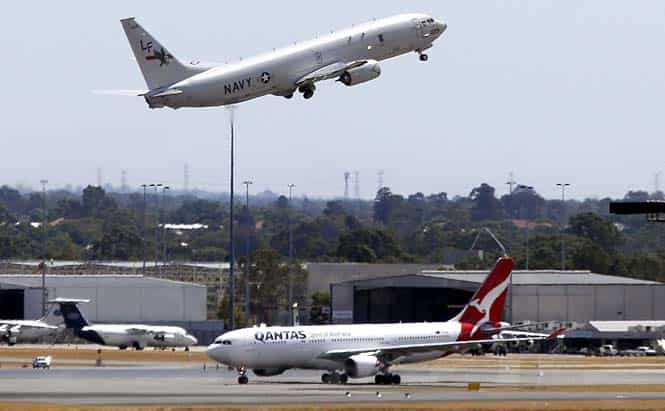
But the search is continuing and and Australian, New Zealand and U.S. aircraft would be joined by Chinese and Japanese planes over the weekend.
"It's about the most inaccessible spot that you can imagine on the face of the Earth, but if there is anything down there, we will find it," Australian Prime Minister Tony Abbott told reporters in Papua New Guineau, where he is on a visit.
"Now it could just be a container that's fallen off a ship. We just don't know, but we owe it to the families, and the friends and the loved ones to do everything we can to try to resolve what is as yet an extraordinary riddle."
Read: Flight MH370 hunt leads to debris off Australia coast
Read: India to deploy P-8I, C-130J planes to locate Malaysian airliner
India said it was sending two aircraft, a Poseidon P-8I maritime surveillance aircraft and a C-130 Hercules transporter, to join the hunt in the southern Indian Ocean. It is also sending another P-8I and four warships to search in the Andaman Sea, where the plane was last seen on military radar on March 8.
Watch video: Australia leads search for missing MH370 debris
In New Delhi, officials said the search in areas around the Andaman island chain was not at the request of Malaysian authorities coordinating the global search for the airliner.
"All the navies of the world have SAR regions," said Capt. DK Sharma, an Indian navy spokesman, referring to search and rescue regions. "So we're doing it at our own behest. "We're doing it on our own because the Malaysian plane is still missing."
Investigators suspect Flight MH370, which took off from Kuala Lumpur for Beijing shortly after midnight on March 8, was deliberately diverted thousands of miles from its scheduled path. They say they are focusing on hijacking or sabotage but have not ruled out technical problems.
The search for the plane also continues in other regions, including a wide arc sweeping northward from Laos to Kazakhstan. In the Indian Ocean, three Australian P-3 Orions joined a high-tech U.S. Navy P-8 Poseidon and a civilian Bombardier Global Express jet to search the 23,000 square km (8,900 sq mile) zone, the Australian Maritime Safety Authority said.
A Norwegian merchant ship, the Hoegh St. Petersburg, was diverted to the area on Thursday and was still searching there and another vessel would arrive later on Friday.
China's icebreaker for Antarctic research, Xuelong, or Snow Dragon, will set off from Perth to search the area, Chinese state news agency Xinhua cited maritime authorities as saying.
Up to five more Chinese ships were steaming towards the search zone from across the Indian Ocean, Xinhua reported.
Australian authorities said they had not asked for the ships to search the area. About two-thirds of the missing plane's passengers were Chinese nationals.
Studying Satellites
There have been many false leads and no confirmed wreckage found from Flight MH370 since it vanished off Malaysia's east coast less than an hour after taking off.
There has also been criticism of the search operation and investigation, as more than two dozen countries scramble to overcome logistical and diplomatic hurdles.
Investigators piecing together patchy data from military radar and satellites believe that, minutes after its identifying transponder was switched off as it crossed the Gulf of Thailand, the plane turned sharply west, re-crossing the Malay Peninsula and following an established route towards India.
What happened next is unclear, but faint electronic "pings" picked up by one commercial satellite suggest the aircraft flew on for at least six hours.
Read:China's request for entering Indian waters turned down
Read:Hunt for flight MH370: Norwegian ship reaches spot to check debris
Three Chinese naval ships were heading to the area, along with the icebreaker Snow Dragon, China's state television reported. The icebreaker was in Perth following a voyage to the Antarctica in January, but it wasn't clear when the other ships would get there.
The combination the planes are using of radar to detect objects coupled with low passes over the ocean to identify them visually is crucial because when "radar blips come back it's not always clear what the object is," said Michael Smart, an aerospace engineering professor at Australia's University of Queensland.
"They use the radar to focus and then they go and visually look to see what it is," he said. "The high technology and the low technology are equally important."
Read:We've not hidden anything about MH 370, says Malaysian consul
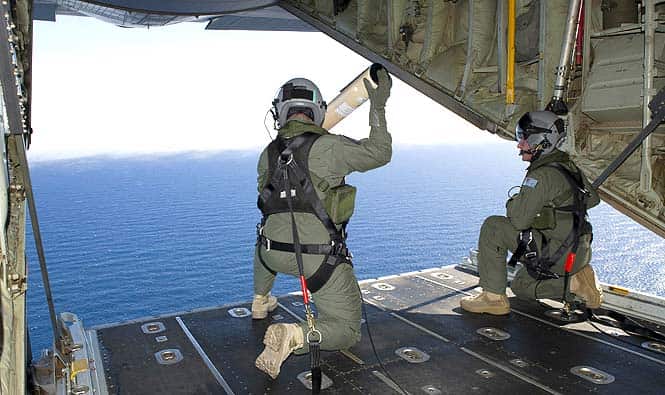
The biggest challenges for the searchers are weather conditions in an area known for its storms, he said, though rainy and cloudy weather appeared to be clearing up Friday afternoon. And if the objects are partially submerged as they bob in the ocean that could also affect the planes' radar detection capabilities.
Smart predicted that "it will be just a matter of time before they are found. If they were going to sink they would have already."
A source with direct knowledge of the situation said that information gleaned from the pings had been passed to investigators within a few days, but it took Malaysia more than a week to narrow the search area to two large arcs - one reaching south to near where the potential debris was spotted, and a second crossing to the north into China and central Asia.
(With AP inputs)
Read:
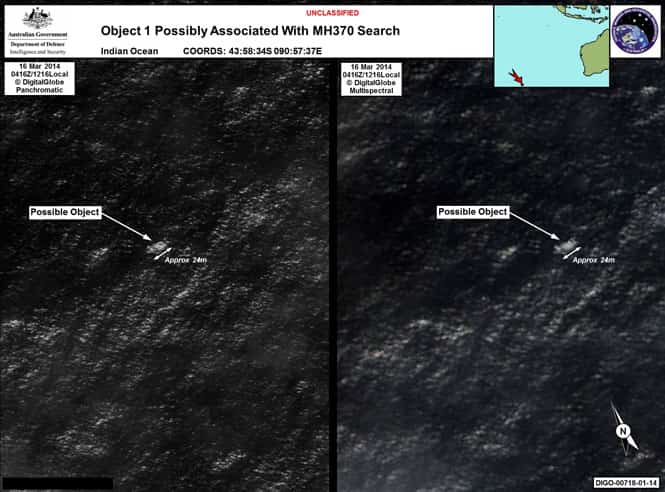
AMSA handout of Object 1 possibly connected with MH370 search


