
 E-Paper



Ukraine readies military op against pro-Russians, sets Monday deadline
Ukraine has given pro-Russian separatists a Monday morning deadline to disarm or face a "full-scale anti-terrorist operation" by its armed forces, raising the risk of a military confrontation with Moscow.


Ukraine has given pro-Russian separatists a Monday morning deadline to disarm or face a "full-scale anti-terrorist operation" by its armed forces, raising the risk of a military confrontation with Moscow.

Angered by the death of a state security officer and the wounding of two comrades near the flashpoint eastern city of Slaviansk, acting president Oleksander Turchinov gave rebels occupying state buildings until 0600 GMT (11.30am IST) to lay down their weapons.
"The National Security and Defence Council has decided to launch a full-scale anti-terrorist operation involving the armed forces of Ukraine," Turchinov said in an address to the nation.
He blamed Russia, which annexed Ukraine's Crimea region when Moscow-backed former president Viktor Yanukovich fled after months of pro-Western protests, for being behind the rash of rebellions across Russian-speaking towns in eastern Ukraine.
"We will not allow Russia to repeat the Crimean scenario in the eastern regions of Ukraine," Turchinov said.
Russia's foreign ministry called the planned military operation a "criminal order" and said the West should bring its allies in Ukraine's government under control.
"It is now the West's responsibility to prevent civil war in Ukraine," the ministry said in a statement.
It said it would put an urgent discussion of the "extremely dangerous" situation in eastern Ukraine on the agenda of the United Nations Security Council.
Earlier, the American ambassador to the UN, Samantha Power, said on ABC's "This Week" that the latest events in Ukraine bore "the telltale signs of Moscow's involvement".
"The president has made clear that, depending on Russian behavior, sectoral sanctions in energy, banking, mining could be on the table, and there's a lot in between," she added.
With East-West relations in crisis, NATO described the appearance in eastern Ukraine of men with specialised Russian weapons and identical uniforms without insignia - as previously worn by Moscow's troops when they seized Crimea — as a "grave development".
Ukraine has repeatedly said the rebellions are inspired and directed by the Kremlin. But action to dislodge the armed militants risks tipping the stand-off into a new, dangerous phase as Moscow has warned it will protect the region's Russian-speakers if they come under attack.

One Ukrainian state security officer was killed and five were wounded on the government side in Sunday's operation in Slaviansk, interior minister Arsen Avakov said. "There were dead and wounded on both sides," he wrote on his Facebook page.
The Russian news agency RIA reported that one pro-Moscow activist was killed in Slaviansk in clashes with forces loyal to the Kiev government. "On our side, another two were injured,"
RIA quoted pro-Russian militant Nikolai Solntsev as adding. Russian TV broadcast grainy footage of what it said was the body of the militant. The images, which Reuters could not verify independently, showed a man in black clothes, slumped against the door of a car, with a pool of blood between his legs. A rifle lay next to him.
'Undermining elections'
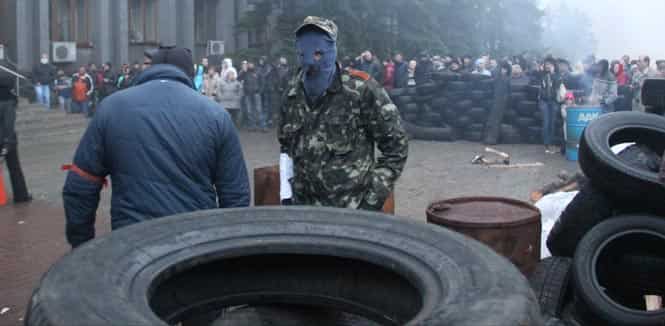
The separatists are holed up in the local headquarters of the police and of the state security service, while others have erected road blocks around Slaviansk, which lies about 150 km from the Russian border.
However, details of the fighting remain sketchy. A statement from the administration of the eastern Donetsk region indicated the security officer may have been killed between Slaviansk and the nearby town of Artemivsk. It said nine were wounded.
An eyewitness in Slaviansk said a gunman walked up to a car in the city centre and fired four or five shots into it. Video footage from the scene later showed a man being pulled out of the car, either seriously wounded or dead. It was not clear what links the shooting had with the unrest in the town.
Kiev accuses the Kremlin of trying to undermine the legitimacy of presidential elections on May 25 that aim to set Ukraine back onto a normal path after months of turmoil.
However, Russian foreign minister Sergei Lavrov said Kiev was "demonstrating its inability to take responsibility for the fate of the country" and warned that any use of force against Russian speakers "would undermine the potential for cooperation", including talks due to be held on Thursday between Russia, Ukraine, the United States and the European Union.
Well organised attackers
Relations between Russia and the West are at their worst since the Cold War due to the crisis that began when Moscow-backed Yanukovich was pushed out by popular protests in February.
Moscow then annexed Crimea from Ukraine, saying the Russian population there was under threat. Some Western governments believe the Kremlin is preparing a similar scenario for eastern Ukraine, something Moscow has strenuously denied.
In Kramatorsk, about 15 km south of Slaviansk, gunmen seized the police headquarters after a shootout with police, a Reuters witness said.
The attackers were a well-organised unit of over 20 men, wearing matching military fatigues and carrying automatic weapons, who had arrived by bus. Video footage showed the men taking orders from a commander. Their identity was unclear.
Their level of discipline and equipment was in contrast to the groups who have occupied buildings so far in Ukraine. They have been mostly civilians formed into informal militias with mismatched uniforms.
NATO secretary-general Anders Fogh Rasmussen expressed concern about similarities in some of the rebels' appearance to that of the Russian troops who seized control in Crimea.
Calling on Russia to pull back its large number of troops, including special forces, from the area around Ukraine's border, he said in a statement: "Any further Russian military interference, under any pretext, will only deepen Russia's international isolation."

NATO has effectively ruled out military action over Ukraine, which lies outside the Western alliance. However, Washington and NATO leaders have made clear they would defend all 28 member states, including former Soviet republics in the Baltic that are seen as the most vulnerable to Russian pressure.
NATO allies have beefed up their air and sea firepower in eastern Europe. The alliance has also cut off cooperation with Russia and stepped up work with Ukraine, including advising its military on reforms and promising to increase joint exercises.
With EU foreign ministers due to discuss the crisis in Luxembourg on Monday, Britain called on Moscow to disown the rebels. "Assumptions that Russia is complicit are inevitable as long as Moscow does not publicly distance itself from these latest lawless actions," a foreign office spokesman said.
Gas war risk
The crisis over Ukraine could trigger a "gas war", disrupting supplies of Russian natural gas to customers across Europe. Moscow has said it may be forced to sever deliveries to Ukraine - the transit route for much of Europe's gas – unless Kiev settles its debts.
For now, though, the focus of the crisis was in eastern Ukraine, the country's industrial heartland, where many people feel a close affinity with neighbouring Russia.
In the eastern city of Kharkiv, supporters of the revolution that brought the Kiev leadership to power clashed with opponents who favour closer ties with Russia. Police said 50 people were hurt, 10 of whom received hospital treatment.
In another eastern town, Zaporizhzhya, Interfax news agency said 3,000 pro-European supporters turned out in a unity rally and faced off with several hundred pro-Moscow supporters, many of them waving the Russian flag.
"We are ready to defend ourselves," said separatist Vyacheslav Ponomaryov, who said he had taken over leadership of Slaviansk after the city's mayor fled.


