
 E-Paper



The rise of JP Nadda from a student leader to the BJP’s working president
Now he will have to be the quintessential organisational man to impress his mentors — the RSS, Modi and Shah

 Prefer HTon Google


It has been a long, arduous journey for grassroots Rashtriya Swayamsevak Sangh (RSS) worker and former students’ leader, 59 year-old Jagat Prakash Nadda who has been appointed the working president of the Bharatiya Janata Party (BJP). He is a symbol of dynamism, perseverance, sobriety and maturity.
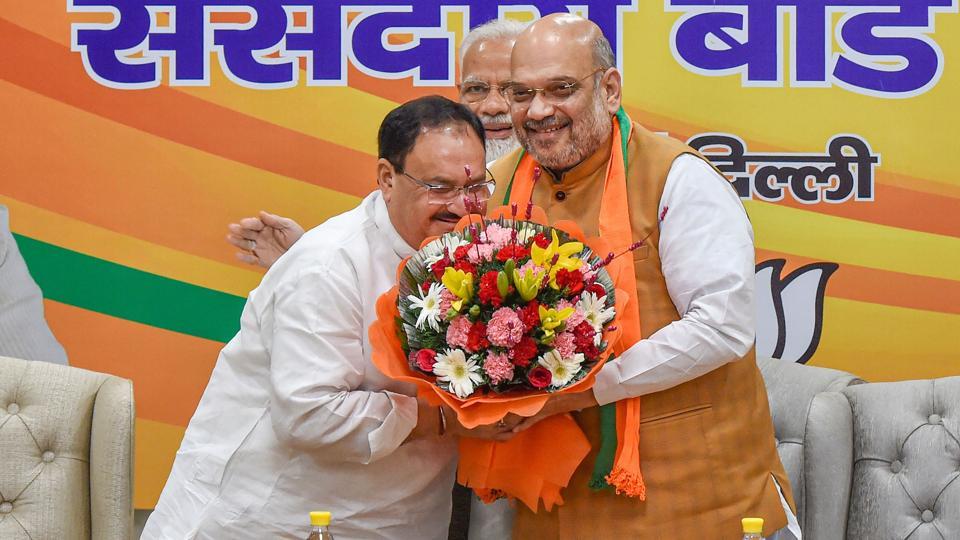
Nadda’s ascent from a students’ leader to the working president of Bharatiya Janata Party (BJP), at a time when the party has flourished in a majority of the states and has decimated the Opposition in the recent parliamentary polls, makes it special and significant as it will likely take him to the top slot in December this year.
Keeping in mind the forthcoming assembly polls in Haryana, Maharashtra and Jharkhand, the parliamentary board has retained Amit Shah as the party chief. This will help Nadda stabilise his position under the guidance of both Shah and Prime Minister Narendra Modi.
At this time, one can’t help but recall Nadda’s forceful exit from state politics in May 2010 due to his differences with former Chief Minister Prem Kumar Dhumal after being a Cabinet minister twice in the BJP government. This turned into a blessing in disguise because it gave him a golden opportunity to work in the organisation. He was then appointed as the general secretary by former BJP chief, Nitin Gadkari.
Nadda credited his success to God and was particularly grateful to Modi and Shah for having expressed their faith in his capabilities to carry on the legacy of master strategist, Shah. He believes that it will be an uphill task to come close to standards set by Shah.
This unflinching faith that Nadda had in Modi and Shah was seen a year and a half ago during lobbying of probable candidates for the post of Himachal Pradesh’s chief minister following the unexpected defeat of Dhumal from the Sujanpur assembly seat. Dhumal had been declared the CM candidate by Shah during campaigning. At that time, Nadda was termed as a front-runner for the post by the press (which can often be wrong). The final choice was Jai Ram Thakur, termed by critics as the accidental CM. Nadda’s reaction of being unaffected by this choice reaffirmed the party leadership’s faith in him.
Analysts firmly believe the notion of Modi and Shah to strategise much in advance. This is evident in the announcement made by the party president in a 2019 Lok Sabha election rally in Hamirpur district of Himachal Pradesh about the possibility of giving greater responsibility to Anurag Thakur if electorates ensured his victory. This categorical assurance surprised many as no one seemed to be sure of a Modi wave at the time. But political observers believe that it was clear proof of secret planning by Modi and Shah to induct Anurag Thakur in the Cabinet while also carving out a big space for Nadda in the organisation.
There are many indications of this strategy. First, despite Nadda being one of the senior ministers in National Democratic Alliance (NDA)-1 and his close proximity to Modi and Shah, he did not get a phone call from the Prime Minister’s Office or from the party President (while Anurag Thakur did). Second, Nadda was given the responsibility of the crucial state of Uttar Pradesh, which is proof of the BJP leadership’s faith in him. His master stroke — the inclusion of the Apna Dal in the NDA — was a snub to detractors and propagators of caste equations. Despite this, no one, including Nadda, had any clue about his future; a fact known only to Modi, Shah and RSS chief, Mohan Bhagwat.
Nadda was a student in Patna College when he participated in Jayaprakash Narayan’s Bihar movement against corruption and the misrule of the state government. This movement later turned into a total revolution to oust Indira Gandhi from power at the Centre on November 18, 1974. He had a close association with the RSS as a worker and was in the RSS’ student wing, Akhil Bharatiya Vidyarthi Parishad for several years and was their national president in 1990-91.
Nadda grew under the influence of stalwarts such as Atal Bihari Vajpayee, Bhairon Singh Shekhawat and LK Advani, who guided him at every step of his political career. He is known for his qualities of being moderate and open-minded.
But a few challenges remain. Nadda faces a new and big challenge of the RSS agenda vis-à-vis the construction of the Ram temple in Ayodhya. The RSS will expect the organisation to be prepared for this eventuality to fulfil the BJP’s promise. Nadda enjoys close relations with the RSS chief as he has been in touch with Bhagwat and other leaders of the Sangh Parivar during his five year tenure as Union health minister. Another challenge is the finalisation of an election strategy to ensure victory in upcoming assembly polls in three states. While Modi and Shah will continue to guide him, the onus of executing an action plan will rest on his shoulders.
As things stand today, Nadda will continually get solicited advice from the RSS, the PM and current party president but he will have to prove to be the quintessential organisational man to impress his mentors. This will ultimately pave the way for him becoming the president of the BJP.
KS Tomar is a senior journalist based in Shimla
The views expressed are personal


