E-Paper



Two years later, Assam’s NRC remains incomplete and controversial
The NRC was updated on the basis of the Assam Accord of 1985, which, in turn, was signed after a six-year-long agitation against illegal immigrants. The entire process, which took four years to complete, was supervised by the Supreme Court, which had ordered revision of the 1951 list

 Prefer HTon Google


It was expected to be a document that would end, once and for all, Assam’s long festering issue of illegal immigrants. But two years since the final list of the National Register of Citizens (NRC) for the state was announced, everything is in limbo and the issue remains where it was.
The evolution of the NRC
The NRC was updated on the basis of the Assam Accord of 1985, which, in turn, was signed after a six-year-long agitation against illegal immigrants. The entire process, which took four years to complete, was supervised by the Supreme Court (SC), which had ordered revision of the 1951 list.
The final list announced on August 31, 2019 (an updated version of the NRC first published for Assam in 1951) excluded 1,906,657 (a little over 1.9 million) applicants, of the 33 million who had applied to be included in the list that identifies Indian citizens.
It was clarified that those left out of final NRC won’t be declared foreigners and they would have the option of filing appeals within 120 days in foreigners’ tribunals (FTs), which was to decide on their citizenship status based on provisions of Foreigners Act, 1946, and Foreigner (Tribunals) Order, 1964.
Also Read | CAA, NRC will not hurt Indian Muslims: Bhagwat in Assam
But till date, those excluded have not been issued rejection slips by NRC office, which would enable them to file appeals. The NRC is yet to be notified by the Registrar General of India (RGI) and several applications seeking re-verification of the list are pending in Supreme Court.
The push for re-verification
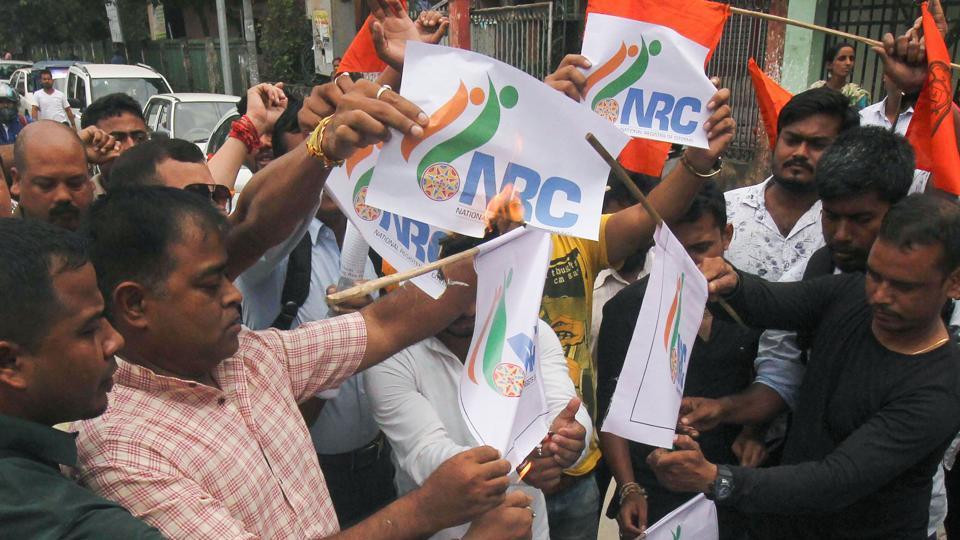
The much-awaited list was denounced within hours of its publication.
The ruling Bharatiya Janata Party (BJP)-led government in the state argued that the figure of 1.9 million excluded was much lower than the actual number of illegal immigrants in the state. The party also believed that nearly 200,000 genuine Indians also got left out.
“We want 20% re-verification of the list in districts bordering Bangladesh and 10% re-verification in other districts. If after that, the NRC is found to be correct, the state government would accept it and take the process forward. But if the NRC is found faulty after re-verification, we would want the Supreme Court to view this issue critically,” Assam chief minister Himanta Biswa Sarma had said in May this year after he assumed office.
The same month, the NRC coordinator in Assam, Hitesh Dev Sarma, filed an application in SC seeking a complete, comprehensive and time-bound re-verification of NRC as some “glaring anomalies of serious nature” were detected in the process.
While the updated NRC was released in August 2019, a draft of the list published in July, 2018 had excluded nearly 4 million of the 33 million applicants.
“Out of the names of 4,007,719 persons excluded from the draft NRC, about 393,975 persons didn’t file any claims and therefore their names are in the exclusion list of NRC. After some sample checks now and analysis of the names of those persons who didn’t file claims on the basis of surnames only, it was found that 50,695 persons were apparently eligible for inclusion in the NRC,” the application stated.
“Out of this, 7,770 persons are from Original Inhabitants category and 42,925 persons are from other states. This figure may increase if detail re-verification is done. For a flawless and complete NRC, names of these persons have to be included in the final NRC, failing which the final NRC will lose its acceptability,” it added. The application also said that some undeserving persons may have been included in the NRC list by wrongly claiming to be Original Inhabitants of Assam.
In Assam, as per the Assam Accord of 1985, anyone who has been staying in the state prior to March 24, 1971, or can establish lineage to people residing on or before that date is considered as Indian citizen — a requirement also accepted for inclusion in the NRC of 1951, which was updated in 2019 as per SC directions and under its monitoring.
The controversy around inclusion, exclusion and corruption
Besides the application filed by the NRC coordinator, several others were also filed in SC blaming the process and seeking re-verification of the list.
Two of them were filed by Assam Public Works (APW), a Guwahati-based NGO, whose petition in 2014 in SC seeking re-verification of the 1951 NRC set the ball rolling for the updated list.
“There were massive anomalies in the entire process, which saw many illegal immigrants getting into the list. We can’t accept such a faulty document and want 100% re-verification of the entire list. Our applications on the same are still pending in SC. The pandemic is one main cause for the delay,” Abhijeet Sharma, president of APW, said.
“We also want action against former state coordinator of NRC, Prateek Hajela, who indulged in corruption amounting to nearly ₹360 crore in appointment of data entry operators and procurement of generators. We are planning to file a case in Gauhati High Court in this regard,” he added.
The gargantuan NRC process was carried out with help of nearly 52,000 persons, most of them state government employees, and nearly ₹1,500 crore was spent in the exercise. But three months after release of the NRC list, a report by the Comptroller and Auditor General (CAG) mentioned that there were financial irregularities of more than ₹100 crore in the exercise.
Apart from the 1.9 million left out of NRC, nearly 800,000 others are also facing problems in getting their Aadhar cards as their biometric details, which were blocked as per a SC guideline during the NRC process, are yet to be unblocked. In November 2018, the SC had directed that all the four million people left out of the draft list of NRC released in July, 2018 would have to submit their biometric details during hearing of their claims to get included in the final NRC.
Nearly 2.7 million of the 4 million appeared for the hearings, of which 1.9 got excluded from the NRC released in August 2019 and the rest got included. Though the SC had ruled that those among the 4 million who get included in NRC would be able to procure their Aadhaar cards as legal citizens of India, these people haven’t been able to do so as their biometric details remain blocked.
Officials at the NRC state office said that since RGI is yet to notify the NRC released on August 31, 2019, there’s delay in “unblocking” the biometric details of around 800,000 who got included in the list.
Since the release of the NRC list, Assam government has written twice to the union home ministry and the RGI seeking relaxation of the SC guidelines on locking of biometric details so that those who were not excluded from the list can apply for and get their Aadhar cards.
“It is unfortunate that the NRC process has not been completed till now. Replying to a question Lok Sabha on the delay in carrying the NRC process forward, the home ministry had replied that Assam’s flood problem and the Covid-19 situation were to reasons for non- completion,” said Congress legislator and leader of opposition in Assam assembly, Debabrata Saikia, said. He demanded that the state BJP government put pressure on the central government to include the left out names and delete the undeserving ones, while initiating the appeal process (for those left out) at the earliest.