
 E-Paper



Bihar Assembly Election 2020: In backward Seemanchal, issues abound but all eyes on Owaisi factor
The Asaduddin Owaisi-led AIMIM seeks to play a spoilsport in the Seemanchal region, as part of the GSDF, a third alternative to the NDA and the GA


All eyes are on the 24 seats in the Seemanchal region among the remaining 78 constituencies, which will go to polls on Saturday (November 7) in the final phase of the Bihar assembly elections.
The Rashtriya Janata Dal (RJD) and the Congress, which are part of the opposition front called the Grand Alliance (GA) or mahagathbandhan, along with the Left parties, have had a traditional sway over the voters in the Seemanchal region that is spread across Muslim-dominated districts of Kishanganj, Araria, Katihar and Purnia.
The ruling Janata Dal (United), which was in alliance with the RJD during the 2015 assembly polls, had also reaped the electoral benefit in the Seemanchal region.
However, the equations have changed this time in the backward region, as the JD (U) is back in the National Democratic Alliance (NDA) fold, which includes the Bharatiya Janata Party (BJP) but excludes Lok Janshakti Party (LJP).
Also read | Tejashwi Yadav writes to PM, complains about ‘step-motherly’ treatment to state
The Asaduddin Owaisi-led All India Majlis-e-Ittehadul Muslimeen (AIMIM) seeks to play a spoilsport in the Seemanchal region, as part of the Grand Secular Democratic Front (GSDF), a third alternative to the NDA and the GA.
GSDF is an alliance of Upendra Kushwaha’s Rashtriya Lok Samata Party (RLSP), the Bahujan Samaj Party (BSP), Rajeev Ranjan alias Pappu Yadav’s Jan Adhikar Party (JAP) and a few other smaller regional parties.
The AIMIM tasted its maiden electoral success in Bihar last October, when the party’s candidate Qamrul Hoda defeated BJP nominee Sweety Singh in a bypoll in Kishanganj.
The Congress candidate, who is the mother of Mohammad Jawed, the sitting Kishanganj member of Parliament (MP) and a former member of the Bihar legislative assembly (MLA), had finished third in a multi-cornered contest.
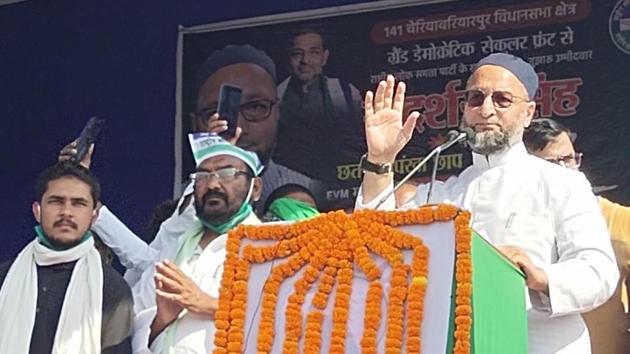
Owaisi is working hard to increase the party’s footprints, where Muslims hold the key in the outcome in many of the 19 seats, where the party is contesting in the ongoing assembly polls.
In 2015, the RJD and the Congress had won 12 of the 19 seats between them.
The AIMIM, which had contested Uttar Pradesh (UP) assembly polls in 2017 to disastrous consequences, is eyeing Bihar’s Seemanchal region to expand the party’s footprint beyond parts of Muslim-dominated Telangana and Maharashtra.
The strategy became clear, when Hoda was felicitated in Hyderabad last year, underscoring the importance that Owaisi attached to his party’s maiden victory in Bihar.
He wanted to use Kishanganj as a stepping stone for the ongoing assembly polls, where six of the 19 party candidates in the Seemanchal region are non-Muslims, as the AIMIM seeks to shed its minority tag and broad-base its appeal among the oppressed sections of the society, irrespective of their faith.
Owaisi has mounted a spirited campaign and has hit out at his detractors for labelling the AIMIM as a vote-splitter.
The loss in the Kishanganj assembly by-poll came as a jolt to the Congress, as it met reverses in its stronghold.
The Congress had won the seat eight times in the past. Kishanganj was the only seat that the Congress had won for the GA in last year’s parliamentary elections and a loss in the by-poll was a case in point about the AIMIM’s ability to hurt the party in its stronghold.
In 2015, the AIMIM had drawn a blank in all the six seats it contested. However, it had polled 26.14%, 10.37% and 0.6% in the Kochadhaman, Baisi and Kishanganj assembly seats, respectively.
AIMIM MLA Hoda exuded confidence about his party’s poll prospects.
“Our alliance is in place and we are more focused than 2015. The GSDF is the only viable alternative to the ruling NDA and the GA. No party can take the voters granted,” said Hoda.
Owaisi, who is addressing packed public rallies despite the coronavirus disease (Covid-19) pandemic, has been explaining to the voters about the reason behind the Congress’s win from Kishanganj in last year’s parliamentary elections.
“Why could it (the Congress) not win any other seat? It was because we managed to stop the BJP in Kishanganj,” Owaisi told the voters.
RLSP chief, Upendra Kushwaha, who has been projected as the chief ministerial candidate of the (GSDF), is gearing up to play the role of a kingmaker, if there is a fracture mandate.
He claimed that the outgoing NDA government betrayed the voters’ mandate and the GA did not enjoy the electorates’ confidence.
He reasoned that the time was ripe for a new alternative.
“We are contesting on all the 243 seats in the Bihar legislative assembly. In the Seemanchal region, the AIMIM has emerged as a force to reckon with. We represent the voters’ aspirations. Owaisi is also focusing on the prolonged backwardness of the region and explaining to the voters how their trust has been betrayed by successive governments. A surprise may well be in store, when assembly election results are declared on November 10,” said the GSDF’s CM aspirant.
Raashid Nehal, a former director of the Aligarh Muslim University’s (AMU), Kishanganj centre, said unemployment and insecurity among Muslims are the decisive factors that could have a bearing on the outcome in the 24 assembly seats in the Seemanchal region.
“It is difficult to say the impact of AIMIM in a multi-cornered contest. Besides, Muslim voters are at the horns of a dilemma because of CM Nitish Kumar’s pro-development image and the RJD CM face Tejashwi Prasad Yadav’s one million government job promise for the region’s unemployed youth. However, security concerns still persist, despite RJD chief Lalu Prasad and CM Kumar’s bid to allay their apprehensions. The AIMIM appears to be a third choice at this stage,” said Nehal, who currently teaches at AMU.


