
 E-Paper



Drawing stories from the land
The graphic novelist Appupen and the publisher Biswadip Chakraborty talk about a forthcoming anthology of graphic short fiction

 Prefer HTon Google


Speaking of this work-in-progress anthology of graphic short fiction, how did acquaintance become collaboration for Appupen and the publisher, Antonym?
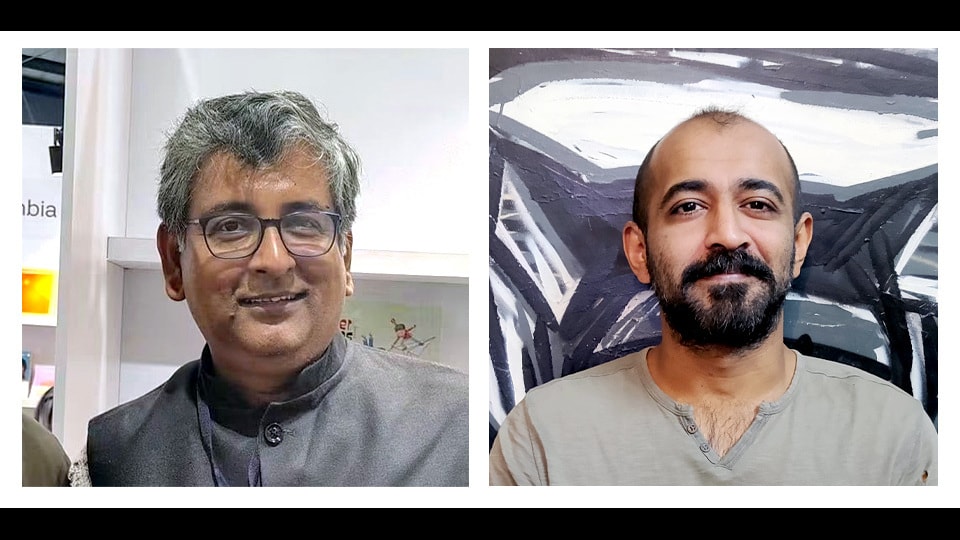
Biswadip Chakraborty: As a publishing house Antonym Collections has a major focus on translation. However, transforming literary texts into graphic form is a special interest with us as well. As we translate from vernacular languages, if we also transform to graphic, we might be able to reach a larger audience, particularly those who are otherwise distant from our culture. Transforming a literary text needs a bit of finesse to keep the authorial voice intact while expressing visually. Capturing cultural nuances is also very critical. I was intrigued by Appupen’s work with Perumal Murugan. We want to do books like that. I wondered how we would build a crop of people who could do this. So, for the anthology, we will have a residency for those who are enthusiastic about the same thing, but need mentoring. It will happen this month, September.
It’s an anthology of short graphic fiction. What do you think this form gives the reader and the writer?
Appupen: A short story can be a complete unit in itself. Probably, some people can enjoy it more; that’s up to them. I was intrigued be this angle of doing local Indian stories and converting them to graphic because I think our visual landscape is unused as yet. If you look at graphic novels, the landscape looks western, like Gotham or New York or generally speaking, a Western sensibility. When I started giving a graphical treatment to Perumal Murugan’s Poonachi, for instance, what I enjoyed was bringing the local Tamil Nadu setting to life in the visual format. It was new to me because I hadn’t seen this landscape in this way before. It’s fresh new territory to translate into the format. If it’s shorter its easier for people who haven’t made too many comics before, and for me to understand their story, for them to coach me and give me the context of their stories. For me, the challenge is to understand where the stories are coming from. The idea is not to dumb it down: ‘Because people are not reading novels, so we are making graphic novels’. There is as much to read in the images as in the text.
You mentioned that you would take up local stories? What does that mean?
Appupen: These will be stories in regional languages. Place and background become essential to the story. So, in Poonachi, the famine and the terrain and the heat. Marking the place as an important character hasn’t been done in Indian graphic storytelling.
Biswadip C: When we have literary texts in vernacular languages, it brings out some of the regional nuances. When you are using graphic, it becomes easier to reach a global audience with the visual rendering of the same. It is kind of giving an extra element to connect with our culture a little more easily. Every medium has its own approach, looking at the text. A lot of things are open for readers to imagine in a novel. When a playwright does it, there is some guidance for the reader. When it becomes a movie, you are able to see only from the director’s angle. In graphic, it falls between play and movie. There is room for imagination. It can deftly incorporate magic realism or myth.
Appupen: The way I tell people is, whatever is written we won’t draw, and whatever we draw we won’t write. Working with Perumal Murugan, for instance, I remember cutting down 3,000 words of description of places and drawing those. Most of the time you can crystallise it down to an image and one line of text.
So that’s the rationale for the anthology and the approach to it. Have the entries opened?
Biswadip C: Yes. There’s been a good response. 24th to 29th September is the residency with Appupen. A micro story has been given for the applicants to attempt. We have only six to eight slots. It’s the beginning of a long journey. We want to bring in people who dream about handling such transformation.
Appupen: There are a lot of creators, but not many people who have sat and completed a 30-plus page story because it is an investment in time. With a recent Westland series of graphic books that I played a small part in bringing out, we had 80-100 entries and selected 20 for publication. The publishing industry is not very helpful. Authors don’t reveal what they make and what is realistic. People spend a year on a graphic novel and realise they will make more money in a month doing advertising work. It is a catalyst for them if there is a programme like this where there is some support and also an assurance that there will be an anthology. That can be a big push for someone who is on the fence. Such programmes and residencies help to retain them and bring them into the niche market. The scene has to grow with more content. We are lacking not only readers but also creators.
Will you select short stories for the anthology?
Appupen: The participants will bring the stories, or we will figure something out with them.
Biswadip C: We will do it depending on the participants. The stories will be chosen from regions and languages they are familiar with. We will offer them the option to select, or we will do it. We have not yet selected the stories.
How would you like this anthology to respond to the current cultural moment?
Biswadip C: One thing we have observed is, globally, there is more interest in reading translated literature. There have been lots of translation workshops over the last five years. There is a greater interest to know about other cultures. During Covid, people were stuck at home and started connecting online. Since then, there has been more interest in translation and translations are coming out from diverse languages. Earlier, only works from four or five major languages were being translated. That is clearly changing. This is a moment to grab, to transform pieces into a different medium.
Speaking of the ‘moment’, Appupen, you are working as creator or jury member or mentor on a bunch of graphic books. Might we say graphic fiction is having a moment in India right now?
Appupen: Yes, I am part of a few projects. These are adaptations from regional Indian writing. Suddenly there is interest in showing Indian stories in graphic format.
I won’t say graphic fiction is having a moment. There is a push for content, and that is because our mainstream has become very strong. Our mainstream has never been so loud in comics and movies. Suddenly, it seems the whole world is watching the same thing. That provides space for more indie/underground content, because sub-streams are getting attention and that is because the mainstream is saturated. So, for example, people are going into Korean dramas or not so mainstream things which become mainstream after some time. Suddenly, we are discovering these Indian themes. If you can enjoy Miyazaki animations set in places like Japan which you don’t know, why not something set in Tamil Nadu? Setting is making things unique. That is happening. But every three-four years, I hear from publishers that graphic novels are having their moment!
Suhit Bombaywala’s factual and fictive writing appears in India and abroad. He tweets @suhitbombaywala.


