
 E-Paper



Review: When it Clicks by Amitabh Pandey
A book that describes how Indian Railways, a solidly public-sector organisation, used e-commerce to change its business paradigm


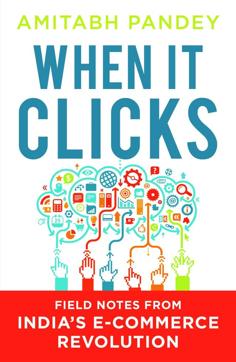
Management books are rarely lightweight (in gms and word count.) This one indeed is heavyweight (in quality of insights shared) but unassumingly light in one’s hands. The subtitle ‘Field Notes From India’s E-Commerce Revolution’ worried me. Much has been written about how India’s e-commerce ‘revolution’ was successfully triggered off by Liberalisation; I wondered if Amitabh Pandey had something new to offer. This book narrates autobiographic ‘field notes’ collected during a career partially spent working in the Indian Railways and describes how this solidly public-sector organisation internalised e-commerce and used it to change its business paradigm. I wondered, and still do to a certain extent, whether the application of e-commerce tricks and techniques in managing the country’s stodgy railroad system makes for a tale sexy enough to interest professionals who pick up management books at airports or buy titles from Amazon. After all, presumably, only a few among them travel by long-haul train and need to carry a book or two to while away time as they chug along.
On introspection, though, this possible weakness is also the book’s strength. Readers’ range of interest is not restricted to familiar subjects and Pandey’s field notes provide insights in areas that the average air traveller will not read about elsewhere. Here’s a nugget from Chapter 3 entitled Introducing E-Commerce To India’s Bricks-And-Mortar Economy: “To nudge the naturally reluctant customer – remember, the unfamiliar is frightening – e-comm needed to offer some huge value-add, enormous discounts or massive convenience compared to brick-and-mortar purchase. In the Indian context reserved railway tickets met all these criteria, most importantly the need for touchy-feely customer interface.” This online facility was a big success. Pandey, who was in the thick of the project, gushes with a forgivable touch of hyperbole that “project implementation didn’t involve any ‘Rocket Science’ yet it brought a massive fundamental change in our economy and society.
By this point, the initial disquiet about the book’s raison d’être was gone and I accepted Pandey’s advice to theorise a little to understand the principal characteristics of e-comm and its likely movement in the Indian business space. A city has countless grocery stores because customers are geographically scattered. To make buying easy, stores must be close to where customers are; this needs many stores all over the city.

The power of the click has spelt the “death of distance” in traditional commerce. Geography is dead too. E-retail operates globally so competition is intense. No wonder Amazon sells every book at a deep discount. Today, price is the only means of vendor differentiation. In the Indian context, Pandey raises two unanswered issues: limited competition and absence of profitability. In Chapter 6 entitled Some Theoretical Musings on E-Commerce, he writes: “One possible narrative told to financiers is as follows: India is a large market and, more importantly, growth possibilities are immense. The consumer has just been introduced to online space and will take considerable time to accept this new way of doing business. She has to be ‘trained’ to accept e-commerce, infrastructure has to be built, the regulatory environment has to develop. A long transition is inevitable.
Read more: Arrive at least 20 min ahead of departure: Just like airports, railways plans to seal stations
To reap the rich harvest of a humongous ecommerce-savvy market, players must play a waiting game of building state-of-the-art platforms, discounting heavily, advertising profusely, capturing market share in customers’ hearts and wallets. Keep faith strong, immense profits will be made.”
Pandey’s last sentence in the book, and mine here, are the same: In election season I hope e-commerce policy makers will set politics aside.
Sujoy Gupta is business historian and corporate biographer


