
 E-Paper



Anthropic’s giant IPO puts the heat on OpenAI
Coding agents are big business. But what comes next?


 Prefer HTon Google


You would forgive the bosses of OpenAI for feeling miffed. Their release of ChatGPT four years ago set the artificial-intelligence boom in motion. Before long countless chatbot imitators had emerged, but none has beaten it in popularity. By last year OpenAI’s annual revenue had soared to $13bn—at the time nearly triple that of its arch-rival, Anthropic.
And yet it is Anthropic, founded by a team of OpenAI secessionists, that this week is expected to raise the largest sum of all time in an initial public offering, with a haul of $90bn. The firm is reportedly aiming for a market value of $1.5trn, topping the $1.3trn at which the still unlisted OpenAI was valued in a recent private fundraising round.
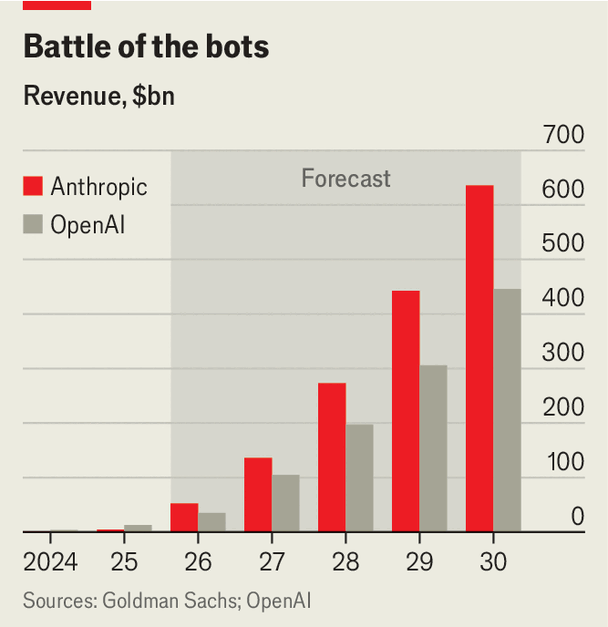
OpenAI may have led the first phase of competition among model-makers, based around chatbots, but Anthropic trounced it in the second phase, where coding agents became the biggest source of business. Claude Code, Anthropic’s software-writing bot, was launched in early 2025, but this year has experienced explosive growth. As a result, Goldman Sachs, the lead investment bank on its IPO, expects the company to pull in $53bn of revenue this year, more than ten times the figure of a year before and comfortably ahead of OpenAI, which expects $35bn (though direct comparisons are tricky, as Anthropic registers all sales through cloud partners as revenue, whereas OpenAI strips out the share it pays over to them).
Nonetheless, the past few years show how quickly leads can be lost in the fast-evolving AI market. Use of OpenAI’s own programming tool, Codex, has grown rapidly in recent months. More important, with both model-makers hunting for their next big source of revenue, a new phase in the competition looks set to begin. Anthropic and OpenAI are eagerly pushing to expand the use of agents into all corners of knowledge work. But OpenAI is also betting on a number of other means of monetising its technology. Which strategy will win out?
Both companies are counting on blistering growth in the years ahead to justify their valuations. Goldman Sachs projects that Anthropic’s annual revenue will hit $636bn in 2030; William Blair, an investment bank not working on the IPO, forecasts $414bn. OpenAI, for its part, recently told investors it was shooting for $446bn in 2030.
Having lost ground to its main rival for much of the year, OpenAI has lately been picking up the pace. Last week the company told investors that revenue from its enterprise sales doubled in the third quarter compared with the preceding three months, helped by price discounts intended to undercut Anthropic.
For the pair, however, enterprise spending remains concentrated. Revenue from agents currently adheres to an “extreme power law,” says one Anthropic investor. The biggest customers contribute an unusually high share of sales, and the heaviest users within those companies—who are nearly always software engineers—are behind much of the spending.
That poses a risk if these users switch to cheaper models, as many have begun to do. But it also suggests that there is still plenty of scope to extend adoption. This year Anthropic and OpenAI have both rolled out general-purpose enterprise agents that non-coders can use to perform a wide variety of tasks. And in addition to working with the consulting giants, the model-makers have set up their own independent advisory businesses, with private-equity backing, to help customers deploy their technology. A person familiar with Anthropic’s Ode, which is supported by Blackstone and Hellman & Friedman, says that more than half of the clients it has helped to redesign their processes have boosted their profits by at least $10m. Last month Anthropic established a separate consulting venture with Hg, another private-equity firm, focused on Europe.
Aaron Levie, chief executive of Box, a cloud-storage company that works with both AI labs, reckons that having “the right kind of product experiences with the right sales efforts” could prove even more important than having the best models. Even so, the models will still matter—and here Anthropic holds a clear lead. Investors in both companies reckon that performance on “long-horizon” tasks that take several hours or even days—such as building an app from scratch—will become increasingly important for the frontier labs as businesses make greater use of less capable models for simpler work to keep costs down. On MirrorCode, one long-horizon benchmark, OpenAI’s leading model, which it released last month, is still outperformed by the top offering from Anthropic as far back as July.
That may reflect Anthropic’s more specialised research programme. Whereas OpenAI has sought to remain at the frontier across a wide range of capabilities, including image and voice, Anthropic has focused on the ability of its models to write code and interact with other software.
That, in turn, highlights an important difference in the strategy of the two firms. Although OpenAI has sought to regain ground in enterprise applications, the consumer segment remains a priority. ChatGPT has 1.2bn weekly users worldwide, almost 100m of whom pay upwards of $8 a month for a subscription. Even those who don’t pay provide OpenAI with revenue via the advertising business it launched in February, which by August had reached an annualised revenue of $1bn.
By contrast, Anthropic’s IPO prospectus barely mentions consumers. It has sworn off advertising, worrying it could muddy Claude’s ability to give helpful answers and incentivise the company to build addictive products.
That leaves OpenAI with a bigger addressable market. But its approach has its drawbacks. In the consumer segment OpenAI must also compete with Google, whose Gemini chatbot has gained ground over the past year, as well as personal agents such as Instinct and Meta’s Muse, which have lately beguiled users with their ability to take on tasks from arranging a dinner with friends to securing sold-out concert tickets.
OpenAI has deprioritised some efforts, including by shutting down its video-generation tool, Sora, in March. But it continues to pursue a strikingly broad set of opportunities. In the coming year it is expected to unveil a device—a small doughnut-shaped speaker—that consumers can use to interact with its AI systems. It is also developing a humanoid robot for good measure. The danger is that it spreads its focus and resources too thinly. Unlike Anthropic, which generated its first quarterly operating profit in the second three months of this year, OpenAI remains deep in the red. It will need to follow its rival into the public markets as soon as it can.


