E-Paper



New Delhi’s AI moment: Inside India’s bid to rewrite the global AI playbook
A central theme of the India AI Impact Summit is Sovereign AI to move the conversation from “doomsday scenarios” to “AI for All”.

 Prefer HTon Google


At the Bharat Mandapam—the same stage where the G20 shifted the global tectonic plates—India is preparing to host what is being billed as the “Bretton Woods moment” for the silicon age.
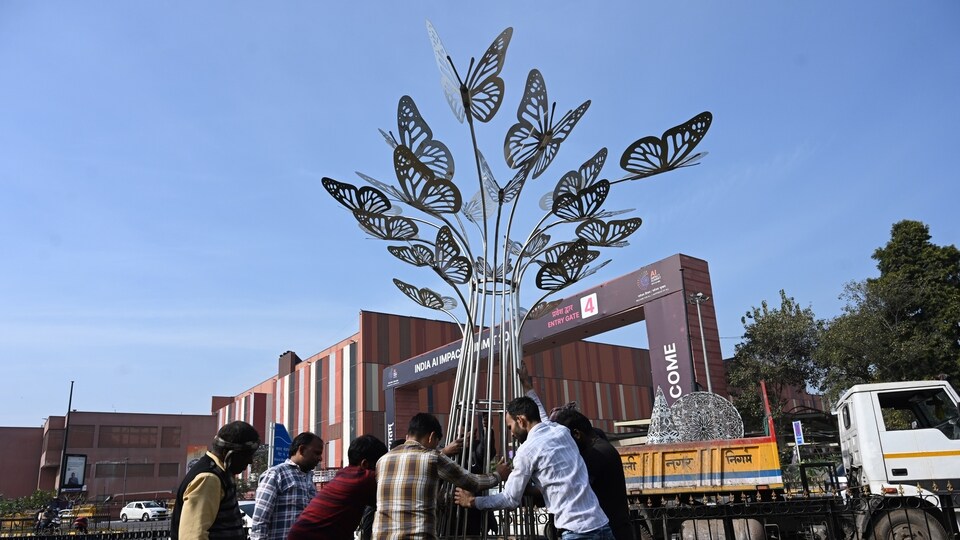
Starting tomorrow, the India AI Impact Summit will transform New Delhi into the gravity centre of the technology world. While previous summits in Bletchley Park, Seoul, and Paris focused heavily on the “existential risks” of rogue algorithms, India’s pitch is decidedly more pragmatic. In the eyes of the Modi govenrment, AI isn't just a frontier to be fenced in, it is a utility to be deployed—the “electricity” of the 21st century.
For the global investor community, the stakes are binary. As AI begins to bite into the traditional margins of India’s $250 billion IT services sector, the summit represents New Delhi’s formal pivot from being the world’s “back office” to becoming its “AI laboratory”.
The power list: Silicon Valley descends on Delhi
The attendee list reads like a Who’s Who of the generative AI boom: Sundar Pichai (Alphabet Inc.), Sam Altman (OpenAI), Demis Hassabis (DeepMind), and Dario Amodei (Anthropic) are all slated to attend. Their presence — alongside heads of state including France’s Emmanuel Macron and Brazil’s Lula da Silva — underscores a shift in tech diplomacy: A global AI standard cannot do without India’s 900 million internet users and its massive data exhaust.
Prime Minister Narendra Modi, who has increasingly linked Viksit Bharat 2047 goals to technological sovereignty, is expected to engage in a series of closed-door “CEO firesides”.
“The key message,” IT Secretary S. Krishnan told reporters ahead of the event, “is that AI needs to be human-centric. We are pushing for democratic access to resources. This isn't just about safety; it’s about equity.”
The ‘Innovation-First’ Doctrine
Investors are closely watching India’s regulatory trajectory. While the European Union has opted for the “AI Act”—a dense thicket of risk-based classifications—and the US relies on a market-driven executive order model, India is carving out a third way: The Development-First Model.
New Delhi’s “Innovation-First” approach suggests that regulation will be “light-touch” until a specific harm is identified. This is designed to provide a “regulatory sandbox” for the country’s burgeoning startup ecosystem.
“If we need to legislate, we can do it quickly,” Krishnan said, “but our goal is to use existing laws to ensure we don't stifle the very innovation that will drive our growth”.
However, the industry remains on edge regarding recent amendments to IT rules. Issues like mandatory labelling of AI content, accountability for deepfakes, and the liability of platform providers are expected to be flashpoints during the summit’s high-voltage deliberations.
Sovereign AI and India Stack 2.0
A central theme of the summit is Sovereign AI. India is wary of “digital colonialism” — a scenario where a few Silicon Valley giants own the foundational models that power Indian healthcare, agriculture, and finance.
To counter this, the IndiaAI Mission is pumping capital into local compute capacity and “AI Commons”. Recently, PM Modi chaired a roundtable with 12 homegrown startups focused on:
- Multilingual LLMs: Building models that speak India’s 22 official languages, not just English.
- Vertical AI: Specialised applications in healthcare diagnostics and engineering simulations.
- GenAI for Commerce: Using text-to-video and 3D modeling to digitize India’s massive retail sector.
By creating indigenous foundation models, India aims to ensure that its strategic sectors aren't reliant on foreign proprietary black boxes.
The Demographic Edge vs The Displacement Fear
The summit arrives at a period of nerves for India’s tech stocks. Markets have turned volatile as investors weigh the disruptive potential of AI against the traditional “linear growth” model of Indian software exports.
With 65% of its population under the age of 35, India’s demographic dividend is its greatest hedge. The summit will feature more than 700 sessions focused on “Workforce Readiness”. The goal is a massive reskilling pivot: moving millions of coders from “maintenance” tasks to “AI-augmented” development.
The success of this transition is vital. If India can successfully integrate AI into its Digital Public Infrastructure—the same system that gave UPI and Aadhaar—it could set the global benchmark for how a developing nation skips a generation of technological evolution.
The Global South focus
This is the first major AI summit hosted in the Global South, and New Delhi intends to use the pulpit to represent the “Global Majority”.
The expected outcome? A Joint Declaration that moves beyond the “doomsday scenarios” of Western labs and focuses on “AI for All”. Expect proposals for shared compute infrastructure and “Trusted AI” tools that can be exported to other emerging economies in Africa and Southeast Asia.