E-Paper



The iPhone moment for VR tech, is a couple of years away: QWR’s Suraj Aiar
Aiar says AI glasses & VR/AR headset form factors will converge, and tech companies will require expertise of sunglass manufacturers to deliver these products

 Prefer HTon Google


Headworn computing is here to stay, but perhaps as an evolution of anything we’ve seen thus far, including the AI glasses that have been made popular for consumers by tech companies including Meta, and the broader augmented reality (AR) and virtual reality (VR) headsets that Meta and Microsoft in particular have invested in extensively over the years. Indian tech company QWR, which unfolds into a thoughtful name Question What’s Real, has been doing this for many years now. Not that many consumers may have realised, because QWR founded by Suraj Aiar, has kept a sharp focus on enterprise use-cases to deliver as many as six distinct product lines — Vrone.Edu, Vrone.4K Gen2 and Humbl, to name some.
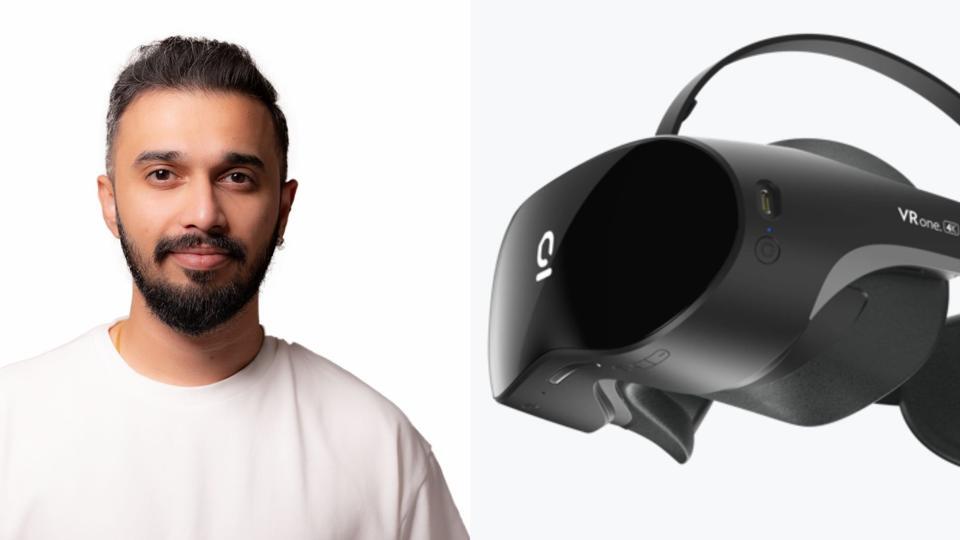
QWR admits, they are far behind the big tech — their 50,000 or so headsets sold over the years to educational institutions, healthcare platforms and even Indian defence solutions firms, pale in comparison to the numbers Meta, HTC and Apple have done. But it is more about balancing a want market and a need market. Specifically on the education front, QWR tells us they’ve partnered with more than 250 KV schools and 10 private Schools across the country, and there are more deals being worked on for this sector. The company’s latest product, the Humbl, are AI-powered sunglasses that hopes to widen AI usage scope when it ships later this year.
The company tells HT that pricing will be “notably lower” than the pricing of the Ray-Ban Meta glasses at this time (that’s around ₹29,900). For Aiar, the chequered flag is as he calls, “the primary problem is that there is no one solution for developers as well as consumers, something we want to change”. Edited excerpts.
Q. At a time when global XR hardware attempts are struggling with profitability, what has QWR done differently to not just buck that trend, but also build when your competition is ‘big tech’ with very deep pockets?
Suraj Aiar: QWR is about eight years old and we have been doing very healthy revenue, especially in the VR segment focused on Enterprise for about four years now. We have created a decent market share for ourselves, especially in domains such as education, healthcare, and defence. How we looked at it was that off the shelf- hardware does not necessarily operate very well in certain categories where it’s not more of a want, but more of a need. For example, in terms of classroom education, we primarily find that inside a classroom, any use of technology is still focused around the teacher. We thought, why don’t we try and integrate technology around the child? The children of today don’t necessarily need to type on a keyboard. When they are getting a job 10 years or 15 years from now, they probably might be wearing a head-worn computer.
The fact that a head-worn form factor is not going away anytime soon, or at least with the big bucks that have already gone into it, make that the constant. That computer form factor is going to be there. We can try to make a mark. Of course, there is Meta operating in the space, but then, because it’s off the shelf approach, there may be a lot of compliances that they may be in breach of when they try to enter segments that we operate in. Education, healthcare, and defence, being the primary sectors that we have been operating in. It has not been easy to survive and make a name for ourselves.
Q. You’ve announced Humbl, which would be a competitor to the Ray-Ban Meta, and there’s also the upcoming Android XR. How did you approach development of this product, and what core areas did you wish to address, building towards mass adoption?
SA: At this point in time, we are trying to attract more developers.
We have understood primarily, since I’ve used every single AI glass that has ever been to market, that there is no open ecosystem for developers to try and experiment with. For instance, Meta is also operating with a closed ecosystem.
Android XR (an operating system developed by Google for extended reality, or XR devices) has been delayed significantly and there is still time before those products come to market. We’re trying to take the hardware platform, something of a hardware as a platform (HaaP), which is hardware as a platform, where we will open and SDKs (also called software development kits, which is a collection of tools and resources that developers use to build applications for a specific platform) to developers so they can develop applications such as a micro-service they wish for people to use. That’s how we want to create a knowledge base, an application base, and a community-first sort of roadmap.
The idea is to go beyond four or five different use cases, such as point-of-view (POV) video or live translations. That is very less utility for something that costs around ₹30,000. With a different approach, we will try to be very competitive with pricing. We are leveraging a bunch of schemes that are there in India to do that. The operating cost is not as high for us as it perhaps is for Meta, and therefore we are not amortising at that scale.
To be honest, we weren’t very convinced about this technology having enough applications for consumers, because our understanding says the relevance is much more in enterprise. But those applications will only come out when there is more than one QWR. We have to get to a scenario where a thousand developers are building a platform for use-cases for enterprises as well as the consumer stack. We are very malleable like that. We will launch for consumers, but we will keep enterprise as a core focus because we think that there’s a decent amount of revenue.
Q. You mentioned about schemes being used for manufacturing…
SA: It’s pretty early stage and right now, we have only leveraged two schemes,
SPECS as well as PMP. With SPECS, we get a capital expenditure subsidy on the machinery and the factory equipment that we buy, while PMP (or Phase Manufacturing Program) allows us a little bit of customs duty relaxation and bypass some compliance requirements that are generally needed for manufacturing electronics in India. But the hope is that eventually, because our VR and XR business already is thriving, our capital base will be enough to qualify for PLI after this fiscal year. Our consumer product also is a part of that projection and if all goes well, then we will be able to leverage PLI and reduce cost even further.
Q. What are the hardware and software specs for Humbl?
SA: On the software side, we’re using Qualcomm’s AR1 stack and therefore the primary driver-level software comes out of them. The only difference between Meta’s glasses versus our Humbl platform is that you can use any AI model. If you have a ChatGPT subscription, you will be able to log in and use that instead of another model such as Llama. That is also true for Perplexity, Google Gemini, Grok, whichever LLMs you are using. Right now, all the AI products are pushing towards live camera feeds and camera-based interactions. We are trying to allow users that openness to play with any AI rather than keep one.
Q.We’ve seen AR, VR and even virtual computing make some noise, and then fade away. Are consumers ready for smart glasses, and what would be the use-case you expect it to tick off most?
SA: I think of this in two parts. We have a thesis that we don’t go to the want market, but instead go to the need market. There is a need for immersive simulated training environments, be it a factory simulator or a road roller simulator, a plane simulator or something on those lines. There’s a gap there. These professional spaces are thriving right now when it comes to adoption for us at least. The consumer, even though is not ready right now, that’ll change.
Coming to the cameras, the novel camera that everybody is using is the Sony sensor because it’s the only one that can fix the form factor. But in a couple of generations, you will likely hear of an iPhone-quality camera being available on a wearable. That’s probably when the delta consumer usage will seriously skyrocket. And it’s really about deploying patient capital and sustaining in a market to wait until the time comes, till that iPhone moment happens. AI glasses and bulkier AR and VR headsets will converge. It’s not that far, it’s probably about two or three years away. And you see a lot of equity purchases being made towards sunglass manufacturers, because primarily the form factor is very clear, just that they require to understand it at a deeper level.
There’s a lack of understanding from technology operators about how this particular new form factor will work, that’s why Google, Meta, even Lenskart, are either buying equity in a technology company or a technology company buying equity in a sunglass manufacturer. Because there’s a lot of knowledge gap, and that knowledge gap cannot happen without a partnership.