
 E-Paper



Air quality in four Haryana cities worsens to ‘severe’ amid spurt in farm fires
The cities are Jind, Charkhi Dadri, Bahadurgarh and Dharuhera.


As farm fire incidents continued to be reported from across Haryana, the air quality index (AQI) of Jind, Charkhi Dadri, Bahadurgarh and Dharuhera cities on Thursday deteriorated to the “severe” category, according to the Central Pollution Control Board (CPCB).
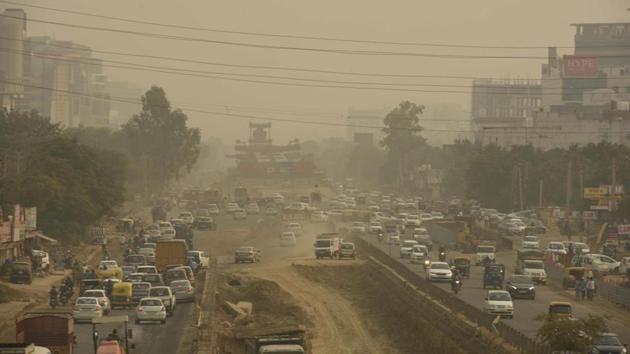
By 4:00pm, the AQI of 10 other cities—Yamunanagar, Rohtak, Panipat, Manesar, Kaithal, Hisar, Gurugram, Fatehabad, Faridabad, and Balllabgarh—had moved into “very poor” zone. The air quality of eight more cities—Ambala, Bhiwani, Kurukshetra, Narnaul, Palwal, Sirsa and Sonepat—was recorded as “poor”.
The AQI between 0 to 50 is considered good, 51 to 100 satisfactory, and 101 to 200 moderate, but the AQI enters ‘poor’ zone when it is between 201 to 300. The AQI is categorised ‘very poor’ between 301-400 mark and it crosses over to ‘severe’ zone at 401.
Haryana had detected 4,211 active farm fire locations until October 30, 2019, prompting the BJP-JJP coalition government to take a slew of steps to stop stubble burning and contain air pollution in the Delhi-National Capital Region (NCR). However, during the ongoing paddy harvesting season that began on September 25, the number of active fire locations have already increased in comparison to the same period last year with 4,837 farm fires (626 more than last year) detected till October 28.
About a dozen-odd Haryana districts are in the NCR and the pollution control board authorities attribute air pollution in the NCR in October-November to multiple factors, including construction, demolition and stubble burning.
Karnal leads in stubble burning
Haryana produces nearly 68 lakh metric tonne (LMT) paddy, including more than 25 LMT basmati, sown on about 32 lakh acre land.
As stubble burning is being blamed for pushing air quality index level in Delhi-NCR to critical levels, the Haryana government has been issuing challans and imposing fine on farmers for burning crop residue.
Listing out eight different steps taken to reduce farm fires, Haryana chief secretary Vijai Vardhan in his October 15 affidavit had assured the Supreme Court that the state government has been taking all necessary steps required to curb stubble burning and to prevent environmental pollution.
As per the latest data of Haryana Space Applications Centre (HARSAC), 114 new Active Fire Locations were detected in past 24 hours. Karnal leads the tally with the highest 872 farm fires in the district.
As per the HARSAC data, between September 25 and October 10, there were 941 active fire locations in the state. This number rose to 2,075 in next 10 days, beginning October 11. And from October 21 to October 28, there were 1821 fresh stubble burning incidences in the state.
After Karnal, Kaithal has the second highest number of farm fires (861), Kurukshetra (756), Ambala (643), Fatehabad (452), Hisar (133), Jind (317), Palwal (77), Sirsa (179) and Yamunanagar (355).
-kMNB-U1021018938041uE-250x250%40HT-Web.jpg)


