
 E-Paper



1 month after floods: Sangli’s poor communities still sinking
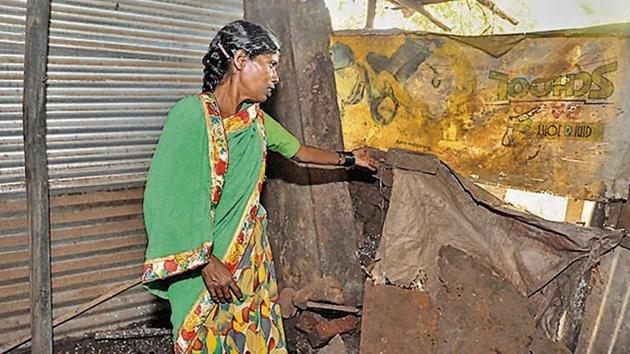
Fallen houses in a state of disrepair, tin shades in place of broken walls, wet floors and a barely existing sewage system greets every visitor of Dhor lane located near Preshit chowk, Haripur road


A month after waters of the swollen Krishna river ravaged parts of Sangli, some of the flood-affected residents of the are still struggling in the aftermath.
The floods claimed 56 lives across the Pune division, that comprises five districts: Sangli, Kolhapur, Pune, Solapur and Satara.
According to administration, 28 persons lost their lives in Sangli with over 87,500 families affected by the floods.
Among the worst hit are among the economically challenged, who are still struggling to return to normalcy.
Fallen houses in a state of disrepair, tin shades in place of broken walls, wet floors and a barely existing sewage system greets every visitor of Dhor lane located near Preshit chowk, Haripur road.
For the residents of this slum area, only a semblance of their life before the flood remains.
The cash-based economy of Sangli city is still reeling from the effects of the flood, as banks and automated teller machines (ATMS) either out of order or out of cash. Of the 392 ATMs in the district, 21 remain out of order while 308 are functional, according to the district collector Abhijeet Chaudhari. However, finding cash in them is difficult, said locals.
No roadside vendors are visible in the market. To find an ATM, one has to travel the length of the market, around the Sangli State Transport bus stop. And it is not functioning.
Subhash Kadam is a resident of Dhor gali, whose bread and butter came from cleaning animal hide used to make drum (dhol) skins.
“This was our only family business and mode of income. I do not know how to recover from these losses. Our families have all stayed in this house for a generation before me and now this house wall has come down,” says 50-year-old Kadam.
Bapu Torne is also like many residents, who lost everything including clothes in flood water.
“You see this saree I’m wearing? It was part of flood relief,” Torne says, underlining that she doesnt have any other clothes left.
Torne’s house walls suffered major cracks during the floods.
While the Ganpati festival is being marked in the upper class areas of Sangli, the effect of the floods is visible to the naked eye as one enters the economically backward and slum areas of the city.
According to district administration, 9,393 houses were completely damaged, while 1,8707 have been affected partially in Sangli.
Sangli district collector Abhijeet Chaudhari said that considering the high productivity of crops, the agriculture loss stands at Rs 1,200 crore.
“We have taken damage assessment from different agencies. The amount which we have to give as a relief fund and in damage to infrastructure comes to around Rs 750 crore. Total damages are Rs 1950 crore. That is the current number. However, it is an ongoing process and I cannot say it is the final number. It may increase, but when we make detailed estimates, it may come down,” said Chaudhari.


