
 E-Paper



Karnataka government silent over HC verdict against Kannada language imposition in UG courses
The government orders on August 7 and September 15 making Kannada a compulsory language had created confusion at the time of admissions to degree colleges in Karnataka in 2021.


Nearly two weeks after the Karnataka high court stayed the government’s proposal to make Kannada a compulsory language for undergraduate courses, the state is yet to decide on the next course of action, people aware of the developments said on Wednesday.
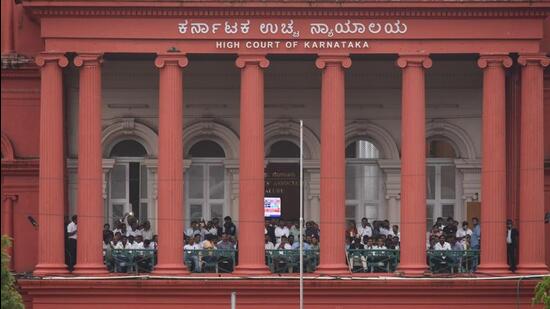
On April 7, a division bench of the high court stayed until further notice two state government orders making the Kannada language a compulsory subject in the higher studies as part of implementing the National Education Policy (NEP) 2020. The order came in the wake of a clarification by the Centre that the NEP does not envisage making the local state language compulsory learning in higher education.
“We (government) were supposed to do a meeting but have not been able to do one yet and no policy decision has been taken since the HC verdict,” said a minister in the Karnataka government, requesting not to be named.
The government orders on August 7 and September 15 making Kannada a compulsory language had created confusion at the time of admissions to degree colleges in Karnataka in 2021.
“In view of the stand of the central government that the Kannada language cannot be made a compulsory subject in higher studies for the purpose of implementing the National Education Policy, we, prima facie, find that the impugned Government Orders dated 07.08.2021 and 15.09.2021 cannot be implemented,” the division bench, comprising Chief Justice Ritu Raj Awasthi and Justice SR Krishna Kumar, had ruled.
Meanwhile, the Kannada Development Authority (KDA), which operates under the Karnataka government, has now moved to implead in the matter independently.
TS Nagabharana, the chairman of the KDA, said that the court is likely to take up the case at the end of June or early July.
“We are asking this not to make them (non-Kannada speakers) as scholars in the language but to live here, they have to know how to communicate in the local tongue. We have divided it into colloquial and scholarly Kannada. This is what we have asked for and not to make Kannada compulsory and this has led to some sort of misunderstanding as it was not represented properly (in court),” he told HT.
The development comes close to the heels of Union home minister Amit Shah’s statement on April 8 that Hindi should be accepted as an alternative to English in Indian states as a unifying language.
“Prime Minister Narendra Modi has decided that the medium of running the government is the Official Language, and this will increase the importance of Hindi. Now the time has come to make the Official Language an important part of the unity of the country,” Shah had said.
The statements courted objections from various political parties and senior leaders across the country as they accused the Union government of pursuing a ‘one-nation, one-language policy’ as a way to make Hindi a common tongue.
Language strikes an emotional chord in Karnataka as it nurses a feeling of neglect for their native tongue under the Prime Minister Narendra Modi-led union government, people aware of the developments said.
Last year in November, the Kannada and culture department issued a notice to Bengaluru Metro after chief minister Basavaraj Bommai was heard speaking in Hindi during his inaugural address in the presence of Union minister Hardeep Singh Puri.
Experts and activists argued that a large part of the disinterest from within the Bharatiya Janata Party comes from the fact that language can rarely attract votes in Karnataka as it does in neighbouring Tamil Nadu, where it forms the core element of the Dravidian movement.
The language protests in Tamil Nadu in 1965 after the then Indira Gandhi-led Congress implemented the Official Languages Act led to the ouster of the party in the state and heralded the then undivided Dravida Munnetra Kazhagam (DMK) to power under its founder CN Annadurai.
“Language has never been an electoral matter in Karnataka the way it is in Tamil Nadu and its Dravidian politics. In Karnataka, it is more or less a matter of symbolic and emotional value without serious implications for voting patterns,” Professor Chandhan Gowda, Ramakrishna Hegde Chair professor at the Institute of Social and Economic Change (ISEC), said.
Even the BJP in Tamil Nadu has taken a strong stand against any proposal to make Hindi the ‘link-language’.
“There’s no compelling situation to learn a language and prove that one is an Indian. One can learn Hindi or any language when it concerns employment or livelihood issues,” K Annamalai, the TN state BJP president, had said earlier.
In stark contrast, the BJP in Karnataka, the only state in the south to have a saffron-led government, is yet to take a stand on the controversy.
“It is very important that primary education be given in Kannada so it has to be given priority,” V Sunil Kumar, Karnataka’s minister for Kannada and culture department told HT.
He, however, said that Shah had said that while talking to other states, there was “nothing wrong” about speaking in Hindi – mirroring the sentiments of several of his cabinet colleagues.
In the 1980s, V.K. Gokak, a Kannada scholar and Jnanpith awardee had recommended making Kannada the first language in Karnataka over Sanskrit, which threatened to overshadow the local language. The then Congress government, headed by chief minister R. Gundu Rao, was forced to accept the recommendations after the agitation gathered strength.
But it has rarely converted into votes and has been sidelined for organising protests against the Maharashtra Ekikaran Samiti, the separatist Marathi-speaking outfit in Belagavi, and any decision associated particularly with the river Cauvery.
In 2017, the then Siddaramaiah-led Congress government had also taken up the issue to remove Hindi on Metro signboards. Factions like Karnataka Rakshana Vedike (KRV), a pro-Kannada group that locks horns with the Maharashtra Navanirman Sena’s (MNS) in the north-eastern part of the state and with pro-Tamil groups in the south, set aside differences and met in Bengaluru for a roundtable to chart out the course to fightback any imposition of Hindi by the Modi-led union government.
Many Kannada literary personalities suggested that the movement continues in other places like Tamil Nadu, Kerala and Mumbai to ensure awareness on the subject.
Historically, Tamil Nadu’s two main Dravidian parties are the only ones to have successfully parlayed anti-Hindi sentiment into political capital. Late Shiv Sena chief Bal Thackeray also succeeded to a certain extent.
Karnataka, particularly Bengaluru, attracts a large number of workers operating in the ecosystem that includes delivery personnel, app-based cab operators, construction workers and others who come to Karnataka in search of better employment opportunities and a better quality of life for themselves as well as their families.
There is also a demand that employees working in the many global corporations in Bengaluru also imbibe Kannada into their daily activities, which is largely done currently in English.
“Inside Karnataka, those who are working here and coming from outside should speak in Kannada,” Prof (retd) Vivek Rai, who taught Kannada for nearly four decades in several varsities, including Hampi Kannada University, said.
Stay updated Bengaluru Weather Live and with all the Breaking News and Latest News from Bengaluru. Click here for comprehensive coverage of top cities including Delhi, Mumbai, Hyderabad, and more across India . Stay informed on the latest happenings in World News.


