E-Paper



Madhya Pradesh budget: ₹4.38 lakh crore with welfare, infrastructure push
Madhya Pradesh presents ₹4.38 lakh crore budget with Krishna-inspired schemes, farmer welfare, rural development, new medical colleges, and infrastructure boost

 Prefer HTon Google


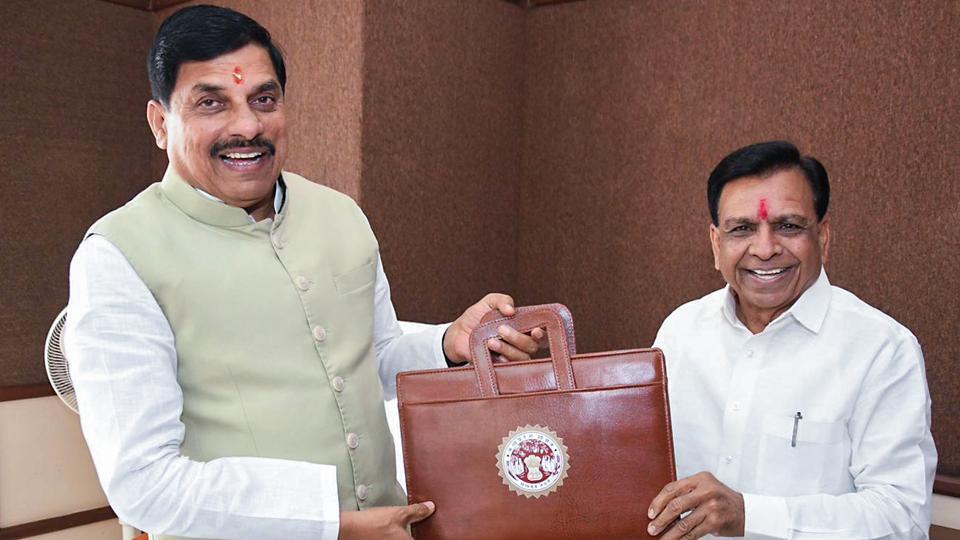
Bhopal: Finance minister Jagdish Devda on Wednesday presented a ₹4.38 lakh crore budget in the Madhya Pradesh Legislative Assembly, announcing welfare and infrastructure initiatives, including milk distribution under the mid-day meal scheme and major allocations for rural and urban development.
The estimated revenue receipts were ₹3,08,703 crore, which include the state’s own tax revenue of ₹1,17,667 crore, the state’s share of Central taxes at ₹1,12,137 crore, non-tax revenue of ₹24,394 crore, and grants-in-aid from the Centre of ₹54,505 crore. The budget reflects a 10.69% increase over the 2025–26 estimate. The BE for 2026-27 is ₹3.89 lakh crore, an increase of approximately 7.5% over the RE of ₹3.53 lakh crore in 2025-26.
Capital expenditure has been pegged at ₹1,06,156 crore, with a revenue surplus of ₹44.42 crore. The largest allocation has been made to Panchayat and Rural Development at ₹40,062 crore, including a separate budget for Viksit Bharat – Guarantee for Rozgar and Ajeevika Mission (Gramin), a scheme that replaces MG-NREGA. The BJP-led state government increased the budget for improving the standard of living by 22%, followed by 21% for health and 10% for education.
The finance minister announced three schemes inspired by Lord Krishna — the Yashodha Scheme of ₹700 crore, under which milk will be provided to students of Classes 1 to 8 in mid-day meals; the Dwarka Scheme of ₹5,000 crore for infrastructure development; and the CM Vrindavan Village Scheme of ₹104 crore.
The government has increased allocations for schemes dedicated to Scheduled Tribes by 25.8% and for schemes dedicated to the Scheduled Caste community by 17%. The Madhya Pradesh government will spend ₹1.15 lakh crore on farmer welfare and ₹1.06 lakh crore on infrastructure development.
For the first time, the Madhya Pradesh government institutionalised a budget process based on the Multidimensional Poverty Index (MPI), developed by NITI Aayog, which measures poverty not just by income, but across 12 key indicators of health, education, and standard of living.
Jagdish Devda said that, for the first time, Social Impact Bonds of ₹40 crore will be listed on the National Stock Exchange to encourage investment in the social sector by service providers.
He also announced new medical colleges under the Public-Private Partnership (PPP) mode in Bhind, Morena, Khargone, Ashoknagar, Guna, Balaghat, Tikamgarh, Sidhi, and Shajapur. The budget allocates ₹3,060 crore for Simhastha, a religious congregation to be held in 2028 in Ujjain. It includes distribution of solar pumps to one lakh farmers, ₹12,690 crore for road repairs, and ₹4,454 crore for the Jal Jeevan Mission. The state government has also restarted the Mukhyamantri Awas Scheme with an allocation of ₹100 crore.
Focusing on forest conservation and plantation, new dedicated schemes include Samriddhi Van — a plantation drive to promote forest growth after removal of encroachments from forest land; Krishi Vaniki Yojana — plantation on private land to meet timber requirements and enhance income opportunities; and Janjatiya Devlok Forest Conservation Scheme — aimed at conserving forest areas of spiritual and cultural significance, said Jagdish Devda.
Chief minister Mohan Yadav expressed pride in introducing initiatives in the name of Lord Krishna. He said, “Madhya Pradesh is progressing in line with Prime Minister Narendra Modi’s vision of development. It is a surplus budget that will change the face of MP. As many as 50,000 people will be recruited in different departments by the government, so the budget has a focus on employment generation as well.”
However, leader of the opposition Umang Singhar criticised the budget, claiming that state debt now equals the budget size. He said, “The budget is uninspiring and lacking focus on public welfare, pointing out the deteriorating condition of health facilities and the absence of major announcements in that sector.”
As per the budget documents, the tax collected in the 2025-26 revised estimate (RE) was ₹1,00,020 crore, compared to ₹1,17,667 crore in the 2026-27 budget estimate (BE). The fiscal deficit as a share of GSDP for 2025-26 BE was 4.6%, RE was 4.45%, and for 2026-27 BE it is 3.87%.