
 E-Paper



Carbon neutral by 2030 goal: Chandigarh to conduct study on pollution trends, formulate combat strategy
Under the National Air Quality Monitoring Programme of the Centre, the Chandigarh Pollution Control Committee (CPCC) has invited bids to carry out a study on source apportionment, emission inventory, and carrying capacity related to pollution levels and sources within the union territory


In a significant step towards attaining its goals of becoming carbon neutral by 2030, the City Beautiful, will take up a study to analyse the increase in pollution levels within the city and arrive at appropriate measures to mitigate the menace.
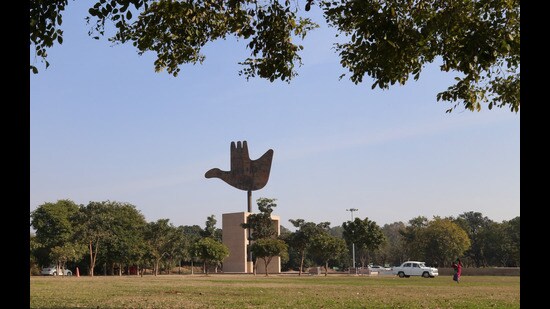
Under the National Air Quality Monitoring Programme of the Centre, the Chandigarh Pollution Control Committee (CPCC) has invited bids to carry out a study on source apportionment, emission inventory, and carrying capacity related to pollution levels and sources within the union territory (UT). The study is expected to be completed within 18 months from the commencement of the work.
The same comes in the backdrop of air quality data showing that the concentration of particulate matter in Chandigarh exceeds the permissible limits set by standards over the years.
Vehicular pollution in focus
A landlocked city, Chandigarh has the highest density of vehicles in India, with more than two vehicles per capita household. Unsurprisingly then, previous studies have indicated that vehicular pollution is the primary contributor to the city’s poor air quality.
Other major sources of air pollution in Chandigarh include roadside dust, burning of dry leaves, litter from trees and gardens, operation of generator sets in certain areas adjacent to the city, and stubble burning in neighbouring areas during specific seasons of the year.
An official emphasised the need for realistic emission factors and vehicle utilisation factors to conduct real-life emission inventories and source apportionment studies, adding that given the complexity of air polluting sources, including industries, automobiles, generator sets, fuel burning, and construction activities, it is crucial to determine the contribution of each source to ambient air pollution.
The information is essential for planning effective and cost-efficient control strategies.
The source apportionment study will specifically focus on respirable particulate matter (PM10 and PM2.5) due to its critical impact and its outcomes will further serve as input for source apportionment studies conducted in Chandigarh.
The main objective of the study is to identify the major sources of air pollution, assess their contributions, and suggest mitigation measures. The study will consider techno-economic feasibility and other social factors while proposing these measures.
Hotspots to be identified based on pollutant
The study will also analyse the ground level concentration (GLC) of air pollutants in different areas of the city, including background, residential, commercial/mixed areas, and specific pollution “hot spots” related to particular sources.
Besides, the study will contribute to the development of emission factors (EF) for different vehicle categories, considering variations in fuel quality, technology, size, vintage of sources, and control systems. It will also aid in selecting appropriate emission factors for non-vehicular sources such as industries, industrial and domestic fuel combustion, roadside dust, construction activities, and generator sets.
Throughout the study, an inventory will be prepared for different air pollutants, documenting their emission rates and pollution loads from various sources. The study will also analyse the spatial and temporal distribution of these pollutants within the city.
The impact of pollution sources on air quality will be assessed under different management, intervention and control options.
Major contributors to air pollution in Chandigarh
*Vehicular density
*Roadside dust
*Burning of dry leaves
*Litter from trees and gardens
*Operation of generator sets in certain areas adjacent to the city
*Stubble burning in neighbouring areas during specific seasons of the year


