
 E-Paper



Chandigarh: Supreme Court stays HC order on verandah construction
The apex court also stayed the December 13 order whereby the high court had issued contempt notice to Chandigarh chief engineer CB Ojha for not commencing the construction work within two weeks

 Prefer HTon Google


The Supreme Court on Friday stayed the Punjab and Haryana high court’s November 29 order directing construction of a verandah outside the chief justice’s court on its premises.
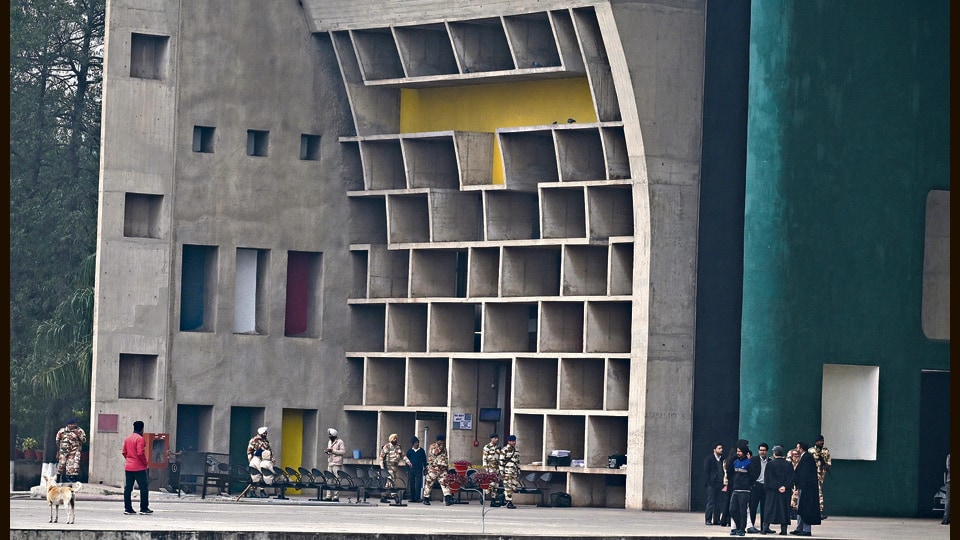
The apex court also stayed the December 13 order whereby the high court had issued contempt notice to UT chief engineer CB Ojha for not commencing the construction work within two weeks.
The top court acted on the plea from the Chandigarh administration, which argued that if the HC order was implemented without UNESCO approval, it may lead to losing the World Heritage tag.
The HC building is part of the Capitol Complex, designed by acclaimed French architect Le Corbusier, and was designated a World Heritage site in 2016. Construction at a heritage site is prohibited without approval from the UNESCO World Heritage Committee.
However, on November 29, the HC had issued directions for construction of roughly 5-metre verandah at the frontal façade of the chief justice’s court (court room 1). Construction work was ordered to be started within two weeks. Currently, a verandah exists only in front of court rooms 2 to 9.
The need for another verandah was felt as the open space outside court room 1 inconveniences visitors, especially during rain. The chief justice’s court is separated from the block having eight other courts.
In the appeal before the apex court, UT argued that the high court, while directing the Chandigarh administration to construct verandah outside court room 1, had ignored the fact that UNESCO designated World Heritage sites of outstanding universal value to cultural or natural heritage that had been nominated by countries, which were signatories to the UNESCO World Heritage Convention.
“The high court has also not considered that the Chandigarh administration has been most receptive to the institutional needs and requirements of the Punjab and Haryana high court. ..the Chandigarh administration in spite of being hard pressed for land has allotted a plot of 15 acre for Punjab and Haryana high court branches,” the petition filed before the apex court read.
UT further argued that HC passed the order on November 29 even as it was apprised that UT’s heritage panel had given the nod to the project and matter had been sent to the Archaeological Survey of India, the nodal agency to take up issues with UNESCO.
The HC order had come during the hearing of a 2023 public interest litigation (PIL) filed by Vinod Dhaterwal, an office-bearer of the high court employees’ association, demanding infrastructure development of the HC complex in the wake of increasing traffic congestion, space crunch and implementation of the holistic development plan.
The plan, conceptualised more than a decade back, envisages setting up of multi-storey buildings to cater to the requirement of additional space at the high court complex. However, the plan had to be put on hold as the Capitol Complex was declared a World Heritage site in 2016.
The Supreme Court, while deferring the hearing, issued notices to various parties returnable within two weeks and said HC can proceed with the PIL, but not in respect of order on construction of verandah and contempt notice issued to Ojha.


