
 E-Paper



Cotton in flowering stage, farmers must stay vigilant : Experts
Following pest attacks since 2021, this kharif season area under cotton has slipped to the lowest ever in Punjab to about 95,000 hectares.


Incidents of pink bollworm growth have been reported in cotton fields across the southwest districts of Punjab as the ‘white gold’ crop has entered its flowering stage.
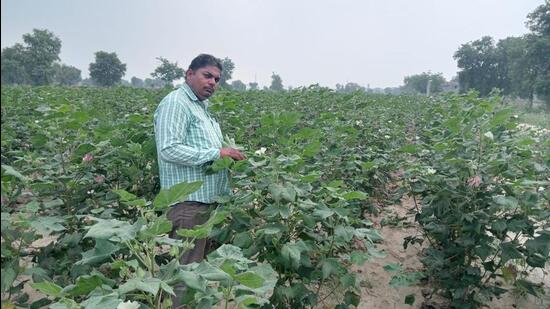
Experts at Punjab Agriculture University (PAU) and state agriculture department have said that there is no immediate threat to the crop as the current climate conditions are contributing to good growth. They asserted that the coming week is crucial for pest management as the crop has entered its flowering stage.
PAU principal entomologist Vijay Kumar said on Monday that based on the field inputs sent by the farm scientists, the pink bollworm has been spotted in different parts of the cotton belt. “Its presence indicates that its next generation may turn up next week. Farmers need to keep an eye on the crop that is in the flowering stage. Cotton crops are vulnerable to pink bollworm attack from the flowering stage and timely use of insecticides might prevent loss of the crop,” Kumar added.
Threat of whitefly, another pest and a serious challenge to the cotton crop, has subsided considerably after a series of showers in the semi-arid region, the expert added.
Following pest attacks since 2021, this kharif season area under cotton has slipped to the lowest ever in Punjab to about 95,000 hectares.
Experts said that the pest infestation is imminent since the pink bollworm has developed resistance to the Bt cotton.
Vinay Pathania, assistant professor (plant protection) at Bathinda Krishi Vigyan Kendra (KVK), said that after the bollworm attack in 2021, apprehension of infestations proved right in the next two kharif seasons when the cotton faced crop loss. “Integrated pest management is the only solution against bollworm attack this time,” he added.
Fazilka chief agriculture officer Sandeep Rinwa said field teams are undertaking surveillance every Monday and Wednesday to create awareness against pest attacks of the crop.
Fazilka has 55,000 hectares, the highest acreage this season, and about 16,000 hectares of land has been diverted from conventional cotton farming towards rice cultivation.
“Owing to poor crop season in the last three years, Abohar, Jalalabad and Khuian Sarvar block farmers have shifted to basmati and parmal varieties. We will try to motivate them to shift again towards cotton in the next season,” Rinwa said.
Rinwa said that cotton plants have gained a height of up to 3 feet and despite a decrease in the area under cotton, good production is expected this year.
Bathinda chief agriculture officer Jagsir Singh confirmed that bollworms have been detected in a few villages and constant monitoring is underway.
He denied a trend where farmers uprooted cotton crops after a massive pest infestation. “Only three cases came to light in which a farmer from Giana village ploughed only five canals out of his 14-acre cotton field due to non-spray of pesticides. A farmer from Tungwali claimed on social media of uprooting crops but a spot visit found his crop on 3-acres. In another case from Bhagi Wander, a farmer already had a nursery prepared to sow PR 125 rice variety and tried to give an impression of pest attack that went out of control,” Singh added.


