
 E-Paper



Monsoon mess: Down the drain in Dera Bassi, Zirakpur
Encroachments along Sukhna Choe, which was earlier 4,500 feet wide, have reduced it to a little over 100 feet in the periphery of Chandigarh. With no drainage, the recent rain left residents marooned, but who will pay for it?


The recent spell of heavy rain and resultant flooding in Chandigarh’s periphery of Zirakpur and Dera Bassi that left residents high and dry was a tragedy waiting to happen given the rampant construction right on the course of the seasonal Ghaggar river and its tributaries.
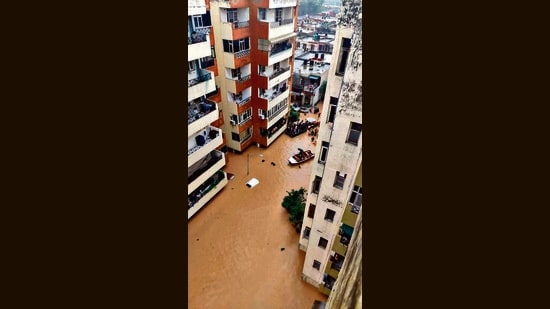
Over the past decade, these towns have grown as commercial and residential hubs when the infrastructure does not support it. The builders are either lawmakers themselves or moneybags who make checking indiscriminate construction a challenge.
Jaswant Singh Lambardar, a resident of Baltana in Zirakpur that falls in Mohali district, who had filed a petition in the Punjab and Haryana high court in 2010 seeking the removal of encroachments from Sukhna Choe and other natural drainage areas, says that the recent flooding was only waiting to happen. “This is a self-inflicted calamity and it is the common man who bears the brunt,” Lambardar said.
In the petition that he filed with six other old residents of Baltana over a decade ago, it was stated that the shamlat (village common) land had been encroached upon by land mafia since the early 2000s.
It was submitted that hotels, unauthorised colonies and shopping malls had come up in the land mentioned as “gair mumkin nadi’ or seasonal rivulet in revenue records.
“The encroachment on the choe and other natural drains has led to this situation,” he said, adding that the Sukhna Choe, which was earlier 4,500 feet wide, had been reduced to merely a little over 100 feet as a result.
The court’s order to remove the encroachments has still not been complied with by the respective administrations.
Dolly Chopra, a mother of a two-year-old girl who stays in an apartment in Zirakpur, regrets her decision of buying property in the town. “Every time it rains, the streets of Zirakpur get flooded due to poor drainage. The potholes only add to the misery of commuters. The common man cannot afford to buy a house in Mohali or Chandigarh, so living in Zirakpur appears to be a compromise,” she said.
Ravneet Singh, executive officer, Zirakpur, “A storm water pipeline was connected with the sewage pipeline, which resulted in sewerage blockage and waterlogging. Four super suction machines have been hired on contract to clear the choked lanes. The snag was fixed and work is in progress so that rainwater directly flows into Sukhna Choe. This will help tackle waterlogging immensely in future.”
Towns with no drainage
The visuals of a marooned Gulmohar Enclave residential society in Dera Bassi were widely circulated last Sunday as cars bobbed in flood waters that threatened to reach the first floor. Boats were out and a tractor-trailer was seen helping evacuate panic-stricken residents.
A school teacher who lives in the locality, Nikita, was among the residents forced to vacate her house. She, along with her children, has been staying at a relative’s place for the past three days. “Earlier, the authorities of the society used to drain out the water on the road, using a motor pump, but this time the overflowing Ghaggar river broke the boundary wall of the colony and the water got accumulated in the society at night itself, giving us no time to react,” she said.
Amit Bawa, a Punjab Congress leader and local resident, blamed the regularisation of illegal colonies was the main reason behind flooding in Dera Bassi. “While these illegal colonies and commercial establishments were regularised, no plans were made to ensure a proper drainage system for these localities,” he said.
“The flooding in Gulmohar Society was caused due to a breach in Ghaggar river. The gushing water broke the wall and it entered into the colony. Essential supplies are being provided in areas where water entered due to the breach. Water is being drained out from low-lying areas,” said Himanshu Gupta, SDM, Dera Bassi.
Concrete jungle eats into choe
Once envisioned as a green belt around Chandigarh, the periphery has ended up becoming a concrete jungle that has encroached upon natural drainages.
“The flooding occurred because no attention was paid to the natural drainage slopes, which constituted the watershed areas of the choe and rivulets that formed the network of drains into which excess rainwater flowed in the pre-1966 days. In fact, none of the natural drain lines are visible today. These concrete jungles have eaten up the original drainage network that has simply disappeared,” said Bawa.
“The mafia of politicians, bureaucrats and builders sold the shamlat land and even the choe that served as a natural drain. Water entered residential societies and villages and people suffered losses running into lakhs of rupees. Elderly residents living on the ground floor are worst-hit. Hundreds of cars have been damaged. Who will pay for this? I am going to write to chief minister Bhagwant Mann for a probe into this scam of selling the drain,” said Kuljit Singh Randhawa, AAP MLA from Dera Bassi.
What caused the deluge
Rampant encroachments along Sukhna Choe and other natural drains that have massively reduced their width and pervious land, thereby decreasing their water storage capacity, increasing rainwater runoff and obstructing drainage
Absence of adequate drainage system to keep up with rise in colonies and commercial establishments
Swollen Ghaggar river breaking the wall Gulmohar Enclave residential society past midnight on July 8, leading to 10 feet water
What needs to be done
Removing encroachments along natural drains
Laying of adequate storm drainage system, especially in illegal colonies that were later regularised
Regular cleaning of existing drainage system
Check on rising level of roads that leads to flooding in houses
Keeping super suction machines readily available
On the periphery
Dera Bassi is a tehsil in Mohali district of Punjab on the Chandigarh-Delhi national highway. The town has a population of nearly 2 lakh.
Zirakpur, spread over 43.15 square km, is a fast-growing township in Mohali district with a population of over 2.5 lakh.


