
 E-Paper



Chiseling of soil for better yield: PAU V-C
Punjab Agricultural University (PAU) vice-chancellor Satbir Singh Gosal urged the farmers in the state to turn to ‘chiseling’ as continuous puddling of the soil for rice cultivation has led to the formation of a hard pan in the upper soil layer


Rice and wheat cultivation has been a primary practice for the farmers of Punjab for the past few decades. However, continuous puddling of the soil for rice cultivation has led to the formation of a hard pan in the upper soil layer, around 15 to 20 cm, reducing water purification. This may cause problems for root growth and in turn, decrease yields in the future crops.
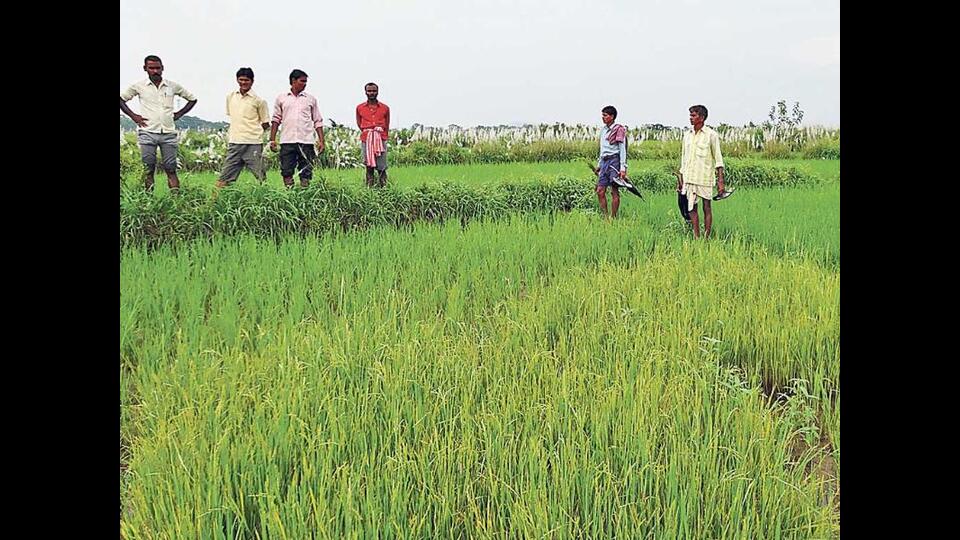
Punjab Agricultural University (PAU) vice-chancellor Satbir Singh Gosal urged the farmers in the state to turn to ‘chiseling’ in order to overcome these challenges. Elaboration on the process, Gosal said that chiseling is a deep tillage technique that loosens the subsoil without inversion. This enhances the infiltration rate of the soil, allowing denser and deeper root growth for better utilisation of water and nutrients, increasing crop yields. He pointed out that the perfect time for the process was after harvest of the wheat crop.
“This farming technique can be a game-changer for farmers in Punjab, providing a solution to the challenges faced in rice-wheat cultivation and improving yields for a more sustainable future”, he added.
Ajmer Singh Dhatt, director of research, gave an overview of soil in Punjab. He said that about 60% of Punjab’s soil is coarse-textured and has high bulk density. On drying, it leads to high soil strength, restricting root growth. This leads to a reduction in crop yields. He added that even heavy or fine-textured soil presents issues with water transmission into the soil due to high clay content, causing water stagnation and aeration problems, and limiting the proliferation of plant roots. He warned that the development of this sub-surface hard pan because of continuous puddling may take a toll on the upcoming yield of the wheat crop.
Dhanwinder Singh, head of department of soil science, further explained the process and said that chiseling is done up to a depth of 40- 45 cm at a specified spacing, 100 cm for sugarcane and 35-40 cm for maize and other crops. According to research conducted at the university, this enhances the yield of crops like maize, 10-100%, wheat, 10-15%, sugarcane, 15%, sunflower, 10-15%, soybean, 5-15% and raya, 5-15%. He added that the benefits of deep tillage are more significant in soils with higher sand content, limited-irrigated conditions, and during the summer or Kharif season.
Meharban Singh Kahlon, principal soil physicist, advised that chiseling should be done in drier soil to achieve maximum loosening and care should be taken to ensure that chisel marks are not compacted by tractor wheels. Talking about the economic burden of the process, he said that it costs between ₹ 600 and ₹ 1000 per acre, depending on spacing. He added that chiseling should be done at intervals of 2-3 years to achieve sustainable gains in crop productivity.


