
 E-Paper



Punjab: Storage worries mount amid reports of bumper paddy crop
This season, the paddy has been cultivated over the highest-ever acreage of 32.76 lakh hectares (over 80 lakh acres), with the procurement target set at 180 lakh tonnes

 Prefer HTon Google


The agriculture department’s prediction of a bumper paddy crop in Punjab this Kharif season last week has set alarm bells ringing for the state’s food and civil department, which is grappling with a paucity of storage space.
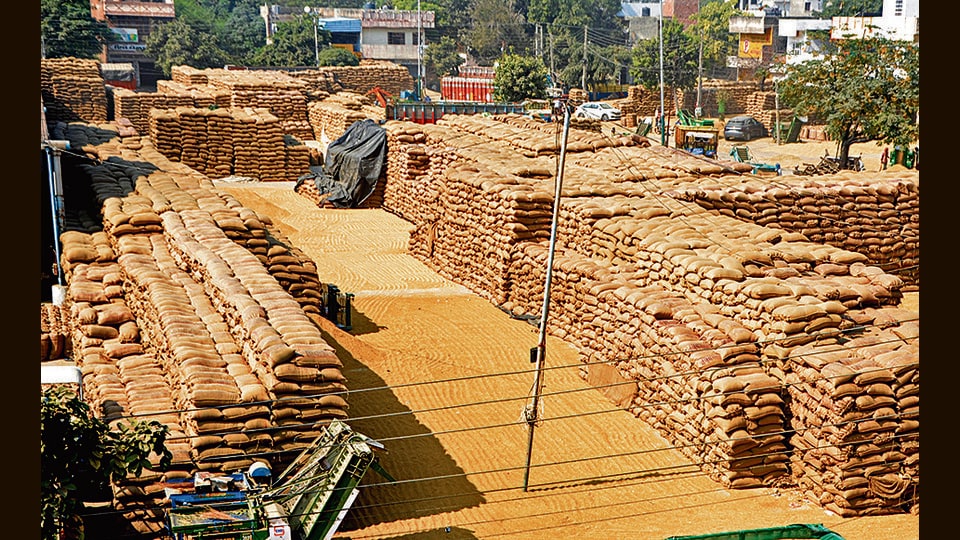
This season, the paddy has been cultivated over the highest-ever acreage of 32.76 lakh hectares (over 80 lakh acres), with the procurement target set at 180 lakh tonnes. The crop is expected to start arriving in the state mandis from October 1, while state warehouses already hold 155 lakh tonnes of rice from the previous three seasons. Another 30 lakh tonnes of paddy from the last season are awaiting shelling at the mills, which will add around 20 lakh tonnes of rice to the existing pile.
The godowns also hold 116 lakh tonnes of wheat. To put things in perspective, against a total warehouse capacity of 180 lakh tonnes, Punjab is presently holding around 271 lakh tonnes of foodgrains, forcing agencies to use rice mills and grain markets as storage centres.
“All state godowns are choked, and space can only be made available by moving rice,” said an official of the state food and civil supplies department.
The official, requesting anonymity, said the department is finding it difficult to move out the rice, as states that historically consumed rice grown in Punjab have started producing the grain in substantial quantities.
In light of the huge grain stocks, the state government has made repeated requests to the Union ministry of food and public distribution to lift grain; however, the process is yet to begin.
Recently, chief minister Bhagwant Mann had announced that the Centre had agreed to move 18 lakh tonnes of grain until September 20. “The grain movement has not started,” the official said.
Reduce 30% area under paddy: Experts
Meanwhile, agricultural experts and scientists have advocated reducing the area under rice cultivation amid concerns over the falling water table.
GS Khush, a California-based rice breeder who led the rice research for three decades at the International Rice Research Institute (IRRI) in the Philippines, called for an immediate reduction in the area under rice cultivation in Punjab, saying otherwise, the state will continue to suffer environmental degradation from the falling water table and economic losses due to lack of inadequate storage.
“The Philippines, where rice is a staple, cultivates the crop over 10.5 lakh hectares, while Punjab is mindlessly cultivating rice instead of other crops due to an assured remunerative price,” he said, adding that the state should also bring down the area under wheat by shifting to mustard.
“According to me, the politically driven decisions such as giving free power to agricultural tubewells have proved a bane for the state. It should be stopped,” he said. According to government data, there are 14 lakh tubewells in Punjab which have pushed 117 blocks out of 165 into a dark zone, meaning water extraction exceeds recharge, leading to a fall in the water level by over one metre annually.
Over the past five years, the state has seen a steady rise in the area under paddy. In 2022, the crop was cultivated on 31.67 lakh hectares, followed by 31.99 lakh hectares in 2023. The area rose to 32.44 lakh hectares in 2024 and 32.49 lakh hectares in 2025. The increase in cultivated area has been directly linked to the rise in paddy’s minimum support price. In 2022, the MSP for the crop was ₹2,060 per quintal, rising to ₹2,203 in 2023, ₹2,320 in 2024 and ₹2,389 in 2025. This year, the MSP has been set at ₹2,461.
Punjab Agricultural University (PAU) vice-chancellor SS Gosal said the trend was alarming, but there was currently no easy way out, and suggestions to shift from paddy to alternate crops seemed far-fetched. “Cotton is failing because of the pink bollworm pest and a lack of hybrid seeds. There are alternative crops such as moong, soyabean and black gram but they lack remunerative prices,” he added. Gosal sought assured marketing and better prices for alternative crops.


