
 E-Paper



Southwest Punjab battles with hazy conditions for one week
The present condition indicates the high level of air pollution in the region is due to ongoing farm fires and other factors, while the remote sensing department corroborates it.


As the burning of paddy residue is going on unchecked in all seven districts of southwest Punjab, the region has been experiencing hazy weather conditions for the last one week. Bathinda and adjoining districts have hardly witnessed a bright day since November 2.
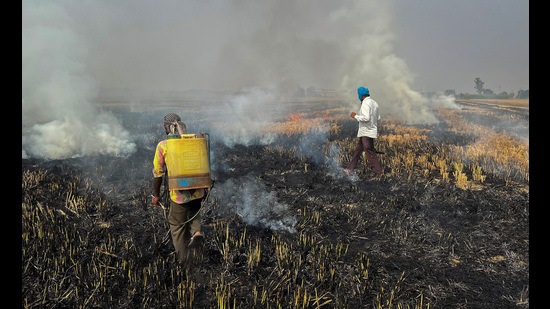
In the last week, 7 districts of the region have reported an average of 1,150 cases of stubble burning every day and the trend of residue burning is likely to continue at least for another one week.
Environmentalists say the present condition indicates the high level of air pollution in the region contributed by ongoing farm fires and other factors.
Data from the Punjab Remote Sensing Centre corroborates it as of 604 farm fires 550 were from the region alone.
According to VK Garg, professor of environmental science and technology at Bathinda-based Central University of Punjab (CUP), hazy conditions in southwest Punjab should not be confused with smog.
“Since the prevalent climatic conditions are not forming fog, pollutants, including paddy stubble burning, dust and vehicular emission, are disrupting bright sunshine hours. A shower can settle dust giving much-needed relief from the pollution,” said Garg.
On November 2, Bathinda and adjoining districts experienced hazy conditions for the first time during the kharif harvest season.
Since then, these 7 districts region has reported 8,047 cases of active farm fires.
In the last one week, Bathinda has reported 1,547 followed by 1,537 in Ferozepur.
This season Ferozepur is leading in southwest Punjab with 2,953 cases of farm fires followed by 2,427 events in Bathinda and 1,646 in Mansa.
Senior medical officer of Women and Child Government Hospital, Bathinda, Dr Satish Jindal said for two to three days, severe impact of air pollution gained prominence.
“It is recommended that people should stay indoors and cut down on outdoor activities to reduce the adverse impact of pollution. Cases of asthma attacks, eye irritation and allergy have increased significantly in the last one week,” said Jindal.


