
 E-Paper



2 yrs after fine, Delhi govt shares waste management plan with NGT
In February 2023, the government was issued a fine of ₹3,132 crore, including a previous penalty of ₹900 crore for solid waste management violations.

 Prefer HTon Google


The Delhi government has prepared a waste management plan for the Capital, which includes setting up of two newWaste to Energy (WtE) plants, expanding two existing ones, and two bio-gas plants by December 2028, when Delhi will be able to handle an additional 7,750 tonnes per day (TPD) of solid waste.
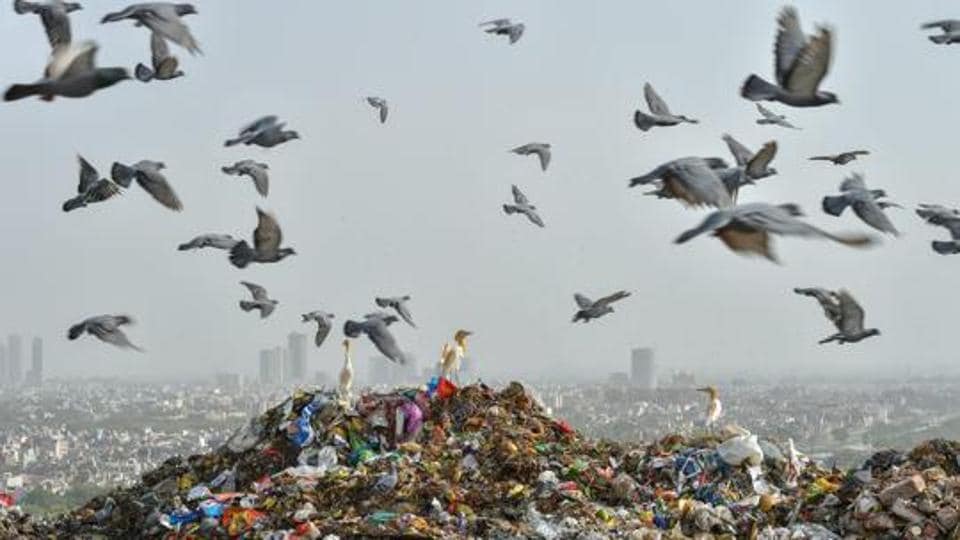
The plan, shared by the government with the National Green Tribunal (NGT), is in response to a February 2023 order of the tribunal which levied an environmental compensation of ₹2,232 crore on the government for violating Solid Waste Rules, 2016.
Further, the plan includes complete bioming of legacy waste at all three landfill sites in the Capital by December 2027 — by July 2026 in Okhla, December 2026 in Bhalswa and December 2027 in Ghazipur. Out of the 28 million metric tonnes (MT) of legacy waste at the three sites in 2019, around 20.5 million MT has been bio-mined so far, the report mentioned.
In February 2023, the government was issued a fine of ₹3,132 crore, including a previous penalty of ₹900 crore for solid waste management violations.
“Deducting compensation for solid waste already levied at ₹900 crore, the remaining ₹2,232 crore has to be paid by the Delhi government on ‘polluter pays’ principle for tackling the emergent situation prevailing in Delhi, apart from continuing damage to the environment which cannot be ignored. This payment will be the responsibility of the chief secretary, Delhi..” the NGT had said in 2023.
The penalty was challenged by the government through a civil appeal in the Supreme Court the same month. However, the government said that the appeal was withdrawn earlier this year.
“This appeal was withdrawn by GNCTD on May 23, 2025,” said the submission dated December 5.
The waste management plan also mentioned that Delhi’s civic bodies aim at a 100% waste collection and 100% segregation at source, with added focus on targeting bulk-waste generators.
The gap in waste management is to be met by four new WtE plants in Narela-Bawana and Tehkhand, with capacity to treat 7,000 TPD of waste. Meanwhile, a 300 TPD bio-gas plant will be set up in Okhla by December 2026 and a 350 TPD plant in Ghazipur by December 2026.
“To fill the gap in municipal solid waste generation and to meet the future requirement, considering the increase in population and municipal solid waste generation in Delhi, MCD has proposed MSW processing facilities in Delhi with a total additional capacity of 7,750 TPD ..” the report stated.
The government said that over 3,700 bulk waste generators (BWGs) had been identified so far, out of which 1,901 had on-site wet waste composting facilities.
About segregation at source, the report cited that the MCD was segregating 59% of its waste at source and 100% segregation by January 2027. The New Delhi Municipal Council (NDMC) was segregating 92% of its waste at source, with a target to take this up to 95% by October 2026.
The Delhi Cantonment Board, meanwhile, is achieving 90% of segregation at source in civil areas and 70% in army areas of its eight wards, the report added. “The target of 100% segregation of waste at source will be achieved by March 2026,” the government told the NGT.
To be sure, management of solid waste is the responsibility of MCD, while the Delhi government manages sewage. The NGT will be hearing the matter on December 8.


Stay updated with all top Cities including, Bengaluru, Delhi, Mumbai and more across India. Stay informed on the latest happenings in World News along with Delhi Election 2025 and Delhi Election Result 2025 Live, New Delhi Election Result Live, Kalkaji Election Result Live at Hindustan Times.


