
 E-Paper



Apex court judge launches book on Kumbh at India Habitat Centre
The book journeys across the Sangam – the sacred confluence of the Ganga, Yamuna and the mythical Saraswati and captures the immensity of the pilgrimage.

 Prefer HTon Google


New Delhi: A packed hall at the India Habitat Centre on Saturday witnessed the launch of “Expressions of Divinity: Mahakumbh 2025” – a photographic tribute to one of the world’s largest spiritual gathering.
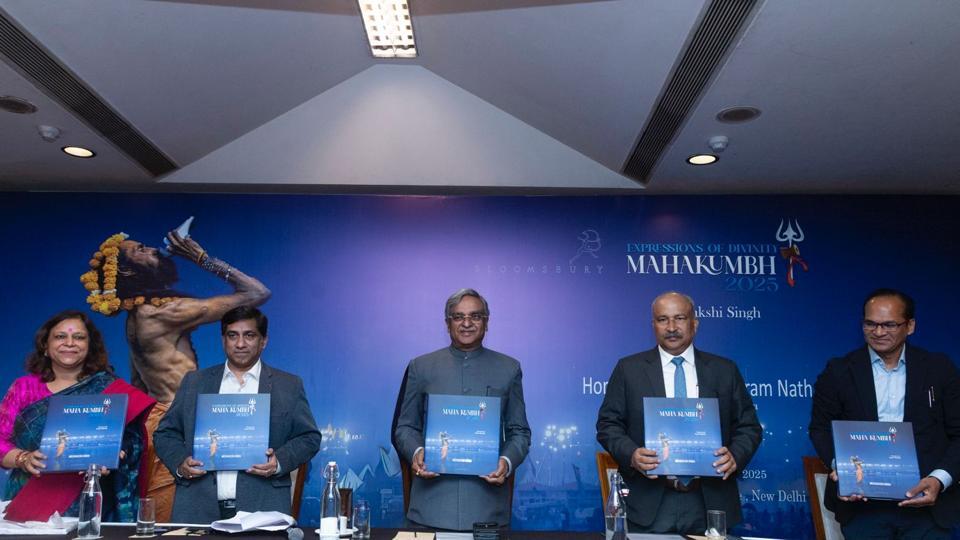
The book authored by Meenakshi Singh was unveiled by Supreme Court judge Justice Vikram Nath, who presided as chief guest at the event.
Published by Bloomsbury, the coffee-table volume documents the Kumbh through sweeping aerial frames and close portraits that attempt to freeze what Singh described as “a living, breathing constellation of faith.” The book journeys across the Sangam – the sacred confluence of the Ganga, Yamuna and the mythical Saraswati and captures the immensity of the pilgrimage.
Singh, currently the principal commissioner of Income Tax in Lucknow, has held key roles in India’s financial and trade administration, but photography has been her creative pursuit. Her first exhibition, Taj Mahal: Through the Twilights of Time, focused on the moods of the monument. This book marks her publishing debut.
Speaking at the launch, Singh described the project as a personal search. “Every author begins with a question and mine was a very simple question. What does divinity look like when it takes the human form?” she said. Recalling her time at the ghats, she said, “I realised that divinity expresses itself not only in just temples and rituals, but also in faces, gestures, silences, colors, stories… gradually this book grew out of the dawns and evenings which I spent amid the chants.”
Across its chapters, the book traces the myths surrounding the Triveni, documents akharas and sacred sites including Akshayavat, Patalpuri, Mankameshwar, Alopi Devi and Nag Vasuki, and follows the pilgrims whose lives intersect briefly at the confluence.
Singh said she wanted the work to function as “a visual pilgrimage” for those who could not witness the Mahakumbh in person. “Divinity is not something very distant. It is embedded… in the humility of the pilgrims, in the strength of the boatsman, in the devotion of women… divinity is most powerful when it is reflected through humanity,” she said.
“This book is a homage to the seeker, to the sages, to the Naga Sadhus who are embodying the austerity of ancient traditions,” she added.
Justice Nath described it as an immersive experience rather than a record. “Some books you merely read, this one you enter,” he said, calling the imagery a bridge connecting tradition, spirituality and environmental responsibility. He praised the author’s ability to capture stillness within a gathering of millions.
The author dedicated the book to her mother and said the project had restored her own sense of faith. “When each face carries a story and each silence holds a prayer… I invite everyone not just to read it but to experience it and let these pages carry you to Sangam,” she said.
Singh also extended her appreciation to Bloomsbury Publishing India – Managing Director Rahul Shrivastava and publisher Paul Vinay Kumar and added that it was the steady encouragement of her husband, Rajeev Krishna, IPS, DGP Uttar Pradesh, that helped her complete the project.
She also acknowledged the presence of IPS Alok Sharma, Director, SPG, who also shared his reflections on the organisational scale and intricate coordination required in managing the Mahakumbh.


Stay updated with all top Cities including, Bengaluru, Delhi, Mumbai and more across India. Stay informed on the latest happenings in World News along with Delhi Election 2025 and Delhi Election Result 2025 Live, New Delhi Election Result Live, Kalkaji Election Result Live at Hindustan Times.


