
 E-Paper



BJP sweeps 7 seats in NCR
The final results announced by the Election Commission of India (ECI) stated that the BJP comfortably won the Gurgaon, Badshahpur, Sohna and Pataudi seats in Gurugram district, with the Congress-- the nearest rival in all but the Gurgaon seat, where it was pushed to third. The BJP also won the Faridabad, Faridabad NIT, and Ballabgarh seats in Faridabad district — the Congress was a distant second in Faridabad and Faridabad NIT, and was humiliated in Ballabgarh, where it came fourth

 Prefer HTon Google


Gurugram:
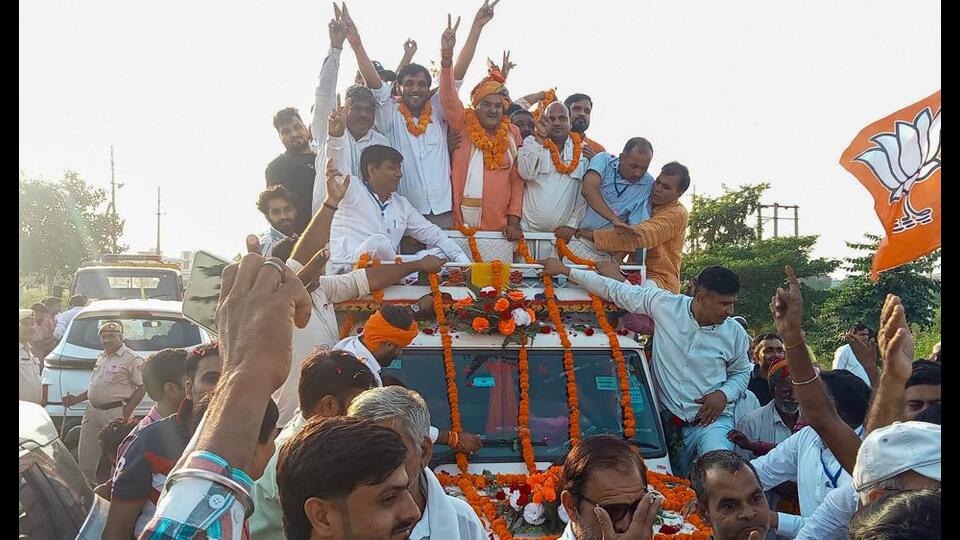
The Bharatiya Janata Party (BJP) swept through seven Haryana assembly constituencies abutting Delhi — four in Gurugram and three in Faridabad — winning all the seats by considerable margins.
The final results announced by the Election Commission of India (ECI) stated that the BJP comfortably won the Gurgaon, Badshahpur, Sohna, and Pataudi seats in Gurugram district, with the Congress the nearest rival in all but the Gurgaon seat, where it was pushed to third. The BJP also won the Faridabad, Faridabad NIT, and Ballabgarh seats in Faridabad district — the Congress was a distant second in Faridabad and Faridabad NIT, and was humiliated in Ballabgarh, where it came fourth.
In the early rounds of vote counting, a close contest was observed in several constituencies, particularly in Badshahpur and Gurgaon. However, the BJP maintained a steady lead and eventually emerged victorious in all the seats, mirroring the party’s strong performance in the two districts during the 2019 elections, when it won six of the seven seats.
Celebrations broke out even as the counting was underway, as the lead of the BJP candidate became unsurpassable, and their supporters began distributing sweets and dancing to the beats of dhols.
BJP’s Rao Narbir Singh won from the seat Badshahpur — Haryana’s largest assembly constituency, by population — by a margin of 60,705 votes, securing 145,503 votes against his Congress rival Vardhan Yadav, who garnered 84,798 votes. Independent candidate Kumudini Rakesh Daultabad was a distant third with 30,885 votes.
Singh attributed his win to the support of Union home minister Amit Shah, saying, “The minister’s trust in me and his personal support during the campaign, including organising a major rally in Badshahpur, played a crucial role in my success.”
Notably, in the 2019 elections, the BJP had been bested by an independent candidate in Badshahpur, losing the seat by around 10,000 votes.
In the Gurgaon seat, BJP’s Mukesh Sharma secured a win with 122,615 votes, defeating independent candidate Naveen Goyal — a party rebel — by more than 68,000 seats. Mohit Grover of the Congress was a distant third, garnering only 46,947 votes.
After his win was confirmed, Sharma said, “This victory reflects the people’s trust in BJP’s vision for development and growth in Gurgaon. I will not only fulfil my promises but will also ensure the problems of common people are heard and resolved in a given period of time. I will not disappoint my voters who helped me to win.”
Meanwhile, in Sohna, Tejpal Tanwar of the BJP continued his winning streak from the previous elections, defeating Congress pick Rohtas Singh by nearly 12,000 votes.
Tanwar credited his victory to the people’s belief in BJP’s policies, and emphasised the importance of continuity in development projects.
“We have worked relentlessly on infrastructure, roads, and water issues in Sohna. The voters have once again placed their trust in us, and I am committed to fulfilling all pending promises and improving the condition of the area,” said Tanwar.
Similarly, in Pataudi, Bimla Chaudhary of BJP won with a comfortable margin, ensuring BJP’s dominance in the district. She attributed her success to the support of the local community, saying, “The people of Pataudi have always stood by the BJP, and this win is a testament to their unwavering faith in our leadership. I will continue to work on improving the quality of life here, especially in the areas of education and women’s empowerment.”
In Faridabad, BJP’s Vipul Goel won by a margin of 48,388 votes, comprehensively defeating his Congress rival Lakhan Kumar Singla.
Meanwhile, in Faridabad NIT, BJP candidate Satish Kumar Phagna garnered 91,992 votes, defeating his nearest opponent, Congress pick Neeraj Sharma, by 33,217 votes.
However, the Congress had its worst performance in Ballabgarh, which was won by BJP’s Mool Chand Sharma who garnered 61,806 votes. He defeated independent candidate Sharda Rathore by 17,730 votes, with the Congress nominee Parag Sharma only receiving 8,674 votes.


