
 E-Paper



Chaos returns to IGI airport as over 220 flights cancelled
Dense fog in Delhi led to chaos at IGI Airport with 228 flights canceled and over 800 delayed, stranding thousands of passengers amid low visibility.

 Prefer HTon Google


As a dense layer of smoke and fog retained its grip over the Capital, a sharp and sudden drop in visibility late Sunday night plunged Delhi’s Indira Gandhi International (IGI) airport into near-total disorder, with 228 flights cancelled and more than 800 delayed, triggering scenes of confusion, anger and exhaustion among thousands of stranded passengers through Monday.
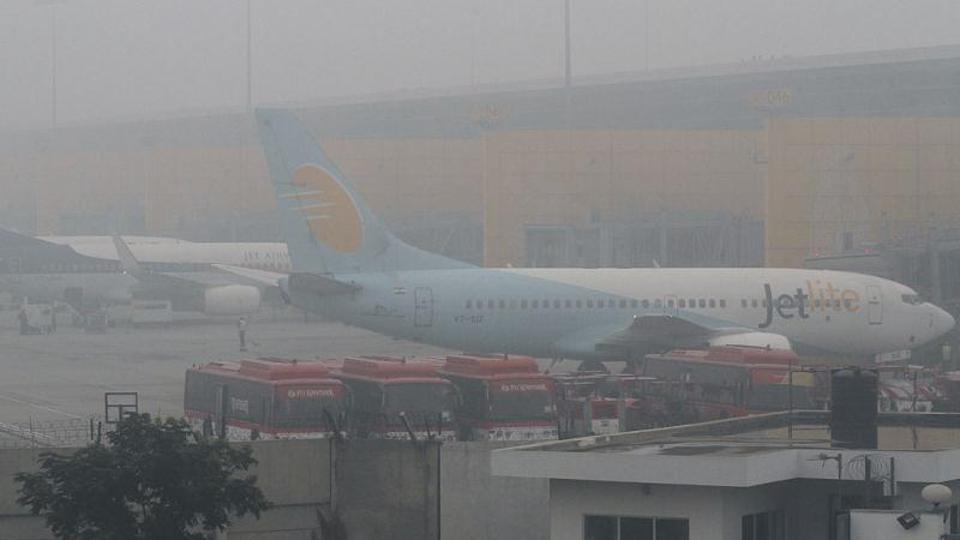
What began as weather-related disruption quickly snowballed into a full-blown operational crisis.
Airport officials said low visibility conditions crippled departures through the early morning, leading to cascading delays that forced airlines to cancel flights throughout the day. By Monday evening, terminals were packed with travellers waiting in long queues for check-in, baggage reclaim, rebooking counters and customer support desks, many with little clarity on when -- or if -- they would fly.
Passengers described spending hours standing in queues only to be told their flights had been cancelled, often after clearing security. Vishan Oberoi, one of the thousands affected, took to X to vent his frustration. “Two hours in the queue to check my bag in, finish security and then my flight is cancelled. I’ve now been in line for 45 minutes to know if I can get another flight,” he wrote late Monday night.
Lawyer Sanjay Hegde said he reached the airport before dawn to catch a 7.45am flight, only to find himself stuck on the tarmac for hours. “Woke up at 5am. Still sitting on the tarmac waiting for ATC clearance. We’re told there are 40 aircraft in the queue ahead of us. The airhostess says some aircraft have been waiting over four hours,” he posted.
Also among those affected passengers was Argentina football player Lionel Messi, who was scheduled to depart from Mumbai early morning and reach Delhi by before noon, but could only make it to the Capital by around 2.30pm as his chartered flight was also held up due to the fog.
For ordinary passengers, the delays often meant missed connections, hotel bookings gone waste and work commitments thrown off track. One passenger said he waited nearly an hour and a half to check in his bags, only to be informed at the counter that his flight had been cancelled. “Now standing in another queue for the last 30 minutes to know if I’ll even get another flight,” he wrote.
Sam Dalrymple, son of historian William Dalrymple, described the situation as in “shambles”. He said passengers on his Air India flight to Hyderabad were woken up at 3am for a 6am departure, only for the flight to be delayed repeatedly -- by an hour at a time -- before being cancelled nearly 12 hours later. “There was no staff to even tell us it was cancelled. We found out only when someone checked the app,” he said. He added that baggage handling descended into further chaos, with suitcases taking hours to arrive and some reportedly misplaced.
Airport officials said the crisis was triggered by a sharp drop in visibility beginning late Sunday night. According to the India Meteorological Department (IMD), visibility at Safdarjung dropped to 150 metres by 11.30pm and touched zero shortly after midnight, remaining there until around 2am. At Palam, near the airport, visibility dipped to as low as 50 metres around 4am.
Low visibility procedures were initiated at IGI airport around 2.30am, but disruptions intensified after 4am as runway visual range (RVR) fell below thresholds required for take-offs.
While Delhi airport recently upgraded its third runway to CAT-III standards – allowing landings in extremely low visibility – officials said departures were the bottleneck. Aircraft can land with an RVR of 50 metres, but require at least 125 metres to take off. “From around 4am, the RVR stayed below that level. Aircraft had to wait in parking bays, leading to severe congestion. Only two take-offs were possible till about 9am,” an airport official said.
Although landings continued through much of the morning, the backlog on the ground eventually forced a slowdown in those as well.
Officials also acknowledged that airlines were already under strain following a turbulent previous week, when operational disruptions -- particularly at IndiGo -- had led to hundreds of delays and cancellations nationwide. “There was very little buffer left to absorb a weather event of this scale,” an official said.
Airlines issued advisories urging passengers to monitor their flight status. IndiGo said in a statement that dense fog had severely impacted operations across northern India. “Low visibility (below minima), due to dense fog, has severely impacted operations at Delhi and other airports across northern India, which is unfortunately beyond our control,” the airline said.
Air India issued a similar statement, saying poor visibility due to dense fog in Delhi had affected the operations of all airlines. “In the interest of safety, and to avoid prolonged uncertainty for our guests, some flights have been cancelled,” it said on X.
Rail travel was also affected, though to a lesser degree. Northern Railway officials said at least 91 trains were delayed by 30 minutes to five hours, with services gradually normalising after noon as visibility improved.
Meteorological officials warned that with low wind speeds and high pollution levels persisting, dense fog could return over the next few days, particularly during late night and early morning hours, leaving Delhi’s transport systems vulnerable to further disruption.


Stay updated with all top Cities including, Bengaluru, Delhi, Mumbai and more across India. Stay informed on the latest happenings in World News along with Delhi Election 2025 and Delhi Election Result 2025 Live, New Delhi Election Result Live, Kalkaji Election Result Live at Hindustan Times.


