E-Paper



'Compelling need' to appoint Asthana top cop: SC affidavit
In an affidavit in response to a clutch of petitions challenging Asthana’s appointment on July 27, the Centre maintained that he was picked “to provide effective policing on the recent law and order situation which arose in the National Capital Territory of Delhi” and that he was given both inter-cadre deputation as well as extension of service “in public interest”.

 Prefer HTon Google


There was a “compelling need” to have someone like Rakesh Asthana head the police force of Delhi, taking into account the national capital’s “extremely challenging situations” of public order, policing issues, and their implications on national security, the Union government told the Supreme Court while justifying the appointment of the 1984-batch IPS officer as the Delhi Police commissioner.
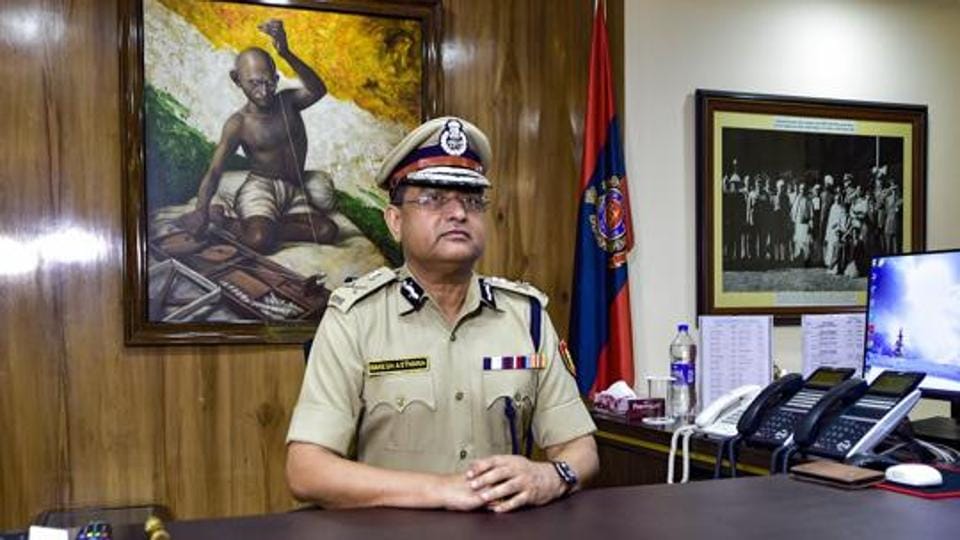
In an affidavit in response to a clutch of petitions challenging Asthana’s appointment on July 27, the Centre maintained that he was picked “to provide effective policing on the recent law and order situation which arose in the National Capital Territory of Delhi” and that he was given both inter-cadre deputation as well as extension of service “in public interest”.
It sought that the petitions challenging the appointment be dismissed. Both his transfer and service extension have been challenged in court.
“It was felt that requisite experience of working and supervising the central investigating agency/para-military force and police force of a large State having diverse political and law and order problem was lacking in the present pool of available officers and hence in public interest, a decision was made by the central government to have an officer who had experience in all the above fields to supervise Delhi Police force,” stated the affidavit, filed through the home ministry.
It added that apart from there being enough reasons to pick Asthana, there is no procedural or legal infirmity in appointing him since the Supreme Court’s 2016 order in the Prakash Singh case, requiring a police chief of a state to have at least six months of service left, applies only to the director general of police or police heads of states but not to Union territories such as Delhi.
“Eight police commissioners have been appointed by the Central Government in Delhi since 2006 prior to Asthana’s appointment by following the same procedure...there has never been any objection to the appointment of respective commissioners in Delhi Police,” said the affidavit, accusing petitioner, NGO Centre for Public Interest Litigation (CPIL) of “selective exhibition of public interest”.
Asthana took charge as commissioner of Delhi Police on July 28, 2021. His appointment for one year came just four days before his superannuation on July 31. Before his appointment, the Indian Police Service officer was granted an inter-cadre deputation to a cadre comprising Arunachal Pradesh, Goa, Mizoram, and Union territories other than Andaman and Nicobar, and an extension of service.
CPIL, in its writ petition on August 2021 before the top court, alleged several illegalities in the inter-cadre deputation and extension of service, and claimed the appointment breached the condition stipulated in the Prakash Singh case because Asthana did not have a minimum residual tenure of six months.
The other petition by CPIL before the Supreme Court on November 2021 is an appeal against the Delhi high court’s October 12 judgment affirming Asthana’s appointment.
A bench of justices Dhananjaya Y Chandrachud and AS Bopanna, which on November 26 issued notices to the Centre and Asthana on the NGO’s petitions, will hear the case on Wednesday. Solicitor general Tushar Mehta appeared for the Centre, while Asthana was represented through senior counsel Mukul Rohatgi. Advocate Prashant Bhushan argued for the CPIL.
The affidavit filed by the Centre sought dismissal of the petition, highlighting that the post of Delhi Police Commissioner is sui generis (unique) as Delhi is the capital of the country and any incident happening here has far-reaching impacts and implications not only throughout the country but beyond the borders.
In May 2021, Chief Justice of India NV Ramana, while participating in the high-powered committee for the selection of the CBI director (the Prime Minister and the leader of the opposition in the Lok Sabha were the other members), flagged the 2006 Prakash Singh case ruling, resulting in the disqualification of Asthana from being considered for the post of CBI director. The Centre, however, claims that this ruling is not applicable in appointment of Delhi Police Commissioner.
“Any statutory provision or any other regime deserves to be read in such a way that a leeway is given to the Central Government in appointment of Delhi Police Commissioner. Any straightjacket or pedantic approach would not be in national interest,” the home ministry said in the affidavit, defending Asthana’s appointment.
On the challenge to Asthana’s inter-state cadre deputation, the affidavit maintained that the rules provide for inter-cadre deputation of all India service officers by the central government, which effected the deputation in public interest after no other officer available in the AGMUT cadre was found suitable to handle the law and order situation in Delhi.
“Considering the complexities and the sensitivities involved and also considering that no officer of appropriate seniority with balanced experience was available in the AGMUT Cadre, it was felt that an officer belonging to a large state cadre, who had the exposure of complexities of governance and who had the knowledge of nuances of broad canvas policing is given charge of Commissioner of Police Delhi,” it added.
The Centre further sought dismissal of CPIL’s petition, calling the NGO a “busybody”. “The petitioner keeps on selectively filing petitions and such selection of selected public interest...are beyond comprehensions...,” added the affidavit.