
 E-Paper



Delhi air turns ‘severe’ day after easing of pollution curbs
Senior India Meteorological Department (IMD) scientists said that with a western disturbance expected to impact Delhi and its neighbouring states from December 22, the wind speeds on Tuesday slowed down, causing pollutants to get trapped closer to the surface.

 Prefer HTon Google


A day after the Commission of Air Quality Management (CAQM) in Delhi-NCR and adjoining areas lifted the ban on construction and demolition activities in the region, and the ban on entry of petrol and diesel trucks into Delhi citing an improvement in air quality, the Capital’s pollution levels spiked into the severe range again.
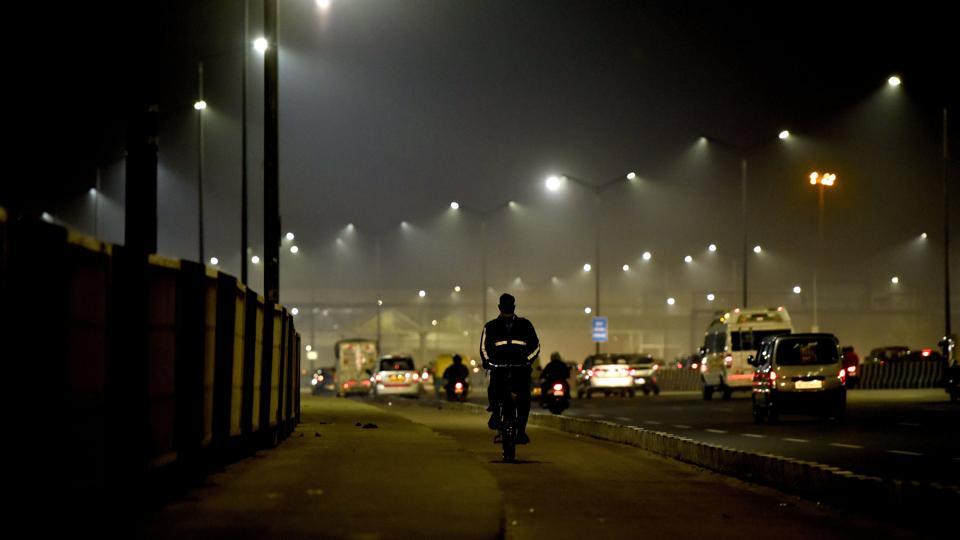
The Central Pollution Control Board (CPCB) recording showed that on Tuesday the overall Air Quality Index (AQI) reading of Delhi deteriorated to 402, in the severe zone. On Monday, the Capital’s average AQI reading was 332, considered very poor on CPCB’s air quality scale.
An AQI reading between 201 and 300 is considered poor, 301 and 400 very poor, and 401 and 500 severe.
Senior India Meteorological Department (IMD) scientists said that with a western disturbance expected to impact Delhi and its neighbouring states from December 22, the wind speeds on Tuesday slowed down, causing pollutants to get trapped closer to the surface. The cold, frigid conditions all across north India, further led to pollution particles becoming heavier, making dispersion all the more difficult.
A western disturbance refers to an area of “disturbed” or reduced air pressure, moving from the west to the east, carrying with it moisture associated with rainfall, snowfall and fog in northern India.
“The winds were largely calm on Tuesday, which caused pollution to accumulate. From Tuesday night, Delhi will start receiving easterly winds because of a passing western disturbance. The wind speed will be around 4-6kmph on December 22 and December 23. By December 24-25, the wind speed will improve to around 10-15kmph,” said a senior Met official.
After recording the worst pollution for the month of November since 2015, with 11 “severe” air days as opposed to the 10 “severe” days recorded in 2016, the national Capital this December recorded two “severe” air days. Before Tuesday, the AQI had peaked to the “severe” category on December 2, with a reading of 429.
Considering the unprecedented pollution levels last month, on the directions of the Supreme Court, the CAQM on November 16 imposed a series of restrictions, including a ban on construction and demolition activities in Delhi-NCR, scheduled operations for thermal power plants, and allowed only those industrial units that have switched to piped natural gas (PNG) to operate, and banned the entry of trucks carrying non-essential items into Delhi.
Over the last one week, the commission has lifted these restrictions in a phased manner.


