
 E-Paper



Arvind Kejriwal flags off smog tower to aid Capital's pollution fight
The tower is meant to pull in polluted air using suction fans located on the top of the structure, filter out the pollutants, and then release clean air from vents at the bottom.

 Prefer HTon Google


New Delhi: Delhi chief minister Arvind Kejriwal on Monday inaugurated a smog tower in Connaught Place as part of the drive to fight air pollution, which leads to a public health emergency in the Capital every winter.
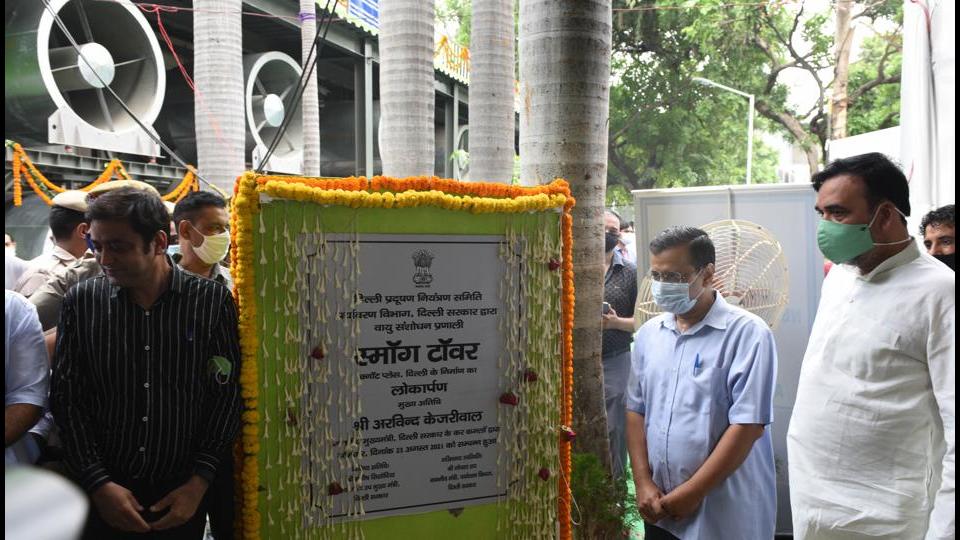
The tower, 24-metres high, located on Baba Kharak Singh Marg, has been designed using American technology, and has been put up on a trial basis, Kejriwal said. It is meant to pull in polluted air using suction fans located on the top of the structure, filter out the pollutants, and then release clean air from vents at the bottom.
“This is among Delhi government’s many efforts to improve the air quality of the city. We are operating this on a trial basis and teams from Delhi Pollution Control Committee (DPCC) will be monitoring how effective this is,” Kejriwal said.
“If it proves successful, more such towers will be set up all over Delhi. This has been developed under the expert supervision of scientists from IIT-Bombay and IIT-Delhi, so we are hopeful that it will yield the desired results,” he added.
Last January, based on submissions made by the Delhi government and the Centre, the Supreme Court called fot the construction of two smog towers in the Capital on a pilot basis. One, which was inaugurated on Monday, was a Delhi government project; the other, which is coming up in east Delhi’s Anand Vihar, is being installed by the Central Pollution Control Board (CPCB). It is likely to be inaugurated by August 31.
The smog tower at Connaught Place -- according to a statement issued by the Delhi government -- is based on a “downdraft airflow model”, where 40 huge fans will induct air from the top of a “special type of canopy structure at the height of about 24 metres, and release clean air of the tune of 1,000 metre cube per second filtered using round 5,000 filters through novel geometry filters of two layers”.
The area of influence is expected to be about a 1km radius around the tower, Delhi government said.
DPCC officials said that the effectiveness of the tower will be studied for the next two years, and the initial findings are likely to come out by the next month. IIT-Delhi and IIT-Bombay will analyse pollution data of the area after the installation of this tower and submit a report on its effectiveness.
Experts unconvinced
However, the inauguration of the smog tower reignited the ongoing debate on the efficacy of such open-air structures in cleaning a city’s air, with some experts calling them “ineffective”.
Jyoti Pande Lavakare, author and co-founder of Care for Air India, said that the only way to reduce air pollution is to control emissions at the source; everything else is as good as “treating a bullet wound with a band-aid”.
“If these smog towers were so effective, don’t you think countries like China and Mexico would have installed thousands of them and cleaned their air? There is no scientific evidence behind the efficacy of such outdoor structures, and all that this is doing is wasting the taxpayers’ money,” Pande contended.
Sarath Guttikunda, director of Urban Emissions, an air pollution information, research and analysis repository, said that “vacuum cleaners are not engineering solutions to counter ambient air pollution”.
In a research paper published by Guttikunda and Puja Jawahar, founder and co-director of Urban Emissions last year, the authors highlighted that the Covid-19 lockdown last year resulted in a major decline in pollution levels. This, the paper said, was proof that pollutants have to be plugged at the source.
“With no boundaries, it is unscientific to assume that one can trap air, clean it, and release into the same atmosphere simultaneously. Expecting filtering units to provide any noticeable results at the community level is unrealistic,” the paper read.
Other experts said the data should be studied assiduously.
“While smog towers might come across as a visible solution to air pollution, there is no scientific evidence to support that they can filter outdoor air effectively. Hence, the data on the effectiveness of the newly installed smog tower should be pursued rigorously by the government and be made available publicly,” said Tanushree Ganguly, programme lead at Council on Energy, Environment and Water (CEEW).
Political tussle
The inauguration of the tower, meanwhile, sparked a political tussle, with the Bharatiya Janata Party claiming that the Delhi government was “stealing credit” and “misleading people” by saying this was the first smog tower in the country.
Delhi BJP spokesperson Praveen Shankar Kapoor said that three smog towers set up by BJP MP Gautam Gambhir, and were operational in Delhi since last year. “East Delhi MP, Gautam Gambhir with his own effort last year on January 3, installed Delhi’s first smog tower at Lajpat Nagar and later in November 2020 got installed two other smog towers at Gandhi Nagar and Krishna Nagar. The way the Delhi government is claiming to have installed the first smog tower therefore clearly reflects its lust for publicity,” he said.
The Delhi government did not respond to requests for comment.


