
 E-Paper



Delhi govt unveils ₹57,000 crore comprehensive drainage master plan
Once it is implemented, the city’s drainage capacity will increase nearly threefold from 25mm per hour of rainfall to 70mm per hour

 Prefer HTon Google


The Delhi government on Friday unveiled a ₹57,000-crore drainage master plan, the first such comprehensive overhaul in nearly 50 years, to prepare the Capital for intensifying monsoons, rising climate pressures and relentless urbanisation.
The plan, which will be implemented in five phases over the next five years, laid out a 30-year roadmap to strengthen the stormwater network, reduce waterlogging and build resilience against extreme rainfall events, officials said.
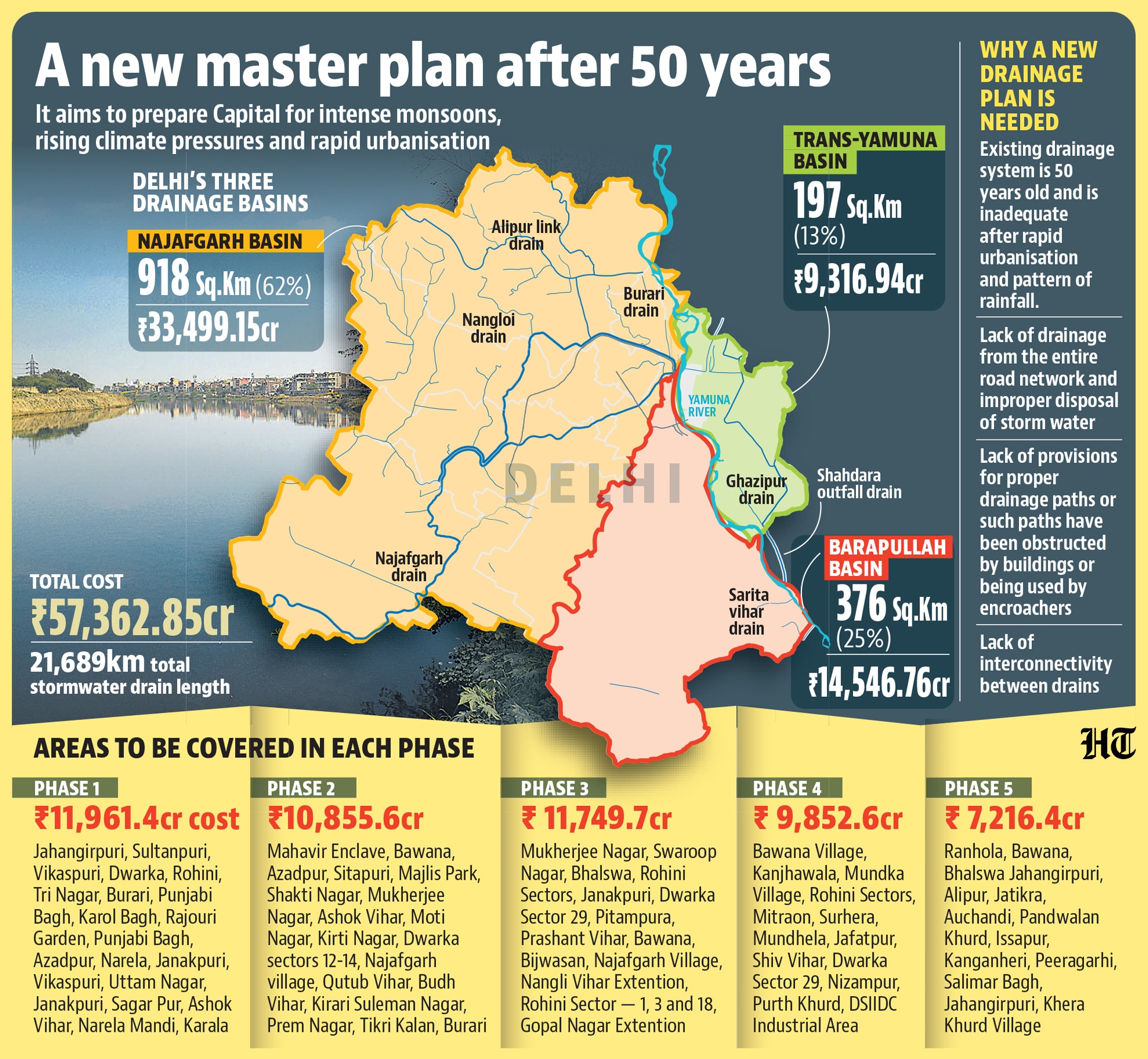
The plan divides Delhi into three basins -- Najafgarh, Barapullah and Trans-Yamuna -- redesigned using modern hydraulic modelling and engineering interventions.
Once it is implemented, the city’s drainage capacity will increase nearly threefold from 25mm per hour of rainfall to 70mm per hour, thus factoring in an additional 11% rise in rainfall intensity linked to climate change.
Also Read: Indus waters may be diverted to Delhi, says Union minister
Officials said the new design, which is the result of an extensive feasibility studies and field surveys by a team of consultants and experts, aims to anticipate the future rather than patch up the present. “The idea is to design drains not just for today’s rainfall but for projected intensities linked to climate change,” an official aware of the plan said.
The master plan envisages real-time monitoring of drains through smart sensors feeding into a central control hub, allowing authorities to anticipate choke points before they escalate into full-blown flooding. A dedicated operations workforce equipped with modern machinery will be tasked with desilting and cleaning drains, ensuring that blockages no longer choke the system. Flood mitigation measures for low-lying areas will include high-capacity pumping stations, stricter desilting protocols and urgent upgradation of critical drains.
The urgency of a drainage overhaul for the city was underscored by floods in 2023 and then again this year, as citywide waterlogging revealed the limits of Delhi’s outdated infrastructure.
Phase one of the project, costing nearly ₹12,000 crore, will focus on vulnerable neighbourhoods such as Jahangirpuri, Sultanpuri, Vikaspuri, Dwarka, Rohini, Burari, Punjabi Bagh, Karol Bagh, Rajouri Garden, Azadpur, Narela, Uttam Nagar, Sagar Pur, Ashok Vihar and Karala.
Basin-wise plan
Of the three basins, the Najafgarh Basin -- covering 918 sq km or 62% of Delhi’s total drainage area -- will absorb the largest share of the budget at ₹33,499 crore. The Barapullah Basin, spread across 376 sq km in south Delhi, has been allocated ₹14,546 crore, while the Trans-Yamuna Basin, spanning 196 sq km in northeast and eastern Delhi, will see ₹9,316 crore invested in its stormwater channels.
Together, the total length of drains covered is 21,689 km.
Officials said the entire plan is expected to be completed in about five years and will prioritise high-risk flood-prone areas. Work on the plan will start once detailed project reports and financial sanctions are cleared and tenders issued, the officials added.
The document acknowledges that Delhi’s drainage system was originally designed for a city four times smaller than today. Encroachments on natural drains, outdated design, mixing of sewage with stormwater, piecemeal construction and poor rainwater harvesting have all worsened the problem.
The new plan sets measurable goals: halving waterlogging incidents within three years, cutting flood-related accidents and health risks by 30% within five years, reducing economic damage from floods by 40% in four years, and improving water quality at drain outfalls by 20%. It also calls for integrating green infrastructure such as rain gardens, bioswales and permeable pavements in at least 10% of new projects.
Where gravity drains are ineffective, new pumping stations will be built, while lakes, wetlands and green parks will be linked to the drainage network to absorb runoff and recharge groundwater.
Delhi chief minister Rekha Gupta said the plan was designed to end the city’s annual ordeal with waterlogging.
“When we took over six months ago, we began by visiting drains and sewers ourselves. Our aim was to ensure that Delhi does not get flooded like every year. After much effort, there was hardly any waterlogging this year despite the city receiving over 399 mm of rainfall, the highest in 15 years,” she said.
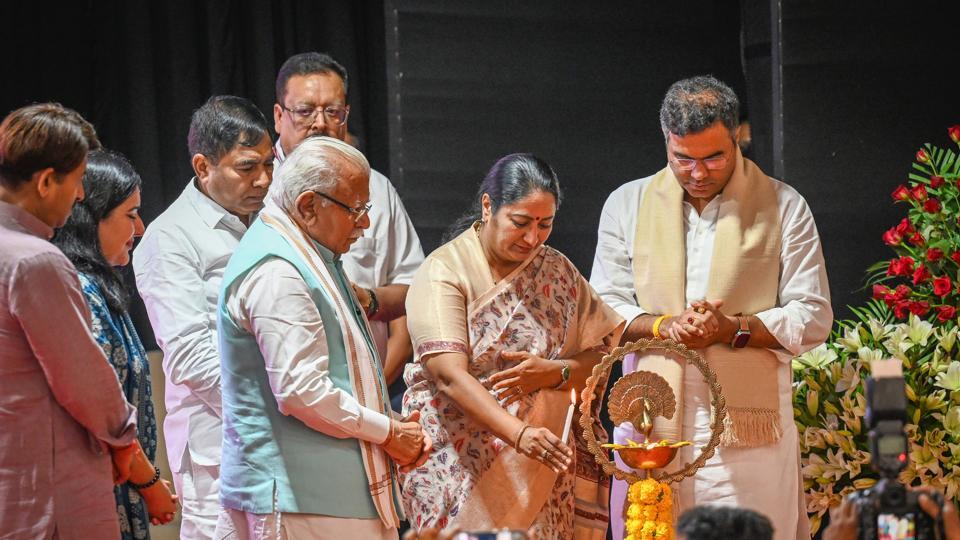
Unveiling the plan on Friday, Union minister for housing and urban affairs Manohar Lal Khattar said the Centre would help Delhi secure the massive funding required. Recalling his own experience of Delhi floods, he noted that waterlogging was worst when the Yamuna ran higher than the low-lying areas of the Capital.
“Under the Swachh Bharat Mission we allocated ₹1,100 crore, but the previous government failed to use it properly. This time we will ensure funding support for the master plan,” Khattar said, adding that efforts to flatten the Bhalswa landfill within a year will also continue.
Speaking at Friday’s event launching the plan, Gupta also took aim at the previous Aam Aadmi Party government, accusing it of leaving Delhi unprepared.
“They were in power for 11 years without policy or purpose. Now, once this plan is implemented, people will enjoy the monsoon instead of crying over it,” she said.
Long-awaited overhaul
The last drainage master plan was prepared in 1976 when Delhi’s population was just six million. Today, the city of nearly 25 million has 18,958 km of drains under eight different agencies, from Public Works Department (PWD) and Delhi government’s irrigation department, to Municipal Corporation of Delhi (MCD), Delhi Development Authority (DDA), New Delhi Municipal Council (NDMC) and Delhi State Industrial & Infrastructure Development Corporation (DSIIDC).
Delhi PWD and irrigation minister Parvesh Verma said this fragmentation had long undermined planning. “When we initially started working on drains we realised that the agency changed after every few hundred metres. One road is with PWD but the adjacent one is under MCD. All these coordination issues will be handled. Also, there was no planning and a large pipeline was connected to a smaller diameter pipeline. These gaps will also be addressed,” he said.
The new plan, finalised by the PWD, aims to create a climate-resilient, technologically advanced stormwater system capable of coping with extreme rainfall, rising population and rapid urbanisation. Verma claimed that after failed attempts since 2009, the plan finally had the political will to succeed. “Over 2 million tonnes of silt were removed this year. All civic bodies are now working together to rid Delhi of waterlogging,” he said.
Nature-based and green infrastructure solutions form a key component of the plan, officials said, adding that this would not only reduce the load on drains but also enhance biodiversity and improve groundwater recharge.
Experts, however, cautioned against disruption for the city’s millions of residents during construction for the drainage upgrades.
Former DDA additional commissioner PS Uttarwar said digging up pipelines across the city could paralyse traffic unless new trenchless technologies were used. “The focus should be on augmenting natural drains wherever possible and carrying out work line by line rather than across entire zones,” he said.

Stay updated with all top Cities including, Bengaluru, Delhi, Mumbai and more across India. Stay informed on the latest happenings in World News along with Delhi Election 2025 and Delhi Election Result 2025 Live, New Delhi Election Result Live, Kalkaji Election Result Live at Hindustan Times.


