
 E-Paper



Delhi University opens registration portal, declares single girl child quota
The university also launched the Common Seat Allocation System (CSAS) portal for admissions to undergraduate programmes

 Prefer HTon Google


The Delhi University (DU) will offer one seat in each course in all colleges under the supernumerary quota to a single girl child from academic session 2024-25, DU officials announced on Tuesday.
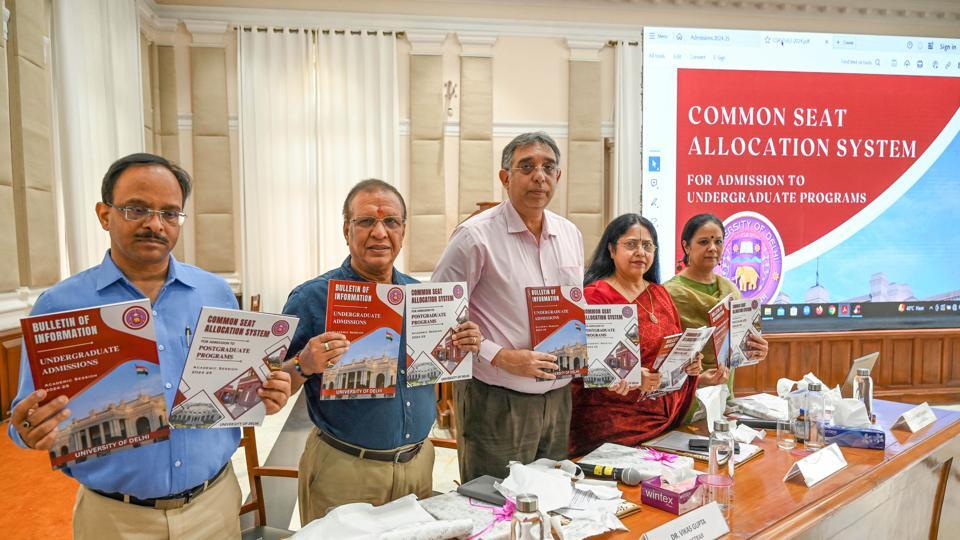
The university also launched the Common Seat Allocation System (CSAS) portal for admissions to undergraduate programmes. Supernumerary quota or seats refer to those that are created over and above the seats already approved for a college.
The university has close to 71,000 seats in 79 undergraduate (UG) programmes and 183 BA programme combinations spread across 69 colleges and departments, the officials added.
“This is the first time that the university will offer a supernumerary quota to a single girl child. There will be an option to apply for the quota in the portal just like we made reservation arrangements for orphan students last year. The rest of the process will be the same as other categories, with the most eligible student getting matched to a corresponding course. The proof and documents will be verified by the colleges before admission,” DU registrar Vikas Gupta said.
The UG admission process will take place in two phases, all of which will be based on the score obtained by students in the Common University Entrance Test (CUET). Admission to the Bachelor’s programmes of Non-Collegiate Women’s Education Board (NCWEB) and School of Open Learning (SOL) will, however, be based on the marks obtained in Class 12. Admission process for NCWEB started on Tuesday and it will begin for SOL from June 3.
For the rest of the programmes where CUET marks will be considered, the first phase commenced with the launch of the CSAS portal.
“The first phase is a simple registration process wherein the candidates seeking admission will have to fill their personal details and academic scores in Class 12, along with CUET (UG) application number,” said Haneet Gandhi, dean of admission, DU.
Gandhi added that other details, including names of parents, social category, caste and gender, will also have to be filled and that students should be careful while submitting the details as they will not be allowed to change anything later.
Following this, the application fee will have to be paid, which will be ₹250 for unreserved, other backward class (OBC) and economically weaker section and ₹100 for categories such as scheduled caste, scheduled tribe and persons with benchmark disabilities (PwBD).
“The second phase of the CSAS (UG) process will commence with the declaration of the CUET (UG) results where students have to complete the preference-filling,” said Gupta.
A DU official said that the candidates will have to map the subjects studied by them in Class 12 to the subjects in which they have appeared in CUET(UG) as the university will only consider those CUET domain papers which are same or similar to the subjects studied in class 12.
“The order of selection of the programme and college combination will also determine the preference order for the allocation of seats, where students get to choose from 1,500 unique programme and college combinations. It is advisable that students opt for the maximum number of preferences to benefit optimally from the upgradation in subsequent allocation rounds,” the official added.
In the subsequent allocation and admission round, the official said that the candidate will have to “accept” the seat allocated, after which the college concerned will check the eligibility and validity of the documents uploaded by the candidate. Once approved, the candidate can pay the fees and get admission in that particular course. Any inaction will be considered as non-acceptance of the allocated seat.
“After the closure of each allocation round, DU will publish details of vacant seats in all programmes and all admitted candidates will have the option to ‘upgrade’ or ‘freeze’. Candidates who opt for ‘Upgrade’ will be considered for upgradation to a higher preference submitted by him/her. A candidate who gets upgraded will have to ‘accept’ the upgraded seat and complete the admission procedures on the upgraded allocated seat/s. On selecting ‘freeze’, such a candidate will not be allowed to opt for upgradation,” said Gandhi.
The university also declared a provision for “mid-entry phase”, whereby candidates who failed to apply for CSAS-24 within the stipulated time will be able to apply through a separate window, which will be later announced by the university.
DU will also admit 20% extra students for each programme in each college under the General, OBC and EWS categories and 30% in the SC, ST, PwBD categories to fill the maximum number of seats.
“However, colleges where last year the withdrawals were less than 5% of the sanctioned strength, 10% extra allotments may be done for UR, OBC(NCL), EWS and 15% in SC, ST, PwBD categories,” the university announced.


