
 E-Paper



Delhi’s AQI deteriorates for third straight day
A thick blanket of smog descended over the city during the day, with winds not breaching 7 km/hr, IMD said


New Delhi: Delhi’s air quality remained in the ‘very poor’ category for the third consecutive day on Wednesday, deteriorating marginally as wind speeds dropped again. The 24-hour average air quality index (AQI) stood at 353 (very poor) at 4 pm on Wednesday, as per Central Pollution Control Board (CPCB) daily national bulletin.
This was the highest AQI recorded so far this season – up from 351 recorded on Tuesday and 345 on Monday.
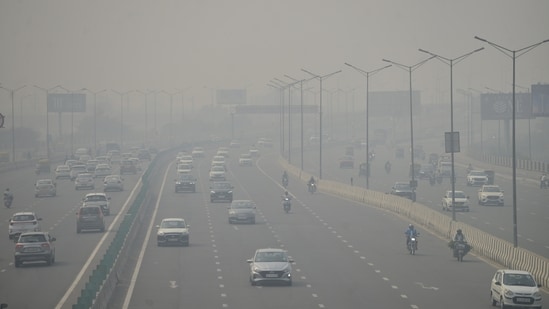
A thick blanket of smog descended over the city during the day, with winds not breaching 7 km/hr, the India Meteorological Department (IMD) said, adding that suitable dispersion is unlikely in the coming days.
“The wind direction changed from easterly to westerly, but no significant change was recorded in the wind speed. Nights are almost calm and during the day, it goes up to 5-7 km/hr,” said Krishna Mishra, a senior IMD scientist.
He said that though a western disturbance is likely around October 27, no significant rain, or increase in wind speed is likely. “It will be feeble and so we are not expecting any significant change in the weather,” he added.
Also Read | Why Delhi's artificial rain plan is on hold despite post-Diwali pollution spike
Winds had briefly picked on Tuesday morning until the evening – effectively blowing away emissions from firecrackers which hung over the city. Wind speeds again began dipping from Tuesday night with a drop in mercury.
Centre’s Air Quality Early Warning System (EWS) forecast shows that AQI is likely to remain ‘very poor’ till Saturday, with it oscillating between ‘poor’ and ‘very poor’ in next six days.
The CPCB classifies AQI between 0-50 as “good”, between 51 and 100 as “satisfactory”, between 101 and 200 as “moderate”, between 201 and 300 as “poor”, between 301 and 400 as “very poor”, and over 400 as “severe”.
Also Read | GRAP stage-3 curbs to wait as Delhi’s AQI nears 400 mark
The data also showed that of the 39 active ambient air quality monitoring stations, three were in the ‘severe’ category at 4 pm, and others in the‘very poor’ range. The worst impacted locations in the city were Nehru Nagar (411) – which on Diwali day recorded a peak PM 2.5 reading of 1763µg/m³ – the highest in the city; Punjabi Bagh (406) and Wazirpur (406).
Only three stations had an AQI below 300, Lodhi road (230), DTU (216) and the IGI airport (294), indicating the impact of the prevailing high pollution levels.
Delhi’s maximum temperature on Wednesday stood at 32.1°C – a degree below normal. However, nights were warm. The minimum of 21.8°C was three degrees above normal for this time of the year. Both maximum and minimum are likely to remain in a similar range till the weekend, officials said.
Tuesday sixth most polluted day of the year
Delhi’s AQI crossed 350 for the first time this season on Tuesday. An analysis of PM 2.5 data by the Centre for Research on Energy and Clean Air (CREA) showed Tuesday was the sixth most polluted day of the year, with the remaining five all coming in January.
Delhi’s 24 hour average PM 2.5 concentration on Tuesday was 241µg/m³. The highest PM 2.5 levels in a 24-hour window this year came on January 9, when it was 273µg/m³, followed by January 15 (255µg/m³), January 4 (252µg/m³), January 3 (249µg/m³) and January 10 (245µg/m³).
“The data shows this is the most polluted spell of the year, after January. October 21 was the sixth most polluted day this year and October 20 the seventh most,” said Manoj Kumar, a researcher at CREA, stating meteorological conditions are particularly adverse in January, when temperatures are low and calm winds lead to inversion – trapping pollutants close to the surface.

Stay updated with all top Cities including, Bengaluru, Delhi, Mumbai and more across India. Stay informed on the latest happenings in World News along with Delhi Election 2025 and Delhi Election Result 2025 Live, New Delhi Election Result Live, Kalkaji Election Result Live at Hindustan Times.


