
 E-Paper



Delhiwale: This way to Mohalla Qabristan
In the beginning, there was no Old Delhi, and Mohalla Qabristan was exclusively a qabristan in a jungle, says an elderly chacha lounging at a chai stall.


As part of our ‘Walled City dictionary’ series that explores Old Delhi places one at a time.
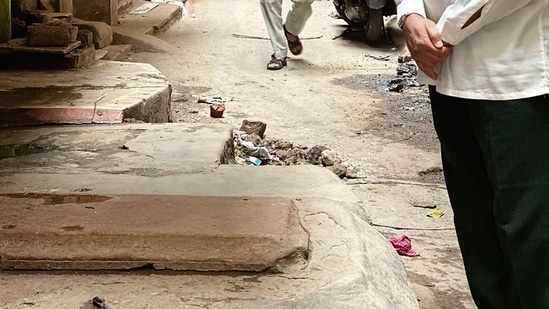
It’s like a wrinkle along the passageway. But it is a qabar, a grave. And this passageway is in Old Delhi’s Mohalla Qabristan, the hood on the graveyard where the graves of the dead and the houses of the living are neighbours.
In the beginning, there was no Old Delhi, and Mohalla Qabristan was exclusively a qabristan in a jungle, says an elderly chacha lounging at a chai stall. He goes on to give his version of Mohalla Qabristan. Its origins, he says, go back to the fifth city of Delhi, in the 14th century, when Emperor Firoz Shah Tughlaq set up Firoz Shah Kotla, the citadel of his capital, whose stoney remains lie a short walk away from the Walled City.
The venerable gent explains that the dead of Firoz Shah Kotla would be buried outside the fort walls, in the bayaban, the jungle, of present-day Mohalla Qabristan. “Later, Feroz Shah’s city declined, his fort fell into ruin, and Shahjahan built the seventh city of Delhi—our Old Delhi—which encompassed the qabristan used by the ruined Firoz Shah Kotla.”
In their turn, the dead of Shahjahan’s new capital started being buried outside their city walls, in what became Dilli Gate qabristan, the graveyard beside Feroze Shah’s ruined fort. Over the centuries, Old Delhi became more crowded, and what was a qabristan turned into Mohalla Qabristan, as houses were built in it to host the living.
By now, only a few graves can be spotted in the lanes of Mohalla Qabristan. One is right by a grocery counter. Another, beside Mainuddin Roti Wale (see photo). A red-coloured qabar was covered with concrete as part of a construction project some months ago. “All the houses and shops here stand on graves,” declares a passerby. By all, he means every single landmark of Mohalla Qabristan—including Noor Chicken & Mutton Shop, Raees Store, Anglo Arabic Primary School, Nasir Khan tailor’s stall, Barku Lal’s shearer and cutter workshop, Javed bhai’s pan shop, Sabir Tent House, and Anas Fashion Boutique.
When a Mohalla Qabristan dweller passes away, the funeral procession—if the deceased is a Muslim— carries the body away from this ex-graveyard, to Dilli Gate cemetery, beside the remnants of Firoz Shah Kotla, whose centuries-old dead, ironically, continue to lie under Mohalla Qabristan


Stay updated with all top Cities including, Bengaluru, Delhi, Mumbai and more across India. Stay informed on the latest happenings in World News along with Delhi Election 2025 and Delhi Election Result 2025 Live, New Delhi Election Result Live, Kalkaji Election Result Live at Hindustan Times.


