E-Paper



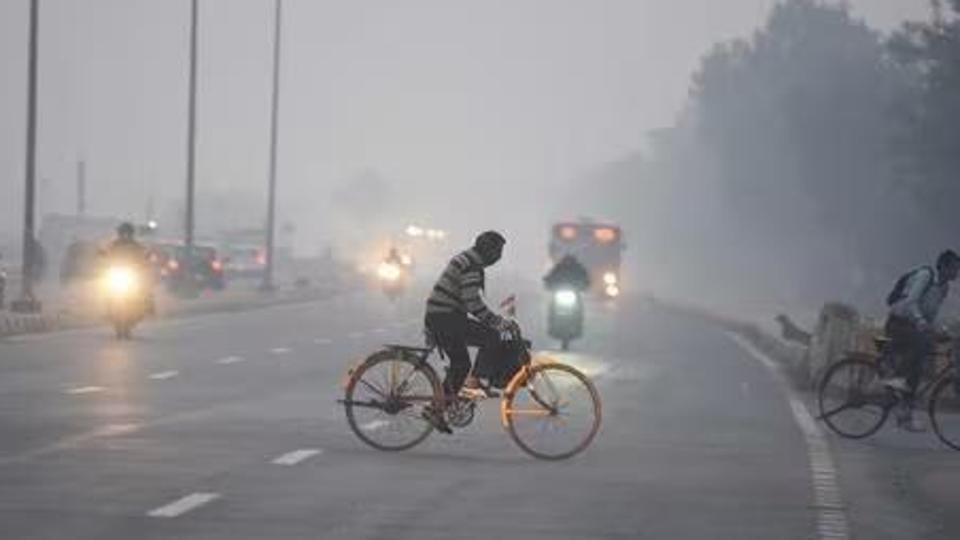
Dense fog shrouds capital, cold wave to continue
Dense fog and cold temperatures continue to affect Delhi, with the city experiencing "cold day" conditions for a third day in a row. The maximum temperature on Thursday was seven degrees below normal, while Friday saw temperatures five degrees below normal. The minimum temperature on Saturday was two degrees above normal. Marginal relief is expected from January 8 onwards, with warmer winds and a chance of light rain on January 9 and 10. Delhi's air quality remains in the "very poor" category. The city also recorded its highest ever peak power demand for the winter months on Friday.

 Prefer HTon Google


Dense fog continued to shroud the capital at upper levels of the atmosphere, with the India Meteorological Department (IMD) forecasting Delhi is likely to record cold day conditions for a third consecutive day.
The IMD classifies it as a ‘cold day’ when the maximum temperature is 4.5°C or more below normal, with the minimum temperature also being below 10°C. It is a ‘severe cold day’ when the maximum temperature is 6.5°C or more below normal.
Delhi recorded a maximum temperature of 12.5°C on Thursday, seven degrees below normal and Delhi’s lowest maximum in two years. The last time it was lower was on January 25, 2022, when it was 12.1°C. This meant it was categorized as a ‘severe cold day’.
Delhi’s maximum on Friday was 14.6°C, five degrees below normal, with it being placed in the cold day category. Forecasts for Saturday show the maximum is likely to be around 15-16°C.
In terms of minimum temperature, Delhi recorded a low of 8.9°C on Saturday morning, which was two degrees above normal. It was 9.4°C on Friday.
Marginal relief is expected only from January 8 onwards, with an approaching western disturbance bringing warmer winds and eventually, chances of light rain on January 9 and 10, IMD officials said.
“The approaching western disturbance should impact Delhi by January 9, with light rain forecast on the day. Warmer winds will also raise mercury slightly,” said Kuldeep Srivastava, scientist at IMD.
The persistent cold over the last few days also saw Delhi recording its highest ever peak power demand for the winter months on Friday. The State Despatch Load Centre (SLDC) data showed Delhi recorded a peak of 5,559 MW at 11:05 am on Friday, the highest ever for Delhi in the winter months. The previous winter peak was 5,526 MW, which was recorded last winter, on January 6, 2023.
Meanwhile, Delhi’s air quality remained in the ‘very poor’ category, but improved in comparison to Friday. Delhi’s average air quality index (AQI) was recorded at 316 (very poor) at 10 am on Saturday. It was 333 (very poor) at 4 pm on Friday.
Forecasts by the Early Warning System (EWS) for Delhi – a forecasting model under the ministry of earth sciences, said Delhi’s air quality should remain ‘very poor’ till January 8.
“Delhi’s air quality is likely to remain in the ‘very poor’ category from January 6 till January 8. The outlook for the subsequent six days shows air quality is likely to remain in the ‘very poor’ to ‘poor’ category. There is a possibility of rain on January 9,” EWS had said in its daily bulletin, issued on Friday evening.