
 E-Paper



District cooling systems possible solution to power consumption
Currently, 12.5% of India’s households have a room air conditioner, but these machines account for 38% of India’s energy consumption, according to the Union power ministry


Air conditioners in India were once deemed a luxury that only adorned the homes of the very rich. However, the country as a whole has recorded an alarming rise in moist-heat stress over the past two decades, making these cooling machines a necessity and a ubiquitous part of much of our urban landscape.
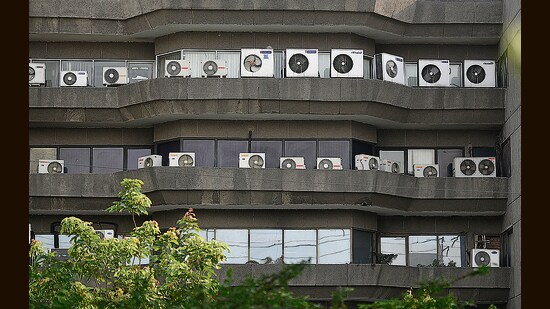
According to the Union government’s India Cooling Action Plan (ICAP) released in 2019, the country’s space cooling demand is expected to rise by 11 times between 2018 and 2038. The International Energy Agency predicts that the space cooling sector from India alone will require more energy than Africa as a whole consumes at present, and will be responsible for 30% of all global emissions by 2050.
To meet this increased demand efficiently, experts from the sector are advocating wide scale adoption of district cooling systems (DCS).
These centralised cooling systems provide chilled water to multiple buildings or facilities in a specific area through underground insulated pipes. Each building connected to the DCS has a heat exchanger unit that transfers the cooling energy from the circulated chilled water to the building’s internal cooling system, and the process helps cool the indoor spaces of the building.
After absorbing heat from the buildings, the now-warm water returns to the central plant through a separate network of pipes, known as the return flow. At the central plant, the water is re-chilled by the chillers and then recirculated back to the buildings, completing the cooling cycle.
One such example of a DCS is at Gujarat International Finance Tec-City (GIFT City) in Gandhinagar, which has been operational since 2015.
DCS may cut India’s energy bills
Currently, 12.5% of India’s households have a room air conditioner, but these machines account for 38% of India’s energy consumption, according to the Union power ministry.
Advocates of DCS say that the adoption of the system may cut India’s power bill by as much as 40%, and unlike conventional air conditioners — which release hot air into the immediate vicinity — a DCS does not impact the micro-climate.
Further, the risk of leakage of refrigerants of individual ACs is reduced in the centralised systems.
People aware of the matter said that buildings in GIFT City that are part of DCS have succeeded in cutting their power demand by 30%, with the area’s electrical demand dropping from 240MW to 135 MW.
Sandeep Kachhawa, a cooling and refrigeration expert at Alliance for an Energy-Efficient Economy (AEEE), said DCSs are still at a nascent stage in India. “DCSs work best when there is a minimum cooling load requirement of around 10,000 TR (tons of refrigeration), and in high-density mixed land use areas,” he said.
Even though the per TR cost of setting up a DCS is higher, the total installed capacity can be halved, he said.
“It makes huge sense to incorporate the necessary infrastructure for centralised cooling in the master planning stage itself for greenfield city development. It requires a greater emphasis on planning and long-term vision,” Kachhawa said.
Soon, the proposed Hyderabad Pharma City and Chennai Fintech City l will have similar DCSs. While a tender has already been awarded for the Hyderabad project, the Tamil Nadu Industrial Corporation is in the process of hiring a consultant to run DCS on a PPP model in the Chennai project.
There is one example of a residential complex in Hyderabad having their own DCS for 390 apartments and some common areas. There has been limited private adoption too, with the likes of DLF Cyber City, and the Delhi and Mumbai airports.
IIT Jammu assistant professor Satya Sekhar Bhogilla said DCSs can easily be integrated with renewable energy sources, such as solar. “Even though ICAP recognises DCSs as an opportunity, there is a lack of significant policy or incentives or mandates in place,” he said.
Financing a major hurdle
Despite these known benefits, over the past decade, there has been no other government initiative to install such systems in India.
Niyati Gupta, senior program associate at WRI India-climate programme, said financing is the major hurdle for the adoption of DCSs. She said in GIFT City too, the infrastructure is financed through a public-private partnership model which allowed for the high upfront capital expenditure.
Further, Gupta expanded on the idea that incentivising the private sector to ‘design-build-operate’ would result in better management of DCSs. Apart from these challenges, she stated that professionals need upskilling for continuous monitoring of these systems to ensure maximum operational efficiency. To alleviate this problem, she said that government intervention is much required at the policy level to better promote this technology.
HT spoke with officials in cities such as Rajkot, Coimbatore, Pune, and Thane, where UNEP (United Nations Environment Programme)-led initiative feasibility studies for DCS were conducted. However, the pilots took off in none of the cities.
Rajkot Smart City CEO Chetan Nandani said that there was a proposal for adopting a DCS in a greenfield development project under the Smart City programme, but the system has not been set up due to the high upfront costs involved.
An official at Thane Municipal Corporation said that as per the feasibility study, it was found that it was not possible to lay the underground piping infrastructure necessary for the DCS.
Sudheer Perla, Managing Director at Tabreed Asia (a joint venture between National Central Cooling Company PJSC or Tabreed UAE and World Bank’s International Finance Corporation or IFC) said there still is a lag in recognising cooling as the single biggest driver for India’s energy demand.
“When a master plan is being readied anywhere in the city, cooling always comes as an afterthought and left at the discretion of end users to plan as opposed to how planning for water, electricity and sewage management is done,” he said.
Similarly, Santhosh Muzumdar, director of government relations and sustainability at Johnson Controls India, said the adoption of DCSs makes sense for governments, end users and service providers and at the same time is environmentally friendly.
“The technology is readily available but there is still not sufficient awareness among developers,” he said. But he said with time, just like green rating for buildings, there will be voluntary uptake of DCSs due to their sustainability factor.

Stay updated with all top Cities including, Bengaluru, Delhi, Mumbai and more across India. Stay informed on the latest happenings in World News along with Delhi Election 2025 and Delhi Election Result 2025 Live, New Delhi Election Result Live, Kalkaji Election Result Live at Hindustan Times.


