
 E-Paper



Delhi blanketed in grey haze as farm fires, firecrackers spike AQI by 100 points
The grey haze that descended late on Wednesday persisted through Thursday morning, as pollution made eyes water, throats scratchy and skin itchy

 Prefer HTon Google


Air pollution levels in Delhi surged by more than 100 points on the air quality index (AQI) on Thursday, as smoke from farm fires in Punjab and the bursting of firecrackers overnight in the capital, combined with local emissions trapped by calm winds and falling temperatures, shrouded the city in a thick haze.
The AQI stood at 311 in the “very poor” category at 4 pm, up from 202 a day earlier, when people in several parts of the city illegally burst firecrackers to celebrate Gurpurab.
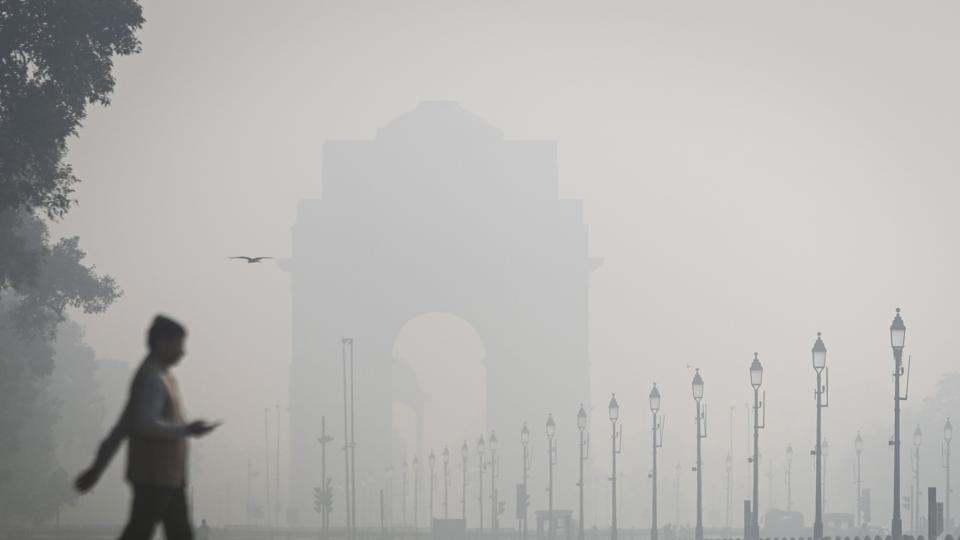
The grey haze that descended late on Wednesday persisted through Thursday morning, a stark contrast to the visually cleaner blue sky just a day earlier, as pollution made eyes water, throats scratchy and skin itchy.
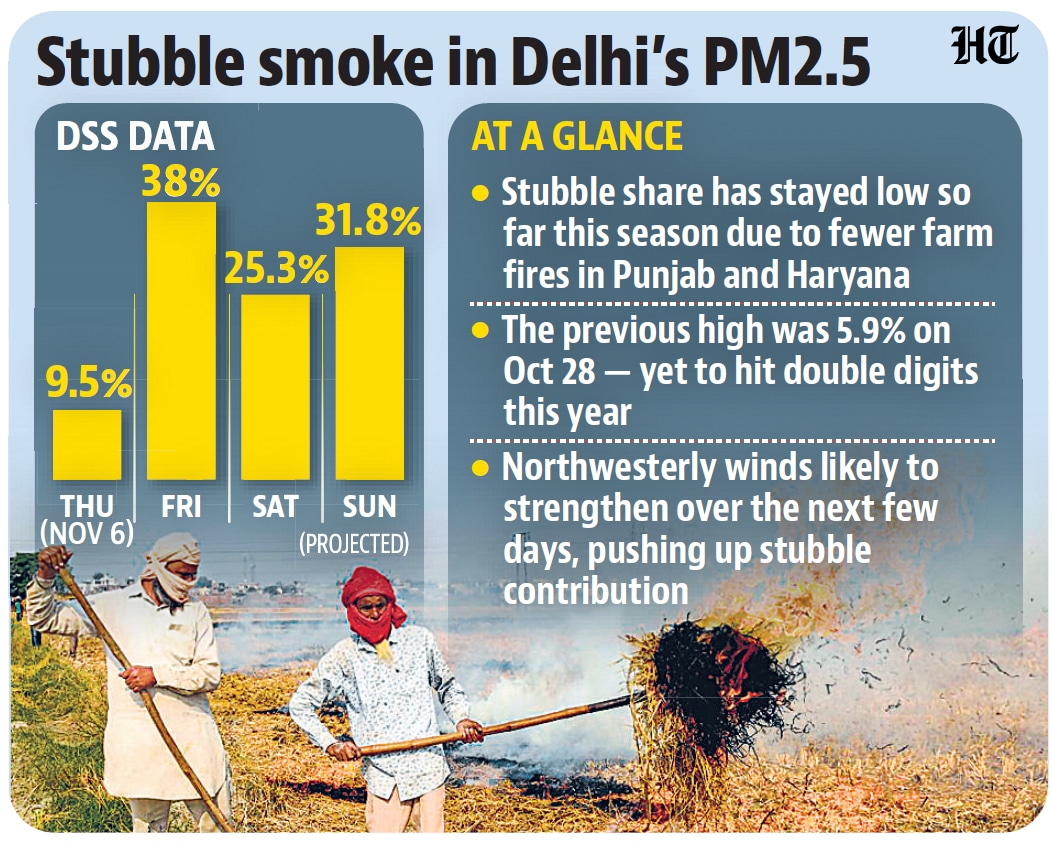
Stubble burning in other states contributed an estimated 9.48% to Delhi’s PM 2.5 pollution on Thursday — the highest so far this winter — with forecasts showing the share could surge to 38% by Friday as northwesterly winds continue transporting smoke from agricultural fires, according to the Centre’s Decision Support System.
Also Read | Internet abuzz with 999+ Delhi AQI pics. What do monitors show?
The current period is among the most acute for the Capital’s annual winter air pollution crisis, when calm local winds, dropping temperatures and smoke from crop residue burning converge to create a public health emergency. Past data shows stubble fires typically peak in the first week of November, with single-day contributions reaching 35% last year and as high as 48% in 2021.
Prior to Thursday, the highest stubble contribution this season was 5.87% on October 28. Weekend forecasts show the contribution declining slightly to 25.3% on Saturday and 31.76% on Sunday as stronger northwesterly winds provide some dispersion, though these winds are also responsible for the long-distance transport of the stubble fire smoke.
“Wednesday night saw a lot of local emissions accumulating, namely, firecrackers and vehicles. Winds remained low till early Thursday and only picked up around noon — dispersing pollutants to an extent,” said Sunil Dahiya, founder and lead analyst at environmental think tank Envirocatalysts. “Forecasts show westerly to northwesterly winds at transport level are likely to blow in the city over the next few days, meaning stubble smoke will be a key contributor ahead.”
The day’s dominant pollutant was PM 2.5 — fine particulate matter from combustion sources — compared to ozone and PM 2.5 a day earlier, indicating a shift toward pollution from burning rather than atmospheric reactions.
Also Read | As Delhi breathes ‘poor’ air, China offers help to tackle pollution crisis
However, even these readings may understate actual pollution levels. Hindustan Times analysis published on November 5 revealed missing data, suspicious measurement patterns and algorithmic loopholes in how the city’s average AQI is calculated, suggesting official readings may not accurately reflect ground conditions.
Of the capital’s 39 active air quality monitoring stations, 29 were in the very poor category on Thursday, with the remainder recording poor air quality above 200. The Air Quality Early Warning System for Delhi forecasts that very poor conditions will persist through Sunday.
CPCB classifies air as good when AQI is 50 or lower, satisfactory between 51-100, moderate between 101-200, poor between 201-300, very poor between 301-400, and severe above 400.
The Decision Support System, which estimates pollution source contributions, had gone silent for four days before updating on November 4 — only after HT raised queries with officials. Data for stubble burning’s contribution on November 1 and 2, historically peak days for agricultural fire impact, remains missing from the system.
Despite floods in Punjab this year that delayed harvesting and subsequent burning, red dots indicating farm fires are accumulating rapidly on satellite imagery. Between September 15 and November 6, Punjab recorded 3,284 farm fires compared to 5,041 during the same period last year, according to Indian Agricultural Research Institute data. Haryana witnessed 206 fires this year against 888 last year during the same period.
Also Read | Data gaps, odd patterns: Questions over Delhi AQI
The lower fire count has not prevented smoke from becoming a major pollution contributor as meteorological conditions — including temperature inversions that trap pollutants near the ground and calm winds that prevent dispersion — have created ideal conditions for pollution accumulation.
Delhi experiences its worst air quality each November when dropping temperatures create atmospheric inversions, wind speeds decline, and northwesterly winds carry smoke from stubble burning in Punjab and Haryana. While Diwali fell earlier this year, providing some relief from the typical convergence of festival firecrackers and seasonal pollution, the capital has now entered the extended period of hazardous air that typically persists through winter.


Stay updated with all top Cities including, Bengaluru, Delhi, Mumbai and more across India. Stay informed on the latest happenings in World News along with Delhi Election 2025 and Delhi Election Result 2025 Live, New Delhi Election Result Live, Kalkaji Election Result Live at Hindustan Times.


